Emergency auto services are defined as specialized roadside and repair solutions designed to get your vehicle moving again after a breakdown. The types of emergency auto services fall into four main categories: basic roadside assistance, emergency towing, mobile on-site repairs, and specialized EV support. Each category addresses a different breakdown scenario, and knowing which one you need saves time, money, and stress. Most car owners call the wrong service first, which delays help and sometimes makes the situation worse.
1. What are the types of emergency auto services?
Standard emergency roadside assistance covers seven core services: towing, battery jump-starts, flat tire changes, fuel delivery, lockout assistance, winch recovery, and minor on-site repairs. That list covers the vast majority of breakdown scenarios you will face on any road. Each service has defined limits, and understanding those limits before you need help is the difference between a quick fix and a long wait.
The coverage limits matter more than most car owners realize. Free towing is typically capped at 5–25 miles, and lockout service reimbursement often maxes at $100, leaving you responsible for any excess. Fuel delivery usually provides 2–5 gallons of gas or diesel, just enough to reach the nearest station. These are not generous allowances, so knowing your plan’s exact limits prevents surprise bills.
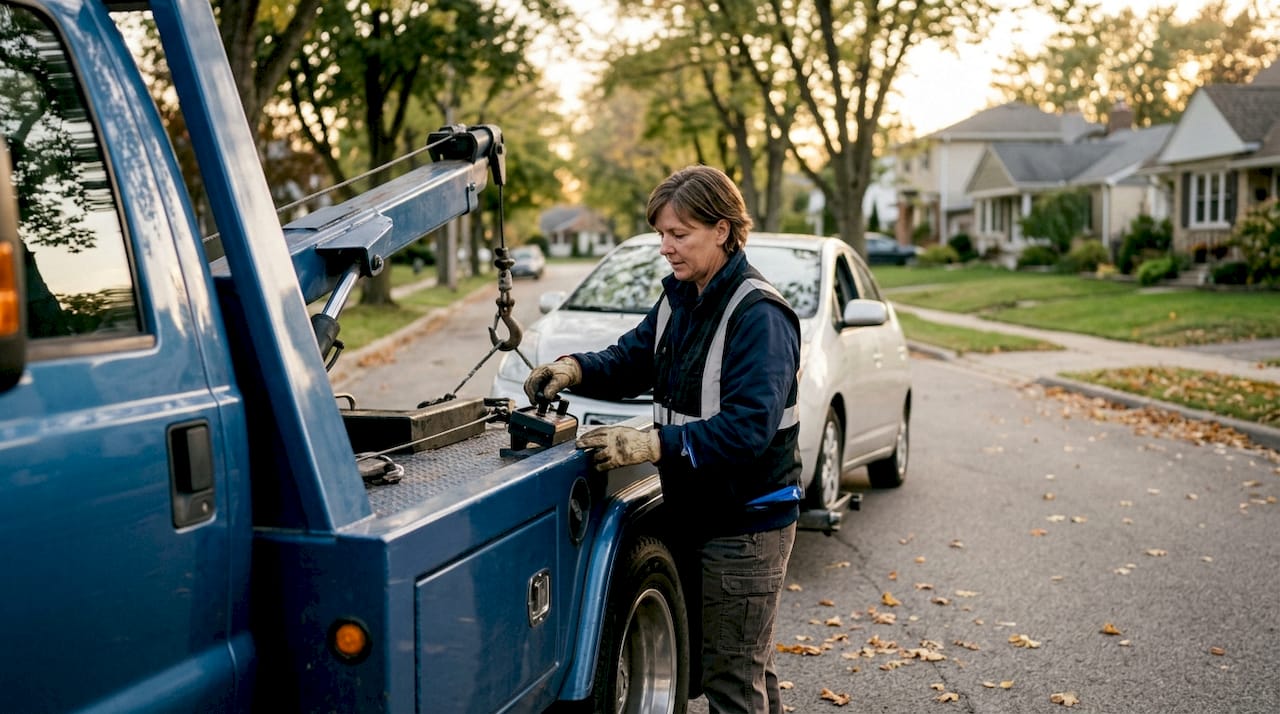
Pro Tip: Read your roadside assistance policy before an emergency, not during one. Note the towing mileage cap and lockout labor maximum so you know exactly what you will owe out of pocket.
Here is a quick reference for the seven core services and their typical limits:
| Service | What it covers | Typical limit |
|---|---|---|
| Towing | Transport to nearest shop | 5–25 miles free |
| Battery jump-start | Restart dead battery | One attempt per call |
| Flat tire change | Swap to spare | One tire per call |
| Fuel delivery | Gas or diesel drop-off | 2–5 gallons |
| Lockout assistance | Unlock vehicle | Up to $100 labor |
| Winch recovery | Pull vehicle from ditch or mud | Varies by provider |
| Minor on-site repairs | Small fixes to get moving | Limited scope |
2. How do emergency towing services differ from standard roadside assistance?
Towing is required when your vehicle cannot be safely driven, whether due to major mechanical failure, a crash, or a seized engine. Roadside assistance is ideal for minor issues; towing steps in when those minor fixes are not enough. The two services are often confused, but they differ significantly in scope and cost.
Towing cost structures follow a predictable pattern. Local tow fees typically include a flat fee for the first 10 miles and a per-mile charge after that, with local rates ranging from $50–$80 plus $3–$5 per additional mile. That means a 30-mile tow could cost you $110–$180 out of pocket if your plan only covers the first 10 miles. Knowing this before you call prevents sticker shock at the worst possible moment.
Most providers offer 24/7 towing for vehicles up to 10,000 lbs, which covers most passenger cars and light trucks. Heavier vehicles like large SUVs or commercial vans may require specialized tow trucks, which cost more and take longer to dispatch. Always confirm your vehicle’s weight class when setting up a roadside plan.
Pro Tip: If your car is involved in a crash, do not assume your roadside assistance plan covers the tow. Crash-related towing often falls under your auto insurance policy, not your roadside plan. Call your insurer first.
Towing can also be a standalone service or a supplement to a broader roadside assistance plan. Some car owners purchase towing-only coverage separately, which makes sense if they already have a plan that handles jump-starts and lockouts but has a short mileage cap for towing.
3. What are emergency mobile repair services and their benefits?
Mobile repair services send a trained mechanic directly to your breakdown location, skipping the tow entirely. Technicians typically arrive in 30–60 minutes in metropolitan areas and perform repairs on-site, including fuse replacements, battery installations, and minor mechanical fixes. This is a fundamentally different service from standard roadside assistance, which only aims to get you moving, not to actually fix the underlying problem.
The practical benefits are significant. Mobile mechanics provide faster turnaround than traditional towing and shop repairs, which means less time stranded and less disruption to your day. A battery replacement that would take a full afternoon at a shop, counting the tow and the wait, can be done in under an hour at your location. For drivers in busy urban areas like Los Angeles, that time difference is enormous.
Mobile emergency repair services reduce downtime and customer stress by performing effective fixes on-site instead of requiring towing to shops. For car owners who cannot afford to lose hours waiting at a repair facility, this model is the most practical option available.
Standard roadside assistance providers rarely perform full mechanical repairs on-site. If your vehicle needs a battery or alternator replacement, most roadside technicians will tow the car rather than fix it at the scene. Mobile mechanics fill that gap by carrying parts and tools to handle a wider range of repairs without moving the vehicle. You can learn more about how this works in practice by reading about on-site car repair directly from a provider that specializes in it.
4. What specialized emergency services exist for electric vehicles?
EV owners face a different set of breakdown risks than drivers of gas-powered cars. Improper towing or handling can damage EV electrical systems, and not every roadside provider has the training or equipment to handle them correctly. Selecting the wrong service can turn a minor breakdown into a costly repair.
The specialized services EV drivers need include:
- Mobile charging: A provider brings a portable charging unit to your location, giving you enough charge to reach a charging station.
- Flatbed towing only: EVs with damaged drivetrains must be transported on a flatbed, never towed with wheels on the ground, to avoid motor damage.
- EV-trained technicians: Providers with specific EV training can safely handle high-voltage systems without risk to the vehicle or themselves.
- Software diagnostics: Many EV breakdowns are software or sensor issues, not mechanical ones. Technicians with EV diagnostic tools can identify these remotely or on-site.
Pro Tip: Before you need help, call your roadside provider and ask directly: “Do your technicians have EV-specific training?” If they hesitate or say no, find a provider who does. This one question can save your battery pack.
EV owners should select providers with trained technicians and proper equipment to avoid damage and receive suitable charges and repairs. The EV market is growing fast, but emergency service infrastructure has not kept pace everywhere. In major metro areas like Los Angeles, specialized EV roadside help is available, but you need to identify your provider before a breakdown, not during one.
5. Understanding coverage portability and policy terms
Some roadside plans follow the driver, not the vehicle. This matters when you are driving a rental car, a borrowed vehicle, or a recently purchased used car that is not yet on your policy. Driver-based coverage travels with you regardless of what car you are in. Vehicle-based coverage only applies to the specific registered car on the plan.
This distinction catches many car owners off guard. You assume you are covered, call for help, and then discover your plan does not apply because you are driving your spouse’s car. Checking your policy type takes two minutes and can save you from paying full price for an emergency tow. The role of an emergency mobile mechanic becomes especially relevant here, since mobile services often operate independently of plan restrictions and can be called directly.
Pro Tip: Keep a functional spare tire in your vehicle at all times. Roadside assistance covers one tire change per call, but only if you have a usable spare. A flat spare means a tow, not a quick fix.
6. How to choose the right car breakdown service for your situation
The right service depends on what is wrong with your vehicle, not just that something is wrong. A dead battery calls for a jump-start or battery replacement service. A flat tire calls for mobile tire repair or a spare tire swap. A seized engine or crash calls for towing. Calling a tow truck for a dead battery wastes time and money. Calling for a jump-start when your engine is seized leaves you stranded longer.
Use this decision framework before you call:
- Can the car be driven safely? If yes, drive to the nearest shop. If no, you need towing or mobile repair.
- Is the problem minor? Dead battery, flat tire, and empty tank are all fixable on-site without a tow.
- Is the problem mechanical? Alternator failure, brake issues, or engine problems require a mobile mechanic or a shop.
- Do you drive an EV? Confirm your provider has EV-specific training before they touch your vehicle.
- What does your plan cover? Check mileage caps and labor limits before you commit to a service call.
24 hour auto services are available from most major providers, but response times vary widely by location and time of day. In dense urban areas, expect 30–60 minutes. In rural areas, wait times can stretch to two hours or more. Mobile mechanics in metro areas often match or beat traditional roadside response times because they operate locally.
Key takeaways
The most effective approach to emergency auto services is knowing which service category matches your specific breakdown before you make the call.
| Point | Details |
|---|---|
| Seven core roadside services | Towing, jump-starts, tire changes, fuel delivery, lockouts, winch recovery, and minor repairs cover most breakdowns. |
| Towing has strict cost limits | Free towing caps at 5–25 miles; costs rise sharply beyond that range. |
| Mobile mechanics go further | On-site mechanics fix problems roadside assistance cannot, often in under an hour. |
| EVs need specialized providers | Improper towing or handling can damage EV electrical systems; always confirm EV training. |
| Policy portability varies | Some plans follow the driver; others only cover a specific registered vehicle. |
What I have learned about picking the right emergency service
The biggest mistake I see car owners make is treating all emergency auto services as interchangeable. They call a tow truck when a mobile mechanic would have fixed the car in 45 minutes. Or they call roadside assistance for a problem that clearly requires a shop visit, then wait an hour for a technician who cannot actually help them.
The second mistake is not reading the policy. Roadside assistance plans have real limits, and those limits show up at the worst possible time. A 10-mile towing cap sounds fine until your nearest shop is 18 miles away and you owe $40 extra on top of your annual fee. Knowing your plan’s exact terms is not optional preparation. It is the minimum standard for any driver.
For EV owners specifically, the gap between what providers advertise and what they can actually do is wider than most people expect. “We cover EVs” often means “we can tow your EV on a flatbed.” It does not always mean “we have a technician who understands your battery management system.” Ask the specific question. Get a specific answer.
The case for mobile mechanics is strong for anyone in a metro area. They arrive fast, fix the actual problem, and eliminate the tow entirely in many situations. For busy drivers who cannot spend half a day at a shop, that model is not just convenient. It is the rational choice.
— Aaron
Onsite Los Angeles Mobile Mechanic is ready when your car is not
When your vehicle breaks down in the Los Angeles area, Onsite Los Angeles Mobile Mechanic sends a trained mechanic directly to your location, no tow required. The service covers a wide range of on-site repairs, from battery replacements and alternator work to brake repairs and more, with upfront pricing and no hidden fees.
Most repairs are completed in under an hour, which means you get back on the road faster than any shop visit could manage. Onsite Los Angeles Mobile Mechanic operates across the greater Los Angeles area and is available to take your call now. Check the full list of mobile mechanic services to see what can be fixed at your location, or call 213-583-4159 to get a quote and schedule help today.
FAQ
What are the main types of emergency auto services?
The main types are basic roadside assistance, emergency towing, mobile on-site repair, and specialized EV services. Each addresses a different breakdown scenario, from a dead battery to a major mechanical failure.
How is mobile repair different from roadside assistance?
Roadside assistance aims to get your car moving with minimal fixes; mobile mechanics perform actual repairs on-site, including parts replacement, often in 30–60 minutes.
Does roadside assistance cover towing for any breakdown?
Most plans cover towing for 5–25 miles at no charge. Beyond that limit, you pay a per-mile fee, typically $3–$5 per mile after the covered distance.
Can any roadside provider help an electric vehicle?
Not all providers have EV-specific training or equipment. Improper EV towing can damage electrical systems, so always confirm EV capability before requesting service.
What is the fastest emergency auto service option in a city?
Mobile mechanic services in metropolitan areas typically offer the fastest resolution, arriving in 30–60 minutes and fixing the problem on-site without the added time of a tow and shop wait.