Most modern cars need an oil change roughly every 5,000–7,500 miles, and some full-synthetic applications can safely stretch to 10,000–15,000 miles, according to HowStuffWorks. The single best next step: open your glove box, find your owner’s manual, and look up the manufacturer’s recommended interval for your specific engine and oil type. If your dashboard shows an oil-life percentage or a wrench indicator, trust that first.
- Modern typical range: 5,000–7,500 miles for most vehicles; up to 10,000–15,000 miles with full synthetic oil
- Time limit: No longer than 12 months between changes, regardless of mileage
- Severe driving: Shorten to roughly 3,000–5,000 miles or follow the manufacturer’s “severe” schedule
- Immediate action: Check your owner’s manual or oil-life monitor today
Pro Tip: If you drive in Los Angeles stop-and-go traffic daily, treat your driving as “severe” by default, which should push you toward the shorter end of your manufacturer’s recommended range.
If you want a mobile oil change without leaving your driveway or parking spot, call Onsite Los Angeles Mobile Mechanic to book by phone.
Key Takeaways
Following your owner’s manual and oil-life monitor is the single most reliable way to set the right oil change interval for your specific vehicle and driving conditions.
| Point | Details |
|---|---|
| Typical modern interval | Most vehicles need an oil change every 5,000–7,500 miles; full synthetic can extend to 10,000–15,000 miles. |
| Time limit applies too | Change oil at least once every 12 months, even if mileage is low, because oil degrades chemically over time. |
| Severe driving shortens the interval | Stop-and-go traffic, towing, and frequent short trips require following the manufacturer’s severe schedule, often roughly half the normal interval. |
| Trust the oil-life monitor | Dashboard oil-life systems track real engine conditions and are more accurate than fixed-mileage rules for most modern vehicles. |
| Onsite Los Angeles Mobile Mechanic | Provides mobile oil changes across greater Los Angeles with transparent pricing, filter replacement, and on-site service in under an hour. |
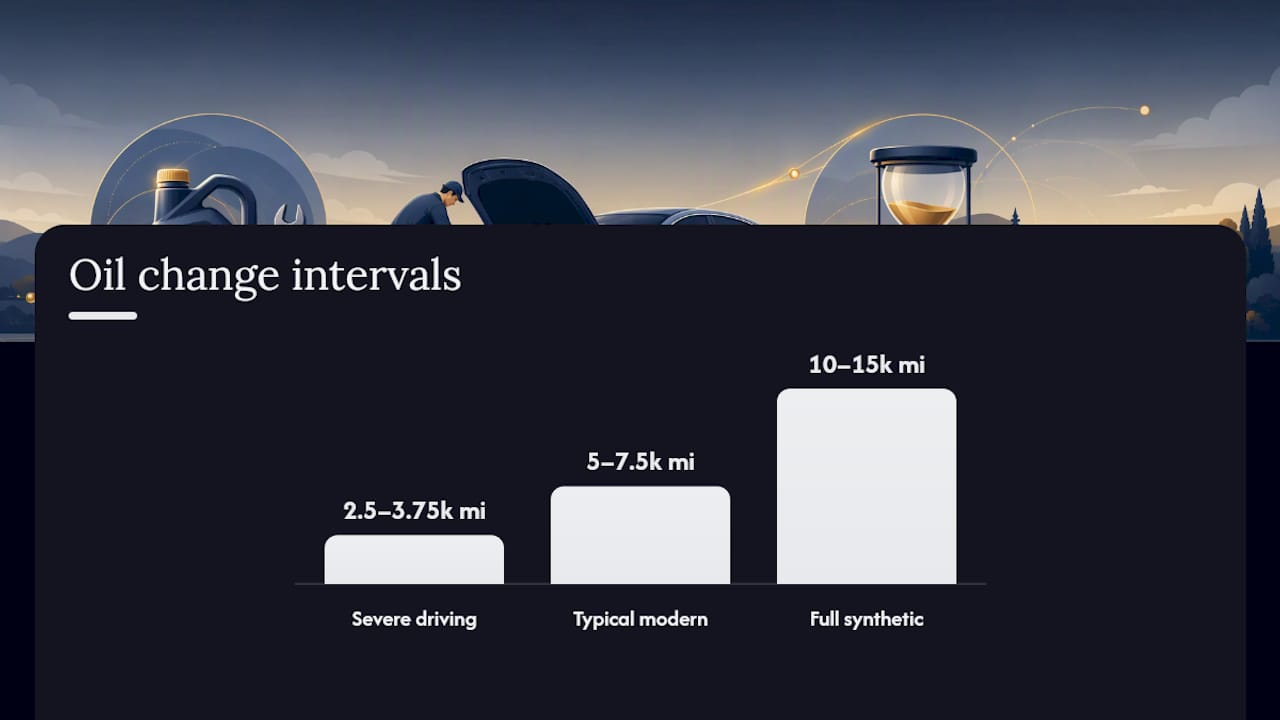
Table of Contents
- What the right oil change interval looks like for your vehicle
- Why the old “every 3,000 miles” rule no longer applies
- How to find the right interval for your specific car
- When to shorten the interval: severe vs. normal driving
- How oil type affects your recommended change frequency
- When months matter more than miles: low-mileage and stored vehicles
- Signs your oil needs changing right now
- How to check your oil level and condition
- What else gets replaced or checked during an oil change
- What an oil change typically costs
- When a professional oil change makes more sense than DIY
- Onsite Los Angeles Mobile Mechanic comes to you for oil changes
- Sources
What the right oil change interval looks like for your vehicle
Consumer Reports puts the standard guidance plainly: most modern vehicles need an oil change every 5,000–7,500 miles or about every six months. Oil type and driving habits shift that number in both directions.
Here is how the ranges break down by oil type:
- Conventional oil: 3,000–5,000 miles. Older vehicles and high-mileage engines often still run conventional oil, and the shorter interval reflects its faster breakdown rate.
- Synthetic blend: 5,000–7,500 miles. A middle ground in both cost and longevity, blends suit most daily drivers who want a modest interval extension without paying full-synthetic prices.
- Full synthetic: 7,500–15,000 miles. Modern turbocharged engines, luxury vehicles, and many newer platforms specify full synthetic. Some manufacturers (BMW, Ford EcoBoost, GM) list 10,000 miles as the standard interval with synthetic.
Time limits matter just as much as mileage. Even if a vehicle is driven very little annually, manufacturers typically recommend changing oil at least once a year due to chemical degradation.
Always verify these ranges against your owner’s manual. A 2021 Mazda3, for example, uses a vehicle-status monitor that alerts before the 10,000 km / 6-month maximum, and its severe-condition schedule drops to 5,000 miles or 6 months. Your car’s manual is the only source that accounts for your specific engine tolerances, oil specification, and filter design.
For a broader look at how oil changes fit into your overall vehicle upkeep, the preventive car maintenance guide from Onsite Los Angeles Mobile Mechanic covers the full service calendar.
Why the old “every 3,000 miles” rule no longer applies
The 3,000-mile rule made sense in the 1970s. Engines had looser tolerances, oil formulations were basic mineral-based products, and filters clogged faster. None of those conditions describe a car built after 2000.
Three things changed:
- Oil chemistry improved dramatically. Modern full-synthetic oils use engineered base stocks and additive packages that resist oxidation, thermal breakdown, and sludge formation far longer than conventional oils from decades past. Mobil’s car-care guidance notes that many automakers now list 7,500 or 10,000 miles as acceptable for normal driving.
- Engine tolerances tightened. Precision manufacturing means less blow-by (combustion gases entering the crankcase), which is one of the primary ways fuel and moisture contaminate oil.
- Filtration got better. Modern oil filters trap finer particles and hold more contaminant volume before bypassing, which extends the effective life of the oil circulating through the engine.
The 3,000-mile myth persists for a few reasons. Quick-lube shops built their business model around it, and older stickers on windshields still carry that number. Some shops apply it conservatively to cover every vehicle type, including older trucks that genuinely do need shorter intervals. If your vehicle is a 2005 or newer model running synthetic oil, following the 3,000-mile rule means you are changing oil that still has significant protective life left. That is not a safety issue, but it is an unnecessary cost.
CalRecycle’s consumer guidance makes the same point: follow your owner’s manual, not outdated blanket advice.
How to find the right interval for your specific car
No single mileage figure applies to every vehicle. Here is the order of operations to find yours:
- Open the owner’s manual. Look for the maintenance schedule section. It lists the oil type, viscosity (e.g., 0W-20), and the recommended change interval under both normal and severe conditions.
- Check the scheduled maintenance chart. Many manuals include a separate chart that maps mileage milestones to required services. Oil changes appear on nearly every line.
- Look at your dashboard. Most vehicles built after 2010 display an oil-life percentage, a wrench icon, or a “Change Oil Soon” message. These systems track actual engine usage, not just odometer miles.
- Contact your dealer if the manual is missing. A dealer can pull the factory maintenance schedule by VIN. This takes about two minutes and costs nothing.
The dashboard oil-life monitor deserves more trust than most drivers give it. Kia’s owner-advice guidance explains that these systems calculate oil degradation using real inputs: engine temperature cycles, start counts, load, and driving patterns. A car that spent the week on the highway will show a higher oil-life percentage than one that made 40 short cold-start trips across the same mileage.
Pro Tip: Always reset the oil-life monitor immediately after a change. If you forget, the system keeps counting from the wrong baseline and will alert you too early or too late on the next cycle.
When to shorten the interval: severe vs. normal driving
“Severe” driving is not about speed. It is about conditions that stress oil faster than a steady highway commute does.
Conditions that qualify as severe, per Toyota’s maintenance guidance:
- Frequent trips under 5 miles (the engine never fully warms up, so moisture and fuel dilute the oil)
- Stop-and-go traffic for most of your driving
- Towing, hauling heavy loads, or driving with a roof rack loaded
- Dusty, sandy, or unpaved roads
- Extreme heat (above 90°F regularly) or extreme cold (below 10°F)
- Prolonged idling, such as delivery routes or rideshare waiting
If any of those describe your typical week, follow the severe schedule in your owner’s manual. For most vehicles, that means roughly half the normal interval. A car with a 10,000-mile normal interval drops to about 5,000 miles under severe conditions. A 7,500-mile interval becomes 3,750–5,000 miles.
Practical steps if you drive severely:
- Set a 5,000-mile reminder in your phone or a vehicle maintenance app that logs service history.
- Check oil condition at every fuel stop during hot summer months or after heavy towing.
- If your vehicle lacks an oil-life monitor, default to the severe schedule without exception.
Dense urban driving in Los Angeles, with its constant stop-and-go and frequent cold starts, creates condensation and fuel dilution in the oil. That accelerates additive depletion faster than the odometer reading alone suggests.
How oil type affects your recommended change frequency
The oil in your engine is not just a lubricant. It carries detergents that clean deposits, anti-wear additives that protect metal surfaces, and viscosity modifiers that keep it flowing at both cold starts and operating temperature. Different formulations do those jobs for different lengths of time.
- Conventional oil uses refined crude oil as its base. It works fine for older engines but breaks down faster under heat and oxidation. Stick to 3,000–5,000 miles.
- Synthetic blend mixes conventional base stock with synthetic components. It handles temperature swings better than straight conventional and suits most commuter vehicles well. The 5,000–7,500-mile range is realistic.
- Full synthetic is engineered from the ground up. It maintains viscosity across a wider temperature range, resists sludge, and keeps its additive package active longer. This is why manufacturers can credibly specify 10,000–15,000-mile intervals for vehicles that require it.
Valvoline’s guidance is direct about the risk of stretching intervals beyond what the oil formulation supports: deposit formation accelerates, additives deplete, and the oil loses its ability to protect bearing surfaces. The damage is cumulative and often invisible until it shows up as premature wear years later.
Some engines require specific synthetic oil formulations or viscosities; using non-specified oils may affect warranty coverage or cause compatibility issues. Examples include BMW’s Longlife-01 and GM’s dexos1 Gen 3 specifications.
When months matter more than miles: low-mileage and stored vehicles
If you drive fewer than 5,000 miles a year, the time-based limit becomes your primary guide. Oil degrades chemically even when the car sits. Moisture from condensation, oxidation from air exposure, and additive breakdown all happen on a calendar schedule, not a mileage one.
- A car driven only a few thousand miles in a year still needs an oil change at the 12-month mark.
- Synthetic oil generally holds up better over time than conventional, but manufacturers typically recommend changing oil at least annually.
- Seasonal vehicles (classic cars, convertibles stored in winter, track-day cars) should get fresh oil before storage, not after. Old oil sitting in an engine over winter carries acids and moisture that corrode bearing surfaces.
For stored vehicles, the practical rule is simple: change the oil before you park it for an extended period, and again when you bring it back into regular use if it has sat for more than six months. An annual service appointment, scheduled by date rather than mileage, works well for low-mileage owners who find it easier to remember a calendar date than an odometer reading.
Signs your oil needs changing right now
Some situations call for an immediate change, not a scheduled one.
Dashboard warnings to act on immediately:
- The oil pressure warning light (usually a red oil can icon) means stop driving now. Low oil pressure can destroy an engine in minutes.
- A wrench icon or “Maintenance Required” message means a service is due. Not an emergency, but schedule it within the week.
- An oil-life percentage below 15% or a “Change Oil Soon” message means book the appointment today.
Physical signs to check:
- Dark, gritty oil on the dipstick. Fresh oil is amber and translucent. Black, opaque oil with visible particles means it is overdue.
- Burnt-oil smell inside the cabin. This often means oil is burning off on hot engine surfaces, which can indicate a leak or severely degraded oil.
- Increased engine noise, especially ticking or knocking. Degraded oil loses its film strength, and metal-on-metal contact becomes audible.
- Visible smoke from the exhaust. Blue-tinted smoke usually means oil is burning in the combustion chamber.
- A sudden drop in fuel economy. Thickened, dirty oil creates more internal friction, and the engine works harder to compensate.
Pro Tip: If you see the red oil pressure light while driving, pull over safely and turn the engine off immediately. Do not drive to a shop. Call for a mobile mechanic or roadside assistance.
How to check your oil level and condition
You do not need a mechanic to tell you whether your oil looks healthy. A dipstick check takes three minutes and gives you real information.
- Park on level ground and let the engine cool for at least 5 minutes. A hot engine gives a falsely low reading because oil is still circulating through the system.
- Open the hood and locate the dipstick. It usually has a brightly colored handle (yellow or orange) near the front of the engine.
- Pull the dipstick out and wipe it clean with a lint-free rag. Do not read the first pull; it gives an inaccurate level because oil splashes during driving.
- Reinsert the dipstick fully, then pull it out again. Now read the level. The oil should sit between the two marks (MIN and MAX, or two dots or lines).
- Check the color and texture. Rub a small amount between your fingers. Amber and slightly translucent is healthy. Black, gritty, or milky (which signals coolant contamination) means it needs attention now.
- Smell the oil. A sharp, acrid, burnt smell is a red flag even if the color looks acceptable.
Pro Tip: Take a quick photo of the dipstick after each check and save it with the date. If you call a mechanic remotely, you can share the image and get an accurate read on whether the oil condition warrants an immediate change or can wait until your next scheduled service.
A milky or foamy appearance on the dipstick is a serious symptom, not just a maintenance flag. It often indicates a blown head gasket or a cracked block allowing coolant to mix with oil. That requires a professional diagnosis, not just an oil change.

What else gets replaced or checked during an oil change
An oil change is the most frequent maintenance touchpoint most drivers have with their vehicle, which makes it the right moment to inspect several other items at no extra labor cost.
- Oil filter: Replace it at every oil change without exception. A clogged filter bypasses dirty oil directly into the engine. Reusing a filter with fresh oil defeats the purpose of the change.
- Drain plug washer: The copper or aluminum crush washer on the drain plug deforms slightly each time it is removed. Many shops replace it automatically; if yours does not, ask.
- Fluid top-offs: Coolant, brake fluid, power steering fluid, and windshield washer fluid are quick checks while the hood is open.
- Tire pressure: A two-minute check at every oil change keeps you within the manufacturer’s recommended PSI and extends tire life.
- Visual leak check: A technician looking under the car for oil, coolant, or brake fluid drips catches problems early, before they become expensive.
- Air filter inspection: The engine air filter typically needs replacement every 15,000–30,000 miles, but dusty driving conditions shorten that. An oil change visit is the right time to pull it and look.
The air filter replacement schedule is worth tracking separately. A clogged air filter reduces engine efficiency and, in severe cases, affects fuel economy noticeably. Combining it with an oil change visit keeps the service efficient and avoids a second appointment.
What an oil change typically costs
Oil change costs vary by oil type, vehicle, and service provider. Prices generally range from modest for DIY parts-only up to higher amounts for dealership or mobile professional services, with factors like oil type, vehicle accessibility, filter quality, and location influencing the final price.
DIY oil changes save money but come with a responsibility most people overlook: used motor oil disposal. You cannot pour it down a drain or leave it in a trash can. Most auto parts stores (AutoZone, O’Reilly, Advance Auto Parts) accept used oil for free recycling. If that extra step feels like a hassle, a professional service handles it for you.
Pro Tip: Ask for an itemized quote before any oil change service. A transparent shop lists oil brand, viscosity, filter part number, and labor separately. If a shop cannot or will not itemize, that tells you something about how they operate.
For more on avoiding unnecessary upsells during routine maintenance visits, that guide covers what to watch for.
When a professional oil change makes more sense than DIY
DIY oil changes make sense for a specific type of driver: someone comfortable working under a car, with the right tools, a place to do it safely, and a plan for waste-oil disposal. For everyone else, the math often favors a professional.
Situations where DIY works:
- You own a floor jack, jack stands, a drain pan, and the correct filter wrench
- Your vehicle has easy access to the drain plug and filter
- You know the correct oil specification and viscosity
- You have a recycling plan for the used oil
Situations where hiring a pro makes more sense:
- Your vehicle has a skid plate or a filter in a difficult location (common on many crossovers and trucks)
- You are within a factory warranty period and want documented service records
- Time is the constraint, not money
- You want the filter replaced, fluids checked, and a leak inspection done in one visit without managing the logistics yourself
Mobile service adds one more layer of convenience: the mechanic comes to your location. No driving to a shop, no waiting room, no arranging a ride. For busy drivers in Los Angeles who cannot afford to lose an hour mid-day, that matters. Most mobile oil changes on common vehicles wrap up in under an hour at your home, office, or parking spot.
Pro Tip: If you are not sure whether your car needs conventional or synthetic, check the oil filler cap or the owner’s manual. Many modern engines print the required viscosity directly on the cap. Using the wrong viscosity, even temporarily, can affect oil pressure and engine protection.
A technician’s perspective on how long you can really wait
The owner’s manual interval is the floor, not the ceiling of how long you should wait. That distinction matters in practice.
Manufacturers set intervals conservatively enough to cover a wide range of driving conditions, but they cannot account for every variable in your specific situation. A driver who makes five short cold-start trips a day in Los Angeles traffic is putting more stress on their oil than someone who drives 30 highway miles each way to work, even if both cars show the same odometer reading at the end of the month.
What technicians see repeatedly: engines that come in for oil changes at the outer edge of the manufacturer’s interval, or past it, with oil that has turned black and lost its viscosity. The engine runs, but the protective film on bearing surfaces has thinned. That wear is cumulative. It does not show up in a single inspection; it shows up five years later as premature engine wear or a repair bill that dwarfs every oil change the owner skipped or delayed.
The practical heuristic: if your vehicle has an oil-life monitor, follow it. If it does not, aim for the lower end of the permissible range for your oil type, especially if any severe-driving condition applies to your week. Booking is by phone with Onsite Los Angeles Mobile Mechanic, not through an app.
Onsite Los Angeles Mobile Mechanic comes to you for oil changes
Skipping the shop entirely is the most convenient option for most Los Angeles drivers. Onsite Los Angeles Mobile Mechanic performs mobile oil changes at your home, office, or wherever your car is parked, with upfront pricing and no hidden fees.

A typical oil change visit covers the oil and filter replacement, a drain plug inspection, a visual leak check, and a fluid top-off, all completed on-site in under an hour for most common vehicles. Waste oil disposal is handled for you. The price is quoted before work begins, so there are no surprises at the end.
Onsite Los Angeles Mobile Mechanic serves the greater Los Angeles area. To book an oil change or ask about your vehicle’s specific interval, call 213-583-4159. Phone booking only.
Sources
These are the primary references behind this guide. When in doubt, your vehicle’s owner’s manual takes priority over all of them.
- The Dirty Truth About How Often You Need Your Oil Changed — HowStuffWorks
- Scheduled maintenance (example: Mazda3) — Mazda USA (PDF)
- How often should I change the oil in a car? — Kia (owner-advice page)
- How To Tell If You May Need An Oil Change — Toyota