Mechanics recommend extra services for two distinct reasons: genuine vehicle care and shop revenue. The difference comes down to motive, evidence, and urgency. Before you approve anything beyond what you came in for, ask one question: “Which of these items are safety-critical or will cause damage if I skip them today, and which can wait?” That single question, backed by real-world testing, cuts through most pressure situations in under a minute.
Three quick identifiers help you sort any recommendation on the spot:
- Safety-critical: Brake pads below minimum thickness, a cracked belt, a battery that fails a load test. These need attention soon.
- Manufacturer-mandated: Services tied to a specific mileage or time interval in your owner’s manual. Legitimate and easy to verify.
- Opportunistic: Items with no symptom, no test result, and no OEM reference. These can almost always wait, or be skipped entirely.
Table of Contents
- Why do mechanics recommend extra services?
- Which upsells are reasonable and which are optional?
- What are the red flags that signal an upsell scam?
- How do you verify whether a mechanic’s recommendation is real?
- What do common upsells typically cost and how long do they take?
- How does a transparent shop actually present recommendations?
- What should you say at the counter to get straight answers?
- Key Takeaways
- The real problem with how upsells are usually discussed
- Transparent on-site inspections from Onsite Los Angeles Mobile Mechanic
- Useful sources and further reading
Why do mechanics recommend extra services?
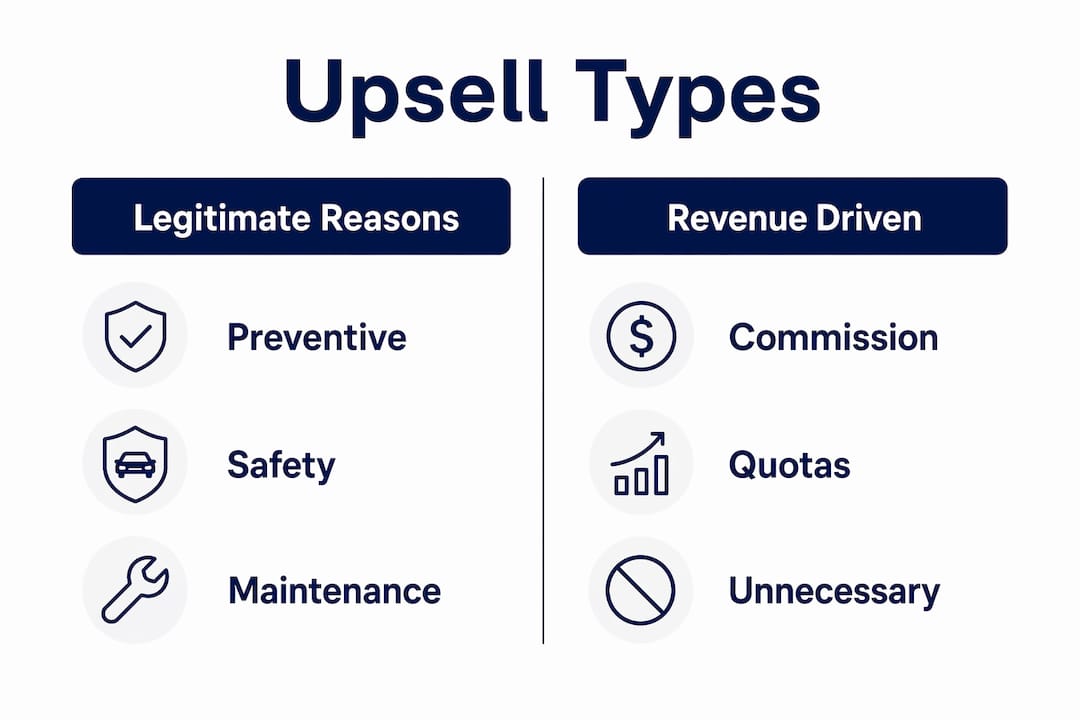
The honest answer is that motivations are mixed, and both can exist in the same shop on the same day.
Legitimate reasons are real. Preventive maintenance genuinely prevents bigger failures. A coolant flush at the right interval keeps a head gasket from warping. Catching a worn serpentine belt before it snaps saves a tow and a much larger repair bill. Many recommendations follow OEM maintenance schedules or are triggered by a measurable condition found during inspection.
Business reasons are also real. Technicians and service advisors often work under commission-based pay or quota structures, which creates a direct financial incentive to add line items. Shops also benefit from efficiency: if your car is already on the lift with the wheels off, adding a brake fluid flush takes 20 minutes and costs almost nothing in extra labor. That bundling logic is not always wrong, but it does mean the recommendation serves the shop’s schedule as much as your car’s needs.
Then there are shop-created maintenance calendars. The FTC flags this directly: some shops build schedules that call for more frequent service than the manufacturer recommends. Those calendars are sales tools, not safety documents. Compare any shop recommendation against your owner’s manual before approving it.
Modern vehicle complexity adds another layer. Systems like ADAS (advanced driver assistance systems) require calibrations after certain repairs, and OEM documentation is the only reliable way to confirm whether a calibration is actually required. Customers who don’t know what ADAS is are easy to oversell on it.
Pro Tip: Pull up your owner’s manual on your phone before you walk into any shop. The maintenance schedule is usually in the back. If a shop recommends something not listed there, ask them to show you the OEM bulletin that supports it.
Which upsells are reasonable and which are optional?
Most upsells fall into a handful of categories. Here is how to read each one.
Brake components are the most common upsell. Pad replacement is legitimate when thickness drops below the manufacturer’s minimum, typically measured in millimeters. Rotor resurfacing or replacement is warranted when rotors are below minimum thickness or show deep scoring. Brake fluid absorbs moisture over time and degrades, so a flush every two to three years has real merit. Ask for the pad measurement in writing.

Filters (air and cabin) are cheap parts with high markups. The cabin air filter is a five-minute, no-tools swap on most vehicles. Manufacturer intervals typically run within a range of miles or about once a year. A visually gray filter proves it has been in the car a while; it does not prove it is past its service interval. Check the date you last replaced it before approving.
Fluid services (transmission, coolant, power steering) have manufacturer-specified intervals that often run into the tens of thousands of miles. If a shop recommends a flush at every visit regardless of mileage, that is a sales calendar. Ask for the OEM interval and compare it to your odometer.
Fuel system cleaning is a frequent quick-lube upsell. Every gallon of gasoline sold in the United States has been required to contain detergent additives since 1995 under the EPA’s Lowest Additive Concentration standard. A generic fuel system cleaning sold to every car regardless of symptoms is largely redundant for most vehicles. The real exception: direct-injection engines can develop carbon buildup on intake valves because fuel never washes over them. That requires a specific procedure, not a bottle poured into the fuel rail.
Belts and hoses have OEM replacement intervals and show visible wear. A cracked or glazed belt is a legitimate finding. Ask to see it.
Wheel alignment is warranted after suspension work, after hitting a significant pothole, or when the car pulls to one side. Recommending it with every tire rotation is aggressive.
Battery replacement should follow a load test, not a visual inspection. A battery that passes a load test does not need replacing, regardless of age.
ADAS calibrations after windshield replacement or suspension work can be genuinely required. Ask for the OEM position statement that specifies the calibration requirement for your exact vehicle.
Pro Tip: For any fluid service, ask the shop to test the fluid first. Brake fluid test strips and coolant test strips cost almost nothing and give you an objective result. A shop that recommends a flush without testing the fluid first is guessing.
- Check your owner’s manual for the service interval.
- Ask for a measurement or test result (pad thickness, fluid test, battery load test).
- Ask to see the worn or failed part before approving replacement.
- If no test result or OEM reference exists, the recommendation is optional until you verify it elsewhere.
What are the red flags that signal an upsell scam?
Pressure and vagueness are the two clearest warning signs. Consumer-facing research identifies a consistent pattern of behaviors associated with overselling:
- Mixed-priority estimates with no urgency labels. When a shop lists safety-critical items alongside optional maintenance with no distinction, it creates artificial urgency. Ask them to separate the list into “do now” and “can wait.”
- Vague language. “Your fluids look dirty” or “your brakes are getting low” without a measurement attached is not a diagnosis. Ask for the number.
- Refusal to show the worn part. A legitimate shop can hand you the old brake pad or show you a photo of the cracked belt. Refusal is a red flag.
- Today-only pricing. Discounts that disappear if you don’t approve right now are a pressure tactic, not a genuine deal.
- Discouraging a second opinion. Any shop that reacts defensively to “I’d like to get a second opinion” is telling you something.
- Bundled packages that hide individual costs. Ask for a line-by-line breakdown of parts and labor. Dealer maintenance packages frequently bundle required and optional services in ways that make the optional items look mandatory.
The psychological mechanics behind these tactics are straightforward: fear, jargon, and time pressure short-circuit careful decision-making. A calm, mildly concerned voice explaining that your car “really needs” something today is a retail technique, not a medical diagnosis. Recognizing it for what it is removes most of its power.
The FTC’s consumer guidance on auto repair recommends getting a written estimate and comparing any shop recommendation against your vehicle owner’s manual before approving work. If a shop cannot point to the owner’s manual page or an OEM bulletin that supports a recommendation, that is your answer.
For a deeper look at how to read an estimate line by line, the auto repair pricing checklist from Onsite Los Angeles Mobile Mechanic walks through exactly what to look for.
How do you verify whether a mechanic’s recommendation is real?
Verification is a short process. Run through these steps before approving anything beyond the original job.
- Ask for an itemized written estimate with parts and labor listed separately. This is your legal right in California under the Bureau of Automotive Repair’s regulations at bar.ca.gov.
- Request photos or video of the issue. A digital vehicle inspection (DVI) that shows the worn pad, the cracked hose, or the corroded battery terminal removes all ambiguity.
- Ask to see the worn part after removal. Reputable shops keep old parts for customer review.
- Ask for diagnostic printouts. Battery load test results, brake-pad thickness in millimeters, and diagnostic trouble codes are all objective data points a shop can print in minutes.
- Compare against your owner’s manual. If the recommendation is not in the maintenance schedule and the shop cannot cite an OEM bulletin, it is optional.
- Get a second opinion for any job over $300 or any recommendation you cannot verify with the steps above. Phrase it simply: “I appreciate the recommendation. I’m going to get a second look before I approve it.”
Shops that provide DVI photos and itemized digital estimates consistently earn higher approval rates for legitimate work, because customers can see the evidence themselves rather than taking someone’s word for it.
“Which items are safety-critical or will cause damage if I don’t do them today, and which can wait?” Ask this question at the counter. A shop that cannot answer it clearly is not ready to earn your approval.
Pro Tip: When requesting a second opinion, you do not need to explain yourself. “I’d like a second opinion before approving this” is a complete sentence. A trustworthy shop will respect it.
What do common upsells typically cost and how long do they take?
Cost ranges vary based on parts brand (OEM vs. aftermarket), labor rate, and vehicle complexity. These are general ranges for common services in the U.S. market.
- Brake pad replacement (one axle): $150–$300, roughly 1–2 hours
- Rotor replacement (one axle, with pads): $250–$500, roughly 1.5–2.5 hours
- Brake fluid flush: $80–$150, roughly 30–45 minutes
- Cabin air filter replacement: $30–$80 (parts and labor), under 15 minutes
- Engine air filter: $25–$75, under 10 minutes
- Battery replacement: $150–$300 depending on battery type, roughly 30–60 minutes
- Wheel alignment: $75–$150, roughly 45–60 minutes
- Transmission fluid service: $150–$300, roughly 1–2 hours
- ADAS calibration: $150–$400 or more depending on the system and vehicle, 1–3 hours
Labor rates in Los Angeles typically run higher than national averages. Always ask for the parts-and-labor breakdown separately so you can spot inflated labor charges on short jobs.
Pro Tip: If a job is going to take more than a day or cost more than your budget allows right now, ask about phased approval and how to prepare for showroom shine mobile service. Most shops will let you approve safety-critical items today and schedule optional maintenance for a later visit. Scheduling repairs in phases spreads the cost and keeps your car safe without forcing a single large bill.
- Get the itemized estimate before any work starts.
- Separate safety-critical items from optional maintenance.
- Approve the urgent work and schedule the rest.
How does a transparent shop actually present recommendations?
A trustworthy inspection follows a clear sequence. The technician inspects the vehicle, captures photos or video of any findings, and delivers an itemized estimate that references the OEM interval or the specific measurement that triggered the recommendation. Each item is labeled: immediate, recommended, or optional. You see the evidence before you approve anything.
Here is what a credible estimate should include:
- DVI photos or video showing the actual condition of the part
- Brake-pad thickness in millimeters (not just “low” or “worn”)
- Battery load test printout with voltage and cold-cranking amp results
- Fluid test results where applicable
- The owner’s manual page number or OEM bulletin reference for any interval-based service
- Parts and labor listed as separate line items
- An urgency category for each item (immediate / recommended / optional)
Shops that present recommendations this way earn trust because the evidence does the work. Customers who can see a photo of a 2mm brake pad do not need to be convinced. Those who see a battery that passed a load test know the replacement recommendation is premature.
Pro Tip: Ask upfront: “Do you do a digital vehicle inspection with photos?” If the answer is no, that tells you something about how the shop communicates findings. Transparency in documentation is a reliable proxy for transparency in recommendations.

What should you say at the counter to get straight answers?
You do not need to be confrontational. Short, direct questions get better answers than long explanations.
Priority question (use this first):
- “Which of these items are safety-critical or will cause damage if I skip them today, and which can wait?”
Follow-up questions:
- “What happens if I delay this by three months or 5,000 miles?”
- “Can you show me where this is in my owner’s manual or an OEM bulletin?”
- “Can I see the worn part or the test printout?”
For the estimate:
- “Can I get that in writing with parts and labor listed separately before you start?”
- “Can we approve the urgent items now and schedule the rest for a later visit?”
For a second opinion:
- “I’d like to get a second opinion before approving this. Can you hold the car or give me the written estimate to take with me?”
- Ask the priority question immediately when the advisor presents additional recommendations.
- Request the written itemized estimate before approving anything.
- Ask for photos, test printouts, or the worn part for any item over $100.
- Use the second-opinion script for anything that feels rushed or unverifiable.
Pro Tip: Write these questions in your phone’s notes app before you drop the car off. Reading from a note at the counter is completely normal and signals that you are an informed customer, which often changes the tone of the conversation.
Key Takeaways
Mechanics recommend extra services for a mix of legitimate and revenue-driven reasons; the priority question separates safety-critical work from optional items every time.
| Point | Details |
|---|---|
| Use the priority question | Ask which items cause damage if skipped today vs. which can wait — this forces clarity on every estimate. |
| Demand written, itemized evidence | Request DVI photos, test printouts (brake-pad mm, battery load test), and a parts-and-labor breakdown before approving work. |
| Watch for red flags | Vague language, refusal to show worn parts, today-only pricing, and mixed-priority estimates without urgency labels are all warning signs. |
| Compare against your owner’s manual | The FTC recommends using the owner’s manual as the baseline; if a shop cannot cite an OEM interval or bulletin, the service is optional. |
| Onsite Los Angeles Mobile Mechanic | Provides upfront itemized quotes and on-site inspections with photo evidence so you can verify recommendations before approving any work. |
The real problem with how upsells are usually discussed
Most articles about mechanic upsells frame the issue as “good shops vs. bad shops.” That framing misses the point. The incentive structure at many shops rewards a larger ticket regardless of individual technician honesty. A straight-shooting technician working under a commission quota still has a financial reason to mention the cabin filter, the alignment, and the transmission service in the same breath as the brake job you actually came in for. That is not corruption. It is a system doing exactly what it was designed to do.
The more useful frame is this: every recommendation is a hypothesis. Your job is to ask for the evidence that supports it. A shop that can produce DVI photos, a measurement, and an OEM reference is presenting a testable claim. A shop that responds to those questions with vague reassurances or pressure is not. The difference between those two responses tells you more about the shop than any review site will.
One thing that genuinely changes the dynamic: removing the shop’s biggest advantage, which is your uncertainty. Knowing your own car’s maintenance history, keeping a simple log of what was done and when, and reading your owner’s manual once takes about an hour. That hour is worth more than any extended warranty or service package a counter advisor will ever offer you.
Transparent on-site inspections from Onsite Los Angeles Mobile Mechanic
If you want an inspection where the evidence comes to you, Onsite Los Angeles Mobile Mechanic brings the mechanic to your location anywhere in the greater Los Angeles area. Every job starts with an upfront quote, parts and labor listed separately, before any work begins. There are no surprise line items added after the car is already apart.
The on-site service model means you can watch the inspection, ask questions in real time, and approve only what you are ready to approve. Many common services, including battery replacement, oil changes, and brake work, are completed at your home, office, or wherever the car is parked. No tow, no waiting room, no pressure to approve a bundled package before you can get your keys back. For a full list of available services, visit the mobile repair services page or call 213-583-4159 to book directly.
Useful sources and further reading
These are the primary sources used in this article, listed by authority:
- Federal Trade Commission — Auto Repair Basics: The FTC’s consumer guidance on written estimates, owner’s manual comparison, and shop maintenance schedules. The most authoritative U.S. consumer protection source on this topic.
- California Bureau of Automotive Repair — bar.ca.gov: The state agency that licenses and regulates auto repair dealers in California. The primary authority on your legal rights to written estimates and itemized invoices in the state.
- Better Business Bureau — bbb.org: Useful for checking shop complaint histories and understanding common consumer disputes in auto repair.
- Consumer Reports — Car Repair Guide: Independent, subscription-supported research on where to get repairs and how to evaluate shop recommendations without a financial stake in the outcome.
- The One Question That Reveals if a Car Repair Is Necessary or an Upsell — Matter Digest: The practical source behind the priority question recommended throughout this article.
- Upselling vs. Overselling in ADAS Repair Shops — RevvHQ: Explains how to distinguish required ADAS calibrations from optional work using OEM documentation.
- Dealer Maintenance Upsells: Services You May Not Need — Mechanic Insights: Covers dealer package bundling and the documentation you should request to evaluate each line item.
- Onsite Los Angeles Mobile Mechanic — Services: The primary services page describing on-site mobile repair options and how to book.
- Why Professionals Choose Mobile Mechanics — Onsite Los Angeles Mobile Mechanic: Background on the transparent, on-site inspection model and how it reduces the information gap between shop and customer.