A fuel pump replacement on a typical modern vehicle runs between roughly $390 and $1,504 depending on the vehicle, system design, and whether a full module or pump-only unit is swapped. DIY is realistic for owners with intermediate mechanical skill, a safe workspace, and the right tools — but in-tank jobs on many late-model cars are genuinely difficult without a lift. If you’re not sure where to start, run a fuel pressure test and check for trouble codes before ordering any parts.
- Typical total cost: $390–$1,504 for most vehicles (parts + labor)
- DIY feasibility: Intermediate skill level; accessible on some vehicles, not all
- Immediate next step: Run a pressure test or pull OBD-II codes, then get a local quote or call a mobile mechanic
Key Takeaways
A correct diagnosis before any parts are ordered is the single step that separates a successful fuel pump repair from an expensive repeat visit.
| Point | Details |
|---|---|
| Total cost range | Most vehicles fall between $390 and $1,504 depending on system design and parts choice. |
| Diagnose before buying | Run a fuel pressure test and voltage check first; a bad relay or clogged filter mimics pump failure. |
| DIY suitability | Accessible external pumps are manageable for intermediate DIYers; in-tank jobs requiring a tank drop usually need a lift. |
| Always replace the seal | Install a new tank seal/O-ring with every pump swap to prevent fuel odor and comeback repairs. |
| Onsite Los Angeles Mobile Mechanic | Offers on-site fuel system diagnostics and pump replacement across greater Los Angeles with transparent upfront pricing. |
Table of Contents
- How much does fuel pump replacement cost, really?
- What are the symptoms of a failing fuel pump?
- How do professionals diagnose a bad fuel pump?
- Can you replace the fuel pump yourself?
- Step-by-step overview: in-tank module vs. external pump replacement
- What parts and tools do you need for a pump swap?
- How long does a fuel pump replacement take?
- When should you call a professional instead of doing it yourself?
- Why professional service often delivers better value
- An honest take on fuel pump replacement planning
- Onsite Los Angeles Mobile Mechanic comes to you for fuel system repairs
- Sources
How much does fuel pump replacement cost, really?
The honest answer is: it depends heavily on your vehicle and what the shop actually replaces. RepairPal’s aggregated data and Kelley Blue Book provide differing price ranges for fuel pump replacement reflecting the variation between pump-only and full module replacement jobs. That gap isn’t a data error — it reflects the difference between a pump-only swap on an older domestic vehicle and a full in-tank module replacement on a late-model import.
The single biggest cost driver is access. An engine-mounted high-pressure fuel pump (common on direct-injection engines) often takes under two hours to swap. An in-tank module on a sedan where the tank must be lowered can push labor alone past $400.
AAA confirms that system design and OEM vs. aftermarket parts choice are the two factors that swing the final bill most dramatically. Here’s how the line items typically break down:
- Parts (pump-only unit): varies from low to moderate cost for many applications, per AutoZone’s published range
- Parts (full module assembly): $150–$600+ depending on vehicle
- Labor: $150–$600+ depending on tank access and shop rate
- Tank seal/O-ring: typically a low additional cost (often sold separately — always confirm it’s included)
- Strainer/sock: generally an additional minor cost
- Fuel filter (if serviceable): cost varies depending on vehicle
- Wiring pigtail or connector repair: possible extra cost if terminals are heat-damaged
- Diagnostic fee: may be charged if not waived on repair
Carparts shows a published band of roughly $400 to $1,500+ and confirms that access, module vs. pump-only, and add-on repairs drive most of the variance. Understanding how parts pricing works in auto repair helps you read any quote more clearly.
Pro Tip: Before accepting a quote, ask specifically whether it includes a new tank seal/O-ring and whether the relay and wiring harness will be tested. Shops that skip both often see the car return within weeks.
What are the symptoms of a failing fuel pump?
Most pumps don’t fail without warning. The signs tend to build gradually, which is exactly why many owners mistake early symptoms for a bad fuel filter or dirty injectors.
- Sputtering or choking at highway speed: The pump can’t sustain pressure under load — one of the most consistent early indicators
- Hard starts or extended cranking: Especially after the car has sat overnight; the pump isn’t building pressure fast enough
- Stalling under acceleration: Demand spikes and the pump can’t keep up
- Loss of power on hills or when towing: Similar cause — sustained high-demand situations expose a weakening pump
- Audible whining from the fuel tank: A healthy pump is nearly silent; a failing one often hums or whines noticeably
- Check Engine light with fuel pressure codes: P0087 (fuel rail pressure too low) is a common one
Kelley Blue Book’s symptom list and GreatWater 360 Auto Care’s checklist both flag intermittent stalls and decreased acceleration as the most common triage indicators before a formal diagnosis.
The catch: a clogged fuel filter produces nearly identical symptoms. So does a failing fuel pressure regulator or a set of dirty injectors. Chasing a pump replacement without confirming pressure at the fuel rail first is how owners end up spending $400 on a part that wasn’t the problem. CarParts.com also notes that keeping the tank above one-quarter full helps cool and preserve pump life — running consistently low accelerates wear.
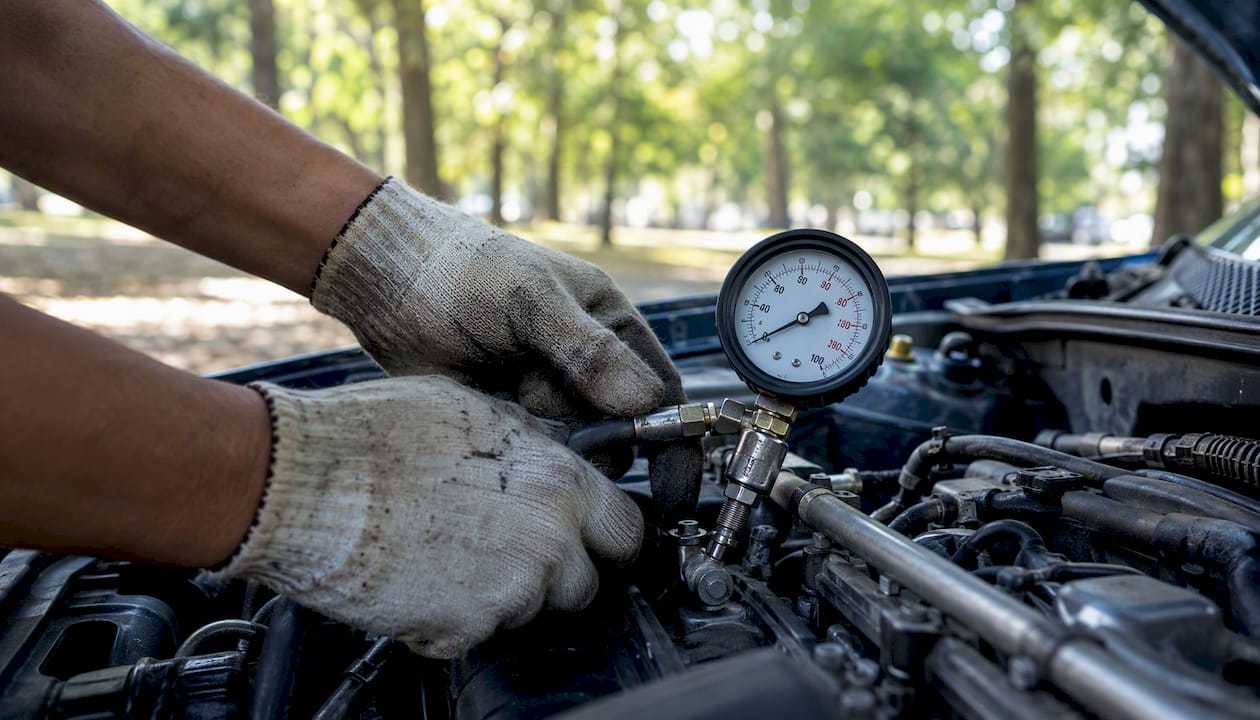
When it becomes urgent: A no-start combined with confirmed fuel pressure loss, or repeated stalls at highway speed, means the pump is close to complete failure. Don’t drive it; call a mechanic.
How do professionals diagnose a bad fuel pump?
A shop won’t replace the pump based on symptoms alone. The diagnostic sequence matters, and knowing it helps you evaluate whether a shop is doing the job right — or just guessing.
The professional diagnostic sequence
- Pull OBD-II trouble codes with a scanner. Fuel pressure codes (P0087, P0088, P0190) point toward the fuel system; misfire codes alone usually don’t.
- Test fuel pressure at the rail or injector port using a fuel-pressure gauge. Compare the reading to OEM spec at idle, under load, and after key-off (residual pressure). A pump that holds pressure at idle but drops under load is a classic failure pattern.
- Verify voltage at the pump harness. A pump getting less than 12V under load may be failing due to a wiring or relay problem, not the pump itself. This step is what separates a real diagnosis from a guess.
- Test the fuel pump relay and ground circuit with a multimeter. A bad relay is a $15 fix that mimics a $400 pump failure.
- Inspect the strainer and fuel filter. A completely clogged strainer can starve a healthy pump and produce identical symptoms.
Safe checks a skilled DIYer can perform
- Listen for pump prime: Turn the key to “on” without cranking. You should hear a 2–3 second hum from the tank. Silence suggests a dead pump, bad relay, or no power to the circuit.
- Measure voltage at the pump connector with a voltmeter (if the connector is accessible without dropping the tank). Anything below 11.5V under crank warrants electrical investigation first.
- Check for roadside electrical faults before assuming the pump is the culprit.
Tools used: fuel-pressure gauge, multimeter, OBD-II scanner, and fuel-line quick-disconnect tools for accessing the test port. Some OEM procedures — particularly on diesel systems with dual-filter setups — also require purging trapped air via specific ignition cycles after service, as Ford’s OEM service content describes for its engine-mounted filter and diesel conditioner module procedures.
Safety rule, no exceptions: Relieve fuel system pressure using the OEM procedure (typically pulling the fuel pump fuse and cranking until the engine stalls) and disconnect the negative battery terminal before touching any fuel-system component.
Can you replace the fuel pump yourself?
For some vehicles, yes. For many late-model cars, the honest answer is: probably not without a lift and some specialized tools. The decision comes down to access, not just skill.
When DIY makes sense
- The pump is engine-mounted (common on GDI/HPFP systems) or accessible through an interior access panel without dropping the tank
- You have a safe, well-ventilated workspace with no ignition sources nearby
- You’ve confirmed the correct part by year/make/model/engine (not just “fits a V6”)
- You own or can rent a fuel-pressure gauge, fuel-line quick-disconnect set, and a multimeter
- You’re comfortable with basic electrical testing and can follow OEM torque specs
When to skip DIY
- The tank must be lowered and you don’t have a lift or jackstands rated for the weight
- The vehicle has a direct-injection high-pressure fuel pump with high-pressure lines (these require specific tools and procedures)
- There’s visible corrosion on tank straps or fuel-line fittings — rusted hardware turns a 2-hour job into a 5-hour one fast
- The diagnosis points to an electrical harness problem, not a mechanical pump failure
AutoZone frames DIY as an intermediate task that can save significant labor costs but requires safety precautions and the right equipment. AAA goes further, noting that the real DIY risk isn’t the physical swap — it’s misdiagnosis and missed corrosion that causes near-term re-failure.
Tools and PPE you’ll need
- Floor jack and rated jackstands (or a lift)
- Approved fuel container and catch pan
- Fuel-line quick-disconnect tool set
- Lock-ring tool (for most in-tank module applications)
- Torque wrench
- Multimeter and fuel-pressure gauge
- Safety glasses, nitrile gloves, fire extinguisher within reach
Decision flow
- Run diagnosis (pressure test + voltage check + codes)
- Confirm access type (engine-mounted vs. in-tank, access panel vs. tank drop)
- Verify you have the correct part and all required tools
- Assess workspace safety (ventilation, no ignition sources, stable surface)
- If any step fails the check, call a mobile mechanic or shop
Step-by-step overview: in-tank module vs. external pump replacement
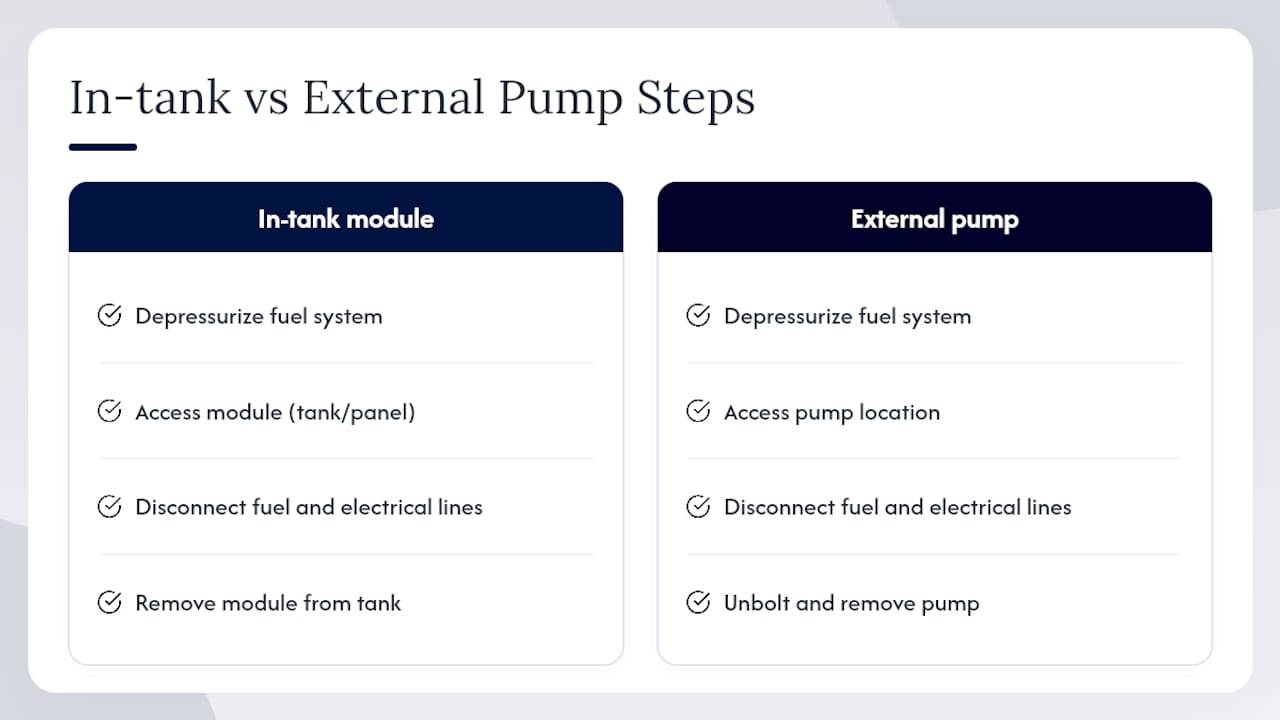
This is a high-level workflow, not a shop manual. Always follow your vehicle’s OEM procedure and torque specifications.
Safety sequence that applies to both system types
- Disconnect the negative battery terminal
- Relieve fuel system pressure (pull the fuel pump fuse, crank until stall, confirm with a gauge)
- Work outdoors or in a well-ventilated area with no open flames, sparks, or running motors nearby
- Have a fire extinguisher and catch pan within arm’s reach
In-tank module replacement (most common)
- Locate and use the access panel if present (some sedans and trucks have one under rear seat or cargo floor)
- If no panel: drain or siphon fuel, support the tank, disconnect straps, and lower carefully
- Disconnect fuel lines (use quick-disconnect tools) and the electrical harness
- Remove the lock ring or fasteners securing the module
- Lift out the module; note orientation of the fuel level sender
- Install the new module with a new seal/O-ring; torque the lock ring to spec
- Reconnect harness and fuel lines; reinstall tank or close access panel
- Reconnect battery, cycle the key 3–5 times to prime, then crank and check for leaks at all connections
External (engine-mounted) pump replacement
- Relieve pressure and disconnect the battery (same safety sequence)
- Disconnect fuel inlet and outlet lines at the pump
- Disconnect the electrical connector
- Unbolt the pump from its bracket or mounting point
- Install the new pump; torque to spec
- Reconnect lines and wiring; prime and pressure-test before starting
| Factor | In-tank module | External/engine-mounted pump |
|---|---|---|
| Typical labor hours | 2–4+ hours | 1–2 hours |
| Main risk points | Tank drop, fuel spill, rusted straps | High-pressure line handling on GDI systems |
| DIY suitability | Moderate to difficult | Easier, if accessible |
| Parts cost | Higher (full module) | Lower to moderate |
For diesel systems with dual-filter setups, purging trapped air via OEM-specified ignition cycles after reassembly is a required step — skipping it causes hard starts and can set false codes.
What parts and tools do you need for a pump swap?
Getting the parts list right before you start prevents a half-disassembled car sitting in the driveway while you wait for a missing O-ring.
Parts checklist:
- Fuel pump or full module assembly (confirm fitment by year/make/model/engine — not just vehicle name)
- Strainer/sock (usually sold separately from the pump)
- Tank seal/O-ring (critical — always replace it; reusing the old one is how fuel odors start)
- Fuel filter, if your vehicle has a serviceable inline filter
- Wiring pigtail or connector if the existing terminals show heat damage or corrosion
Tools checklist:
- Floor jack and rated jackstands or a lift
- Fuel-line quick-disconnect set (sized for your vehicle’s line diameter)
- Lock-ring tool or spanner wrench (for most in-tank module applications)
- Torque wrench
- Multimeter
- Shop rags and a catch pan for fuel
Related repairs that commonly appear alongside a pump job:
- Damaged or rusted tank straps (often discovered only after the tank is lowered)
- Bad fuel pump relay or corroded wiring connector
- Clogged fuel filter — if yours is serviceable and hasn’t been changed recently, replace it now; Briggs & Stratton’s filter safety guidance applies the same core principles to vehicle fuel-filter work: drain or isolate fuel, protect your eyes, and inspect lines for cracks before and after service
- Fuel level sender unit (often integrated into the module; if the gauge has been reading erratically, replace it with the pump)
Buying tip: inspect the old connector before ordering parts. Heat-damaged terminals are common on high-mileage vehicles and a new pump wired into a corroded connector will fail prematurely. A replacement pigtail costs under $30 and takes 15 minutes to splice in.
How long does a fuel pump replacement take?
Realistic time estimates matter when you’re scheduling a repair or deciding whether to attempt it on a weekend.
- External or engine-mounted pump: 1–2 hours in most cases; straightforward access and no tank work
- In-tank module with an access panel: 1.5–3 hours; no tank drop required, but space is tight
- In-tank module requiring tank removal: 2–4+ hours under normal conditions; longer if straps are rusted or the tank is full of fuel that needs draining
- Extreme cases (heavy corrosion, contaminated fuel, additional electrical repairs): 5+ hours is not unusual
Common delay causes:
- Rusted or seized tank straps and fuel-line fittings (the most frequent time-killer)
- Fuel that must be drained or siphoned before the tank can be safely lowered
- Contaminated tank requiring cleaning before the new pump is installed
- Electrical harness repairs discovered mid-job
- Missing parts (seal, strainer, or pigtail not included in the kit)
When scheduling, ask the shop or mobile mechanic whether a post-repair leak check and test drive are included in the quoted time. A job that ends without a pressure test and a short drive isn’t finished.
When should you call a professional instead of doing it yourself?
Some situations make DIY genuinely risky, not just inconvenient.
- Direct-injection high-pressure fuel pump components: These systems operate at pressures that require specific tools and procedures — not a job for a standard socket set
- Extensive rust on tank straps or fuel-line fittings: What looks like a 2-hour job becomes dangerous when fittings snap or straps won’t release without cutting
- Diagnosis points to an electrical harness problem: Chasing wiring faults without proper diagnostic equipment leads to misdiagnosis and repeat failures; electrical fault diagnosis is a separate skill set from mechanical pump replacement
- You can’t safely relieve fuel system pressure: If the fuse box is inaccessible or the procedure is unclear, stop — pressurized fuel is a fire hazard
- You’re stranded at home or work: A mobile mechanic comes to you, which eliminates towing costs and the logistics of getting a non-starting car to a shop
Short decision rule: if you lack the right tools, can’t confirm the access type, or aren’t comfortable with fuel-system safety procedures, the labor cost of a professional is cheaper than the risk of a mistake.
Why professional service often delivers better value
A qualified mechanic doesn’t just swap the part. The value is in what gets checked alongside it.
- Accurate diagnosis first: Pressure testing and voltage checks confirm the pump is actually the problem before any parts are ordered
- Wiring and relay verification: A new pump installed into a faulty circuit fails again quickly; pros test the full circuit
- Seal and leak verification: New tank seal installed, all connections pressure-tested before the job is signed off
- Reduced comeback risk: Missed corrosion and skipped electrical checks are the two most common causes of repeat failures after DIY pump jobs, per AAA’s guidance
When booking a reputable mobile service, expect a transparent upfront quote that separates parts from labor, a clear scope of work, and a stated timeframe. Ask whether the quote covers the seal, strainer, and a post-repair pressure test. A shop or mobile mechanic that can’t answer those questions clearly is worth reconsidering. For a deeper look at how quotes break down, the auto repair pricing checklist covers what to ask before approving any repair.
An honest take on fuel pump replacement planning
The most expensive mistake in fuel pump repair isn’t the pump itself. It’s replacing the pump before confirming the diagnosis.
A pressure test and a voltage check at the pump connector take 20 minutes and cost almost nothing. Skipping them and ordering a $300 module because the symptoms “sound like” a pump failure is how owners end up with a new pump and the same problem. The filter, the relay, the wiring, and the pressure regulator all produce overlapping symptoms. Diagnosis first is not optional.
The second mistake is underestimating access. An in-tank pump on a 2019 crossover is not the same job as an external pump on a 1998 pickup. If you’ve never dropped a fuel tank, a YouTube video is not sufficient preparation. The tank is heavy, the fuel is flammable, and rusted straps don’t care about your schedule.
For most vehicle owners, the math on professional service is straightforward: the labor cost buys you a correct diagnosis, a tested repair, and someone else’s liability if it fails again. That’s worth more than the savings on a job done without the right tools or the right information.
Onsite Los Angeles Mobile Mechanic comes to you for fuel system repairs
Skipping the tow truck is the clearest advantage Onsite Los Angeles Mobile Mechanic offers for a no-start or fuel-system problem. Instead of arranging a flatbed and waiting at a shop, you call and a mechanic comes to your location anywhere in greater Los Angeles.

The process is straightforward: call with your vehicle’s year, make, model, and the symptoms you’ve observed. Onsite Los Angeles Mobile Mechanic provides a transparent upfront quote before any work begins, covering parts and labor separately so there are no surprises. On-site diagnostics include fuel pressure testing and electrical checks to confirm the pump is actually the problem before any parts are ordered. When the job is feasible on-site, the replacement is completed at your location. Jobs that require a shop lift or heavy tank service are disclosed upfront and scheduled accordingly.
Call Onsite Los Angeles Mobile Mechanic at 213-583-4159 to get a quote and schedule a visit. Have your vehicle’s year, make, model, and engine size ready when you call.
Sources
- Fuel Pump Replacement Cost Estimate
- How Much Does a Fuel Pump Replacement Cost? | AAA Automotive
- Carparts
- How Much Does Replacing a Fuel Pump Cost? | AutoZone
- Fuel Pump Replacement Prices & Cost Estimates | Kelley Blue Book
- How to change a fuel filter in small engines