You’re already late and your car won’t cooperate. Whether it’s a dead battery, a flat tire, or a warning light that just came on, the fastest car repairs under one hour are the ones that get you back on the road without burning your entire day. Knowing which repairs realistically fit that window, and what makes them quick in the first place, separates a frustrating morning from a manageable inconvenience. This guide breaks down the repairs that actually qualify, what to look for in a provider, and how to make the smartest call when time is tight.
Table of Contents
- Key takeaways
- What makes the fastest car repairs under one hour actually possible
- 1. Battery replacement
- 2. Air filter replacement
- 3. Spark plug replacement
- 4. Tire patch or replacement for a minor flat
- 5. Brake pad replacement (straightforward cases)
- 6. Headlight or taillight bulb replacement
- 7. Wiper blade replacement
- 8. Fuse replacement
- 9. Oil top-up or quick oil change
- 10. Oxygen sensor replacement
- Quick comparison: common repairs by time and complexity
- Tips for finding quick and trustworthy same-day car repair services
- My honest take on fast repairs and what most people get wrong
- Get your car fixed fast with Onsite Los Angeles Mobile Mechanic
- FAQ
Key takeaways
| Point | Details |
|---|---|
| Parts availability drives speed | Common, in-stock parts are the number one factor in whether a repair finishes under an hour. |
| Diagnostics still belong in the window | Skipping a quick diagnostic scan to save time usually leads to repeat repairs and more downtime later. |
| Mobile mechanics cut wait time significantly | On-site service eliminates shop drop-off, waiting rooms, and towing, making one-hour repairs more accessible. |
| Not every “quick” repair is equally quick | Battery swaps and wiper replacements are genuinely fast; brake jobs vary widely by vehicle and condition. |
| Ask about total time, not just repair time | Always clarify whether the quoted time includes diagnosis, not just the hands-on work. |
What makes the fastest car repairs under one hour actually possible
Speed in auto repair is not about rushing. It comes down to a specific set of conditions that align. When those conditions are met, a repair that looks complex can be done in thirty minutes. When they are not, even a “simple” fix can stretch into the afternoon.
Here is what actually drives fast turnaround:
- Parts availability: Common, in-stock parts allow a repair to move straight into execution. Older vehicles or rare models often face sourcing delays that blow past any one-hour window regardless of technician skill.
- Repair complexity and access: A battery sits on top of the engine bay. An oxygen sensor on some vehicles is three bolts away from being replaced. Physical accessibility matters as much as mechanical complexity.
- Clear scope from the start: A repair that starts with a defined problem finishes faster than one that expands mid-job. Diagnostic time is often not included in advertised one-hour quotes, and skipping diagnostics to save time tends to cause incorrect repairs and longer downtime later.
- Certified technician experience: A tech who has replaced a specific sensor fifty times will do it in fifteen minutes. Someone doing it for the second time might take forty-five. Experience compresses time.
- Vehicle make, model, and age: A 2019 Honda Civic and a 2007 Land Rover Discovery are not the same job. Tight engine bays, corrosion on older vehicles, and non-standard bolt layouts add time that no amount of skill fully eliminates.
- Quality still applies under time pressure: Certified technicians use OEM scan tools and follow manufacturer procedures even on expedited repairs, which protects you from rework and keeps warranty coverage intact.
Pro Tip: Before booking any quick car repair service, ask specifically whether the quoted time includes the diagnostic scan. That one question will immediately tell you whether the shop is being realistic or just selling you a number.
1. Battery replacement
A dead or failing battery is one of the most common roadside emergencies, and it is also one of the fastest fixes available. A technician can swap a standard 12-volt battery in fifteen to twenty minutes in most vehicles. The job requires minimal tools and no special vehicle access. The only variable is whether your car needs a battery registration procedure, which some European vehicles require to tell the ECU that a new battery has been installed. That adds maybe ten minutes. Total time is still well within sixty minutes.
2. Air filter replacement
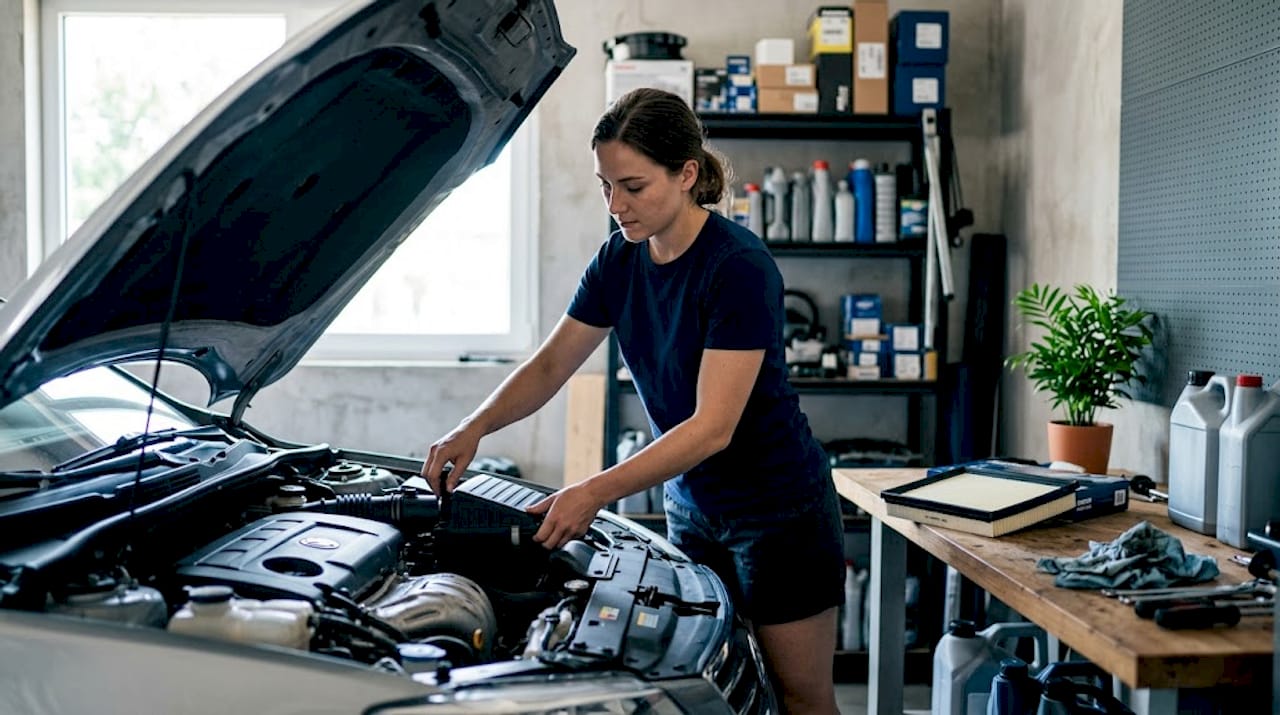
Engine air filters sit in a plastic housing that typically snaps open without tools. Replacing one takes about ten minutes, including the time to inspect the housing for debris. Cabin air filters are equally fast on most vehicles, though a few models require removing the glove box panel, which adds another fifteen minutes. Either way, this is a same day car repair that barely registers as a job.
3. Spark plug replacement
On a four-cylinder engine with an accessible valve cover, replacing all four spark plugs takes roughly thirty to forty minutes. Six-cylinder engines take longer, and V8s with rear-bank plugs can push past sixty minutes depending on the vehicle. For most daily drivers, though, a spark plug set is a textbook fast vehicle maintenance job. The key is having the correct plugs on hand before the appointment starts.
4. Tire patch or replacement for a minor flat
A simple puncture in the center tread area of a tire can be patched in twenty to thirty minutes. A full tire swap on a single wheel, including mounting and balancing, typically runs thirty to forty-five minutes. Neither job requires anything beyond standard shop equipment. Where it gets slower is when the damage is on the sidewall, which cannot be patched and requires a full replacement, or when the wheel has corrosion that makes breaking the bead difficult.
5. Brake pad replacement (straightforward cases)
Front brake pads on a standard passenger car with good caliper access can be replaced in forty-five to sixty minutes per axle. The job becomes faster when the rotor does not need replacement and the caliper slides move freely. It becomes slower when rotors are scored, slides are seized, or the vehicle has an electronic parking brake that requires a special tool to compress the rear caliper piston. Always confirm the scope before counting on this being under an hour.
6. Headlight or taillight bulb replacement
On most vehicles, bulb replacement is a five to fifteen minute job. Reach behind the housing, twist out the old bulb, twist in the new one. The exception is vehicles with sealed headlight assemblies that require bumper removal to access, which turns a simple bulb swap into a forty-five to sixty minute job. Knowing your vehicle’s design ahead of time avoids that surprise.
7. Wiper blade replacement
This is the fastest repair on the list. A set of wiper blades takes five to ten minutes to replace, requires no tools, and the parts are available at every auto parts store. It belongs in the category of emergency car repair only in the sense that driving in rain with torn wipers is genuinely dangerous. Get this done before it becomes urgent.
8. Fuse replacement
A blown fuse causing a non-functional accessory, failed power window, or dead interior light can be diagnosed and replaced in under twenty minutes. The diagnostic step of identifying which fuse is blown takes most of the time. Once located, the physical swap is thirty seconds. Proper diagnostic scans before and after repairs are still recommended to confirm no underlying electrical issue caused the fuse to blow in the first place.
9. Oil top-up or quick oil change
A simple oil top-up with the correct oil grade on hand takes ten minutes. A full oil and filter change, done by an experienced technician with the vehicle already at temperature, runs twenty-five to thirty-five minutes. This is one of the most common examples of auto repair in one hour that providers advertise, and it genuinely fits the window when parts are prepped and the vehicle is a common make.
10. Oxygen sensor replacement
Sensor and ignition issues are typically resolved same day with diagnostic included, which puts them squarely in the one-hour category for accessible sensor locations. An upstream oxygen sensor on a four-cylinder engine is often a twenty to thirty minute job with the right socket. Downstream sensors and those buried near catalytic converters on tight-bay vehicles take longer. Fast engine diagnostics confirm which sensor is failing before any parts are ordered, avoiding a wasted replacement.
Quick comparison: common repairs by time and complexity
| Repair | Typical time | Parts needed | Skill level | Avg. cost range |
|---|---|---|---|---|
| Battery replacement | 15–25 min | Standard 12V battery | Low | $120–$250 |
| Air filter (engine) | 10–15 min | Filter (common, cheap) | Low | $25–$60 |
| Wiper blade replacement | 5–10 min | Wiper set | Low | $20–$50 |
| Spark plug replacement (4-cyl) | 30–45 min | Plug set | Medium | $80–$150 |
| Oil change | 25–35 min | Oil, filter | Low-Medium | $60–$120 |
| Tire patch | 20–30 min | Patch kit | Medium | $20–$40 |
| Fuse replacement | 15–20 min | Fuse set | Low | $10–$30 |
| O2 sensor replacement | 30–50 min | Sensor (verify fit) | Medium | $100–$250 |
| Brake pad replacement | 45–60 min | Pad set | Medium-High | $150–$350 |
Note: Times reflect straightforward cases on common vehicles. Your specific make, model, and condition may change these estimates.
Tips for finding quick and trustworthy same-day car repair services
Knowing which repairs are fast is only half the equation. Finding the right provider to execute them quickly and correctly is where most car owners run into trouble.
- Verify technician certification: Even for a fifteen-minute battery swap, you want someone who has done it hundreds of times with the right tools. ASE-certified technicians bring both speed and accuracy.
- Ask about diagnostic tools upfront: Shops and mobile mechanics using modern OBD-II scanners and manufacturer-level software identify faults in minutes instead of hours. That speed directly cuts total service time.
- Consider mobile mechanic services: Mobile mechanics expand access to quick car repairs that previously required scheduled shop visits and waits. Coming to your location eliminates drop-off logistics, waiting room time, and the need to arrange a ride.
- Clarify total time in the quote: Good shops communicate proactively about parts availability and realistic time frames. If a provider cannot tell you whether their quoted time includes diagnostics, that is a red flag.
- Check reviews for time-specific feedback: Look for customer comments that mention whether the repair finished on schedule, not just whether the quality was good. Speed and quality together are what you are evaluating.
- Pre-arrange parts when possible: For non-emergency repairs, calling ahead to confirm that your specific part is in stock can shave thirty minutes off a same-day appointment. Many mobile mechanics will source the part before arrival when given a VIN and symptoms.
- Understand the cost versus speed trade-off: Expedited car service sometimes carries a premium for after-hours or priority scheduling. That premium is often worth it when being without a vehicle costs you more in missed work or logistics than the upcharge itself.
Pro Tip: When you call to book, say the exact symptom and your vehicle’s year, make, and model in your first sentence. A technician who can pre-diagnose remotely and arrive with the likely part already in hand will finish the job in half the time of someone arriving cold.
My honest take on fast repairs and what most people get wrong
I have seen the same pattern repeat itself enough times to say this plainly: the biggest mistake people make when seeking quick car repair services is treating speed as the only variable. They book whoever promises the fastest window and end up back at square one a week later because the root cause was never actually confirmed.
Rushing diagnostics is expensive. A scan that takes fifteen minutes before a repair begins can prevent a two-hour job next Friday. Even simple repairs require systematic diagnostic tests to avoid repeat repairs and safety issues. The providers advertising “ten minute” everything are usually the ones skipping that step.
What has actually changed the fast repair equation is mobile service. The ability to get a certified technician to your home, office, or parking lot means the logistics time that used to dominate your day is now gone. The repair itself was always quick for the jobs on this list. It was the driving, dropping off, waiting, and picking up that consumed the hours. Mobile mechanics removed that friction entirely, and that is a bigger shift than most people realize. Learn more about how onsite repair works if you have never used the model before.
My advice: be specific with whoever you call, ask about the diagnostic step directly, and do not confuse a low time estimate with a trustworthy one. The best fast repair is the one you never have to repeat.
— Aaron
Get your car fixed fast with Onsite Los Angeles Mobile Mechanic
When you need a repair done today and you do not have time to sit in a waiting room, Onsite Los Angeles Mobile Mechanic brings certified service directly to you anywhere in the greater Los Angeles area, including Pasadena, Long Beach, and surrounding neighborhoods.
From battery replacements and oil changes to sensor swaps and brake pad services, the full range of mobile repair services covers the most common fast vehicle maintenance needs, with upfront pricing and no hidden fees. Many repairs finish in under an hour. You get a transparent quote before any work starts, and you stay in control of the decision. Call 213-583-4159 to book your appointment and get an honest time and cost estimate on the spot. No app needed. Just a quick call and a technician headed your way.
FAQ
What car repairs can realistically be done in under an hour?
Battery replacements, oil changes, wiper blade swaps, air filter changes, fuse replacements, and spark plug replacements on four-cylinder engines all fit comfortably within sixty minutes when parts are available and the vehicle is a common make and model.
Does the one-hour estimate include diagnostics?
Not always. Many advertised one-hour repair times cover only the hands-on work. Skipping diagnostics risks incorrect repairs, so always ask your provider whether the quoted time includes a scan before and after the job.
How do I get quick car repairs without going to a shop?
Mobile mechanic services come directly to your location, eliminating drop-off and waiting room time entirely. Calling with your vehicle details and a clear description of the symptom helps the technician arrive prepared with the right parts, which speeds up the repair significantly.
Are fast repairs lower quality than standard shop repairs?
Not when done by a certified technician with the right tools. Speed comes from experience and preparation, not from cutting corners. Certified technicians follow manufacturer procedures even on quick jobs, and quality providers offer warranties on their work regardless of how fast the repair was completed.
What makes a brake pad replacement take longer than an hour?
Scored rotors that need replacement, seized caliper slides, and electronic parking brake systems that require a special reset tool can each push brake jobs past sixty minutes. Confirming the full scope of the job before the appointment starts prevents that surprise.