Car trouble is expensive, but the time it steals from your day is often the real cost. Most people don’t realize how dramatically mobile mechanics save work hours until they’ve watched a traditional shop appointment swallow an entire afternoon. You drop off the car, arrange a ride, wait, get a call, arrange another ride back, and somehow half your workday is gone. Mobile mechanics eliminate every single one of those steps, and the time savings are backed by real data that most drivers have never seen.
Table of Contents
- Key takeaways
- Why mobile mechanics save work hours compared to traditional shops
- How route optimization makes mobile mechanics more efficient
- The real cost of vehicle downtime
- How digital tools keep mobile mechanics on schedule
- How to get the most time savings from your mobile mechanic
- My take on what people miss about mobile mechanics
- Get your time back with Onsite Los Angeles Mobile Mechanic
- FAQ
Key takeaways
| Point | Details |
|---|---|
| Dramatic wait time reduction | Mobile mechanics average a 48-hour turnaround from booking to completion, over 11 days faster than traditional garages. |
| Repairs happen at your location | Your car gets fixed at your home, office, or parking lot, so you keep working while the job gets done. |
| Route optimization benefits customers | Mechanics using route density tools fit more appointments daily, meaning shorter waits and faster access for clients. |
| Downtime has a measurable dollar cost | Commercial vehicles lose $400 to $1,800 per day when off the road, making on-site repairs a financially smart choice. |
| Bundle tasks to save even more time | Scheduling multiple services in one appointment multiplies your time savings with zero extra scheduling overhead. |
Why mobile mechanics save work hours compared to traditional shops
The average traditional garage visit does not just take the time you spend waiting in the lobby. It takes your entire morning or afternoon once you factor in drop-off, transportation logistics, waiting for the diagnosis, approvals, and pickup. For a busy professional managing meetings or a parent managing school pickups, that’s a serious disruption.
The data makes the case clearly. Mobile mechanics deliver an average 48-hour turnaround from booking to job completion, which is over 11 days faster than the typical traditional garage timeline. That is not a marginal improvement. That is a structural advantage that changes how you plan your week.
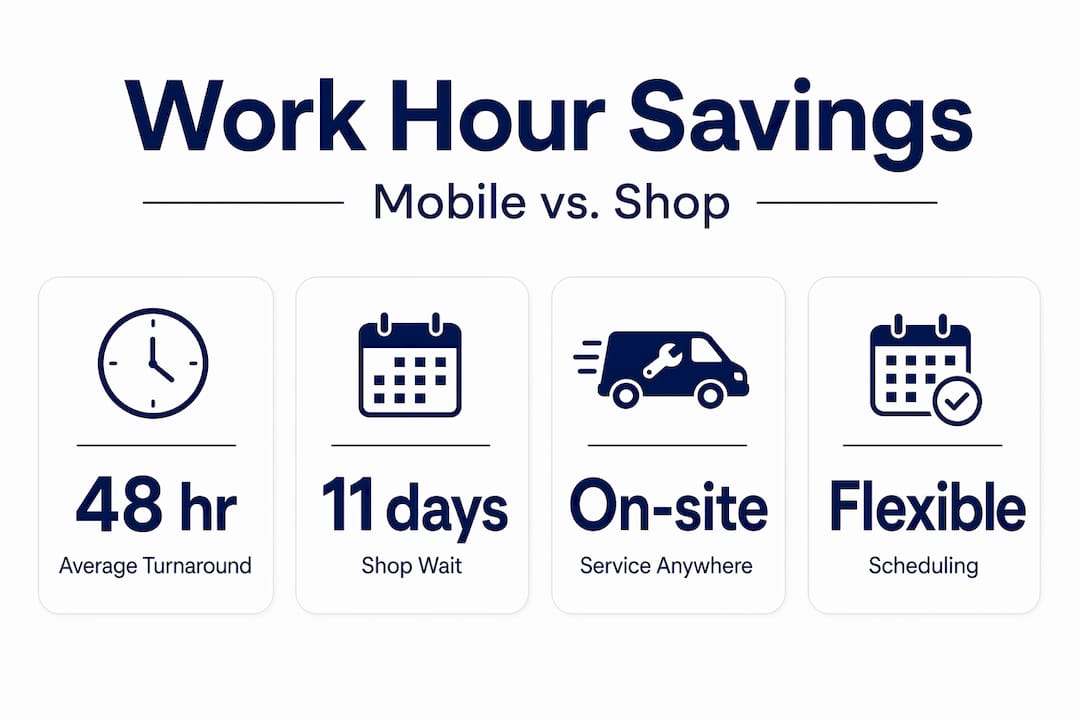
Beyond speed, the location factor matters enormously. A mobile mechanic can come to your office parking lot while you’re in back-to-back meetings, to your home while you sleep, or to wherever your car broke down. You are not the one doing the logistics. You save on towing fees and rideshare costs on top of the time saved, which adds up fast in a city like Los Angeles where rideshare prices and towing fees are substantial.
The mobile car repair convenience model is not just about skipping a waiting room. It’s about keeping your day intact while the problem gets solved around your schedule.
How route optimization makes mobile mechanics more efficient
Here’s something most customers never think about: the mechanic’s routing efficiency directly affects how quickly you can get an appointment. Mobile mechanics who use modern scheduling tools are dramatically more organized than the image of “a guy in a van” might suggest.
Using software-based route density zones, mechanics cluster appointments by neighborhood to reduce the unproductive driving between jobs. This means that if three people in your area book on the same day, the mechanic can serve all three without backtracking across the city.
The time savings are real and quantifiable:
- Route optimization tools save mechanics between 45 and 90 minutes of driving time each day.
- That recovered time translates to at least one additional appointment per day.
- More appointments per day means more availability for customers, which means shorter lead times for you.
- Geographic clustering also reduces the chance of delays caused by long cross-city drives stacking up through the day.
For customers, this translates to faster access and more flexible scheduling windows. A mechanic running efficient routes can often offer same-day or next-day appointments in high-demand areas where a traditional shop might have a multi-day backlog.
Pro Tip: When booking a mobile mechanic, ask whether they’re already scheduled in your neighborhood that day. Many services can offer a tighter arrival window when they’re already routing nearby, which makes planning your day much easier.
Longer-distance jobs can still be profitable for a mobile mechanic, but route optimization is critical to balance travel time against productive billable work. The best mobile mechanics treat scheduling like a logistics operation, not just a calendar.
The real cost of vehicle downtime
Time lost to car repairs is not just an inconvenience. For professionals and business owners, it carries a direct financial cost that rarely gets calculated.

For commercial vehicles and fleet operators, the number is striking. Each day a vehicle sits off the road costs between $400 and $1,800 in lost revenue. Mobile mechanics specifically address this by performing repairs on-site, often during off-hours, so a delivery van or service vehicle is back in operation before the workday starts.
| Scenario | Traditional garage | Mobile mechanic |
|---|---|---|
| Vehicle sits idle | 2 to 14+ days | Often same or next day |
| Customer transportation needed | Yes, at your cost | No, mechanic comes to you |
| Revenue lost during downtime | $400 to $1,800 per day | Minimized by off-hours repair |
| Work hours disrupted | Half to full day | Near zero |
Even for individuals, the indirect cost adds up. Missing a client call, losing focused work time, or burning a vacation day to handle a car issue are all productivity losses that never appear on an invoice but are very real.
Mobile mechanics perform repairs on-site during off-hours, which means a vehicle that breaks down Monday night can be road-ready Tuesday morning before anyone loses a billable hour.
For families, the mobile mechanic time-saving benefits extend beyond just work. Parents do not have to coordinate childcare around a shop visit. Repairs happen at home, in the driveway, while life continues around them.
How digital tools keep mobile mechanics on schedule
One of the less visible reasons mobile mechanics work efficiency is so high comes from the back-end technology they use. Unlike a traditional shop with a physical parts room, mobile mechanics depend on real-time digital parts tracking linked to local suppliers. This prevents the scenario where a mechanic has to make an extra trip to source a part, which would push your appointment back and disrupt their entire day’s routing.
The operational systems running behind a good mobile mechanic service include:
- Real-time job management software that tracks every appointment, part order, and invoice digitally.
- Supplier integrations that allow the mechanic to confirm part availability before arriving at your location.
- Digital invoicing that eliminates the back-and-forth paperwork delays common at traditional shops.
- Automated scheduling tools that flag conflicts and optimize routes before the day begins.
These systems exist because fragmented parts sourcing is one of the biggest efficiency risks in mobile mechanic work. A mechanic who doesn’t have the right part on arrival loses time, the customer loses time, and the entire day’s routing gets thrown off.
Pro Tip: Before your appointment, confirm that your mechanic has already sourced the necessary parts. A quick phone call to verify part availability saves everyone time and eliminates the risk of a two-trip job.
The investment in technology is what separates a professional mobile mechanic service from an informal one. When you choose a mechanic using modern scheduling and parts management tools, you are not just choosing convenience. You are choosing reliability.
How to get the most time savings from your mobile mechanic
Knowing why mobile mechanics save time is useful. Knowing how to maximize those savings for your specific schedule is even better. Here’s how to make every appointment count:
- Bundle your services. If you need an oil change and suspect your brakes need attention, schedule both in one appointment. Bundled service packages increase efficiency for the mechanic and eliminate the need for a second scheduling cycle for you.
- Choose your most convenient location strategically. Your home is ideal for evening or weekend appointments. Your workplace parking lot works well during business hours when your car sits idle anyway. Match the location to when you least need the vehicle.
- Ask about flat-rate diagnostic pricing. Services that offer flat diagnostic fees in the $250 to $450 range simplify your decision-making, since you know the cost upfront without waiting for a shop estimate.
- Book ahead in your neighborhood’s peak window. Mechanics using route density scheduling fill neighborhood clusters fast. If you know you’ll need service next week, booking a few days early often gets you a tighter arrival window.
- Communicate specific symptoms before the appointment. The more detail you provide when booking, the more accurately the mechanic can prepare parts and tools. This single step prevents the most common cause of appointment delays.
Following these steps consistently turns a mobile mechanic from a convenience into a genuine productivity asset.
My take on what people miss about mobile mechanics
I’ve watched people dismiss mobile mechanics as a “lesser” option compared to a full-service shop, and I think that’s a mistake based on outdated assumptions. The conventional wisdom treats a physical garage as the serious, professional choice and mobile service as a backup for minor fixes. That framing is wrong.
What most people don’t see is the operational discipline required to run a good mobile mechanic service. Coordinating parts logistics, managing geographic routing, maintaining diagnostic equipment on a vehicle, and keeping appointments tight across a city like Los Angeles is genuinely complex. The mechanics doing it well are running what amounts to a precision field service operation.
The deeper issue is that traditional shops were designed for the convenience of the shop, not the customer. You work around their hours, their location, and their workflow. Mobile mechanics invert that entirely. Your schedule becomes the anchor point, and the service adapts to fit around it.
For professionals who measure their time in billable hours, or families trying to keep a household running, that inversion matters. The hours recovered by not dealing with shop logistics are real, recurring, and compound over a year of car ownership. I’d encourage anyone still defaulting to the traditional model to run the actual math on what those afternoons at the shop have cost them.
— Aaron
Get your time back with Onsite Los Angeles Mobile Mechanic
If the time savings covered in this article sound worth pursuing, Onsite Los Angeles Mobile Mechanic delivers exactly this kind of service across the greater Los Angeles area. There’s no app to download and no waiting room to sit in. You call to book, and a qualified mechanic comes to your home, office, or wherever your car is located.
Common on-site services like oil changes, battery replacements, and brake repairs are frequently completed within an hour. Onsite Los Angeles Mobile Mechanic uses transparent upfront pricing with no hidden fees, so you know exactly what you’re paying before any work begins.
Whether you’re in Pasadena, Long Beach, or anywhere in between, the service brings the repair to you. Call 213-583-4159 to schedule your appointment and stop letting car maintenance cost you an afternoon.
FAQ
How much faster are mobile mechanics than traditional shops?
Mobile mechanics average a 48-hour turnaround from booking to completion, which is more than 11 days faster than a typical traditional garage. For busy professionals, that difference represents real, recovered work time.
Can a mobile mechanic handle serious repairs or just basic maintenance?
Mobile mechanics handle a wide range of services beyond oil changes, including engine diagnostics, brake repairs, alternator replacement, and more. The scope depends on the mechanic’s equipment and your vehicle, so it’s worth calling ahead to confirm your specific repair is covered.
How do mobile mechanics reduce downtime for businesses with vehicles?
By performing repairs on-site during off-hours, mobile mechanics allow commercial vehicles to return to service before the next workday starts. This directly reduces the $400 to $1,800 in daily revenue loss associated with vehicles sitting off the road.
Does using a mobile mechanic actually save money beyond just time?
Yes. Mobile mechanics eliminate towing fees, rideshare costs, and the indirect cost of lost work hours. For professionals whose time has measurable dollar value, the total savings often exceed the cost difference between mobile and shop-based service.
What’s the best way to maximize time savings with a mobile mechanic?
Schedule multiple services in one appointment, communicate your vehicle’s symptoms in detail before the booking, and choose a location where your car sits idle anyway, such as your workplace lot during business hours. These steps cut appointment time and eliminate the need for repeat scheduling.
Recommended
- Mobile Mechanic Los Angeles — I Come to You | 213-583-4159 – Onsite Los Angeles Mobile Mechanic
- Mobile Mechanic Services – 213-583-4159 – Local Auto Repair Services – Onsite Los Angeles Mobile Mechanic
- Mobile Mechanic Long Beach – I Come to You | 213-583-4159 – Onsite Los Angeles Mobile Mechanic
- Mobile Mechanic Pasadena – I Come to You | 213-583-4159 – Onsite Los Angeles Mobile Mechanic