Before you hand over your keys or your card, run these checks: confirm the final invoice matches your written estimate line-by-line, verify every part is labeled new, used, or rebuilt with a price, confirm the odometer readings are recorded, check that any charges above the estimate were authorized in writing, and make sure warranty terms appear in plain language. That’s the short version. Here’s how to work through each one at the counter.
- Match the final total to your written estimate; ask about every dollar of difference
- Confirm each part lists quantity, part number, unit price, and condition (new/used/rebuilt)
- Check that labor shows the hourly rate and hours billed separately
- Verify both odometer readings (drop-off and pickup) appear on the invoice
- Confirm any extra charges were approved by you before the shop did the work
- Ask for replaced parts or written documentation if the shop returned them to a vendor
- Read the warranty terms before signing; they should state duration and what’s covered
Key Takeaways
A complete car repair invoice checklist is the single most reliable tool customers have to catch overcharges, confirm authorizations, and protect their warranty rights before paying.
| Point | Details |
|---|---|
| Get a written estimate first | Secure a signed estimate with parts, labor, and an approval threshold before any work begins. |
| Check parts and labor separately | Verify each part’s condition label and part number; confirm labor hours and rate appear as distinct line items. |
| Confirm authorization for extras | Any charge above the estimate needs documented written approval; pay disputed amounts separately in writing. |
| Keep every document | Scan the signed invoice, receipts, and photos of replaced parts; store them in a dedicated vehicle file. |
| Onsite Los Angeles Mobile Mechanic | Provides upfront quotes with no hidden fees for on-site repairs across Los Angeles; book by calling 213-583-4159. |
Table of Contents
- What should you confirm before authorizing any repairs?
- How do you check a final repair invoice line by line?
- Should you ask for your replaced parts back?
- What do you do when the final bill is higher than the estimate?
- How should you pay and what records should you keep?
- When is a second opinion worth getting?
- Printable pickup checklist for the service counter
- How transparent mobile repair services reduce invoice disputes
- The invoice check most customers skip
- Onsite Los Angeles Mobile Mechanic: upfront pricing, no shop required
- Sources
What should you confirm before authorizing any repairs?
The paperwork you get before work starts determines how much leverage you have when you pick up the car. According to FTC consumer guidance, you should ask how the shop prices labor, get a written estimate that identifies the vehicle’s condition, the parts needed, and the anticipated labor charge, and secure a signed copy that specifies when the shop must contact you before exceeding a dollar or time limit.
- Written estimate / work order: Get it signed. It should list the problem description, parts anticipated, labor estimate, and an explicit approval threshold for additional costs. A proper estimate covers all of these fields.
- Labor pricing method: Ask whether the shop bills flat-rate (book time from a labor guide) or actual clock hours. The answer affects how you read the final invoice.
- Authorization for diagnostics: If the shop needs to disassemble, inspect, or run a diagnostic test before quoting, get written authorization for that step separately. The Texas Attorney General’s consumer guidance specifically calls for written authorization before towing, inspection, or disassembly.
- Approval threshold in writing: Many states prohibit shops from exceeding a written estimate by more than a set percentage (often around 10%) without your explicit consent. Ask the shop to confirm their policy and get it on the work order.
- Diagnostic fee credit: Ask upfront whether a diagnostic fee will be credited toward the repair if you approve the work. Many shops do this; many customers never ask.
Pro Tip: If a shop won’t give you a written estimate before starting work, that’s a signal to find another shop. Verbal estimates are nearly impossible to enforce.
How do you check a final repair invoice line by line?
A compliant final invoice must include the date, odometer reading, a description of each repair, labor and parts costs, and the nature of each part (new, used, or rebuilt). According to Invoxa’s mechanic invoice guide, a professional invoice also lists shop contact information, customer and vehicle details, itemized parts with part numbers and unit prices, labor hours and rates, warranty information, and a record of customer authorization.
Work through the invoice in this order:
- Customer and vehicle info: Confirm your name, contact info, VIN, license plate, and both odometer readings (in and out) are accurate.
- Line-by-line estimate match: Place your written estimate next to the final invoice and compare every line. Any addition needs a written authorization note.
- Parts detail: Each part should show quantity, part number, unit price, and a condition label. “New,” “used,” “rebuilt,” and “remanufactured” are not interchangeable; the label affects your warranty expectations. Confirm whether OEM or aftermarket parts were used.
- Labor detail: The invoice should show the shop’s hourly rate and the hours billed as separate figures. Ask which labor guide was used (Mitchell1, ALLDATA, and Chilton are the common ones) and whether the shop bills flat-rate or actual time. If a job looks padded, you can compare billed hours to industry book time to convert a gut feeling into an objective claim.
- Shop supplies and miscellaneous fees: A shop supplies fee is standard, often calculated as a reasonable percentage of labor. A large flat fee with no explanation is worth questioning.
- Discounts, deposits, and taxes: Confirm any prepayments are subtracted, discounts are applied, and taxes are itemized separately. None of these should be buried in a single line.
- Warranty terms: Warranty language must appear on the invoice itself, not just on a separate handout you might lose. Check duration, what’s covered, and where you can get warranty service.
Sample invoice audit row:
Pro Tip: Vague line items like “engine work” or “general repair” are red flags. Ask the shop to break any bundled line into its component parts before you sign.
Should you ask for your replaced parts back?
Yes, and you should ask before work begins. Shops often return core parts to suppliers for a credit (called a core charge), which is legitimate, but they should tell you that upfront and document it. According to Texas Attorney General guidance, a returned replaced part or a photo of it can be decisive evidence in a dispute or warranty claim; if the shop can’t return parts, get a vendor-return note in writing.
- Ask at drop-off whether you can have your replaced parts returned at pickup.
- When you receive parts, match the part numbers on the parts themselves to the numbers on your invoice.
- Photograph the parts before you leave the lot. A cracked rotor or a worn brake pad is concrete proof the work was performed.
- If the shop says parts were returned to the vendor, ask for a written vendor-return note and keep it with your invoice.
Pro Tip: Some states have laws requiring shops to return replaced parts on request. Check your state’s motor vehicle repair rules before your appointment.
What do you do when the final bill is higher than the estimate?
Don’t pay and walk away. Don’t refuse to pay entirely either. Mechanics often hold a legal right to keep your vehicle until the bill is settled (a mechanic’s lien), so withholding full payment can leave you without a car and in a weaker legal position. The practical move is to pay the undisputed amount, note the disputed portion in writing at the counter, and then pursue the difference through the channels below.
- Step 1: Ask the shop for a written explanation of every charge that exceeds the estimate. Keep that explanation with your original estimate and final invoice.
- Step 2: Document every communication: dates, times, names, and what was said. A quick text or email to the shop summarizing a phone call creates a paper trail.
- Step 3: Get a second written opinion from another mechanic. A written inspection report from an independent shop converts a dispute into an objective comparison.
- Step 4: If you paid by credit card, contact your issuer about a chargeback. Act within the issuer’s dispute window, which varies but is typically 60 days from the statement date.
- Step 5: File a complaint with your state Attorney General’s consumer protection office or the Better Business Bureau. State regulators can investigate shops that routinely exceed estimates without authorization.
- Step 6: Small claims court is an option for amounts within your state’s limit. Bring every document: estimate, invoice, authorization records, photos, and the second mechanic’s written report.
| Escalation Step | What You Need | Timeline |
|---|---|---|
| Written dispute at counter | Estimate + final invoice | Same day as pickup |
| Credit card chargeback | All receipts and written dispute | Within issuer’s window (often 60 days) |
| State AG / consumer protection | Full documentation file | As soon as possible after dispute |
| Small claims court | All documents + second opinion | Per your state’s filing rules |
Pro Tip: Comparing billed labor hours to an industry labor guide (Mitchell1, ALLDATA, or Chilton) turns a subjective complaint into an objective, verifiable claim that regulators and credit-card issuers can actually evaluate.
How should you pay and what records should you keep?
Pay by credit card when you can. Credit cards give you a chargeback option that cash and debit cards don’t. If you pay by check, note “Paid” with the date on your copy and keep it.
- Scan or photograph the signed final invoice, work order, and all receipts before you leave the parking lot.
- Keep replaced parts or photos of them in a labeled folder with the invoice.
- Record warranty details, the technician’s name, and both odometer readings in a dedicated vehicle-service log.
- Store everything digitally (a phone photo synced to cloud storage works) and keep a physical copy for major repairs.
A complete car maintenance documentation file supports warranty claims, strengthens dispute cases, and adds documented service history that can increase resale value.
When is a second opinion worth getting?
Get one when a problem recurs after a repair, when new issues appear that weren’t there before, when a charge is large and unexplained, or when the workmanship looks wrong. Bring the original estimate, the final invoice, any replaced parts, and your photos. Ask the second mechanic for a written inspection report and a written repair estimate. That written comparison is your strongest tool in a dispute, a chargeback request, or a small-claims filing.
Printable pickup checklist for the service counter
Print or screenshot this before you go:
- [ ] VIN and license plate match your vehicle
- [ ] Both odometer readings (in and out) are recorded
- [ ] Final total matches the written estimate, or differences are explained and authorized in writing
- [ ] Each part lists quantity, part number, unit price, and condition (new/used/rebuilt/remanufactured)
- [ ] Labor shows hourly rate and hours billed as separate figures
- [ ] All miscellaneous fees (shop supplies, disposal) are itemized and explained
- [ ] Warranty terms appear on the invoice with duration and coverage details
- [ ] Replaced parts received, or vendor-return note provided in writing
- [ ] Discounts, deposits, and taxes are correctly applied
- [ ] You have a signed, dated copy before you leave
Photograph the signed invoice and any returned parts before driving away.
How transparent mobile repair services reduce invoice disputes
On-site repair removes several of the friction points that produce invoice surprises. When a mechanic works at your location, you can watch the job, ask questions in real time, and review the documentation before the car moves anywhere. There’s no towing charge to dispute and no handoff between a service writer and a technician you never meet.

Onsite Los Angeles Mobile Mechanic operates on this model across the greater Los Angeles area. Customers receive upfront quotes with no hidden fees, and many common services (oil changes, battery replacements) are completed within an hour. Reviewing how onsite car repair works shows how the transparent pricing structure keeps the estimate and the final invoice aligned from the start.
The invoice check most customers skip
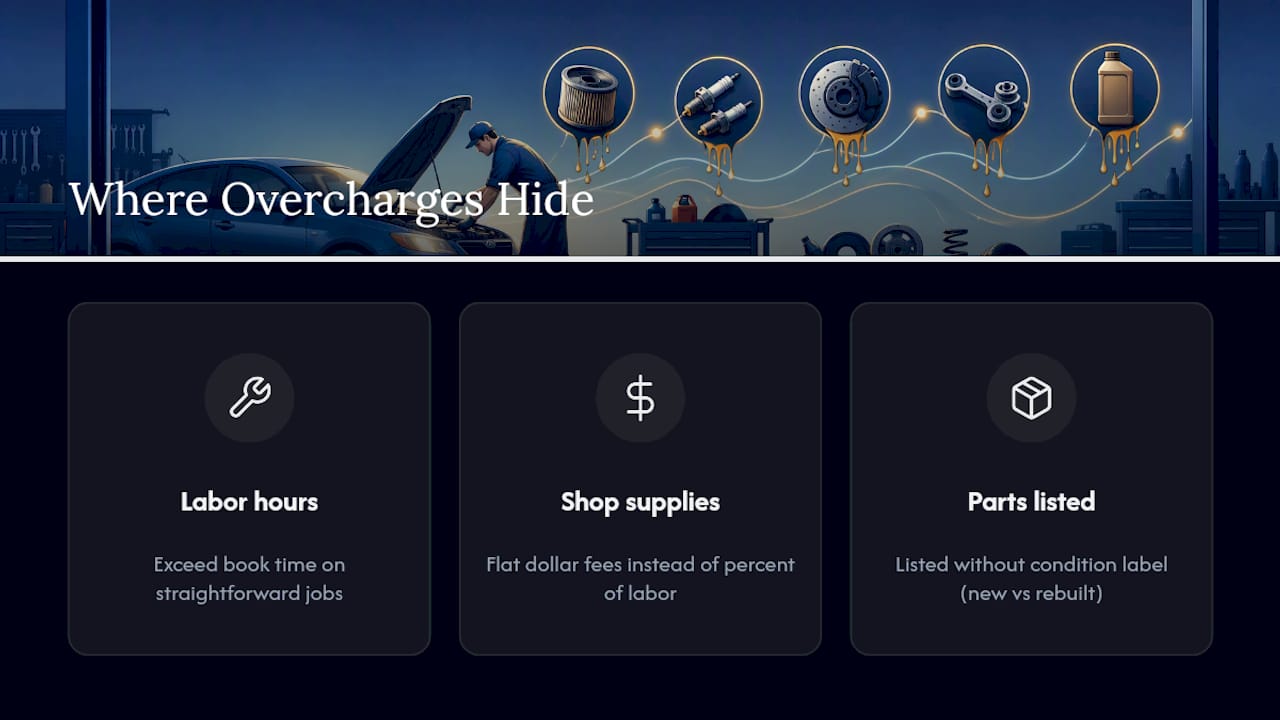
Most drivers focus on the total. The total is almost never where the problem hides. Overcharges tend to live in three places: labor hours that exceed book time for a straightforward job, shop supplies fees that are a flat dollar amount rather than a percentage of labor, and parts listed without a condition label (new vs. rebuilt matters a lot for a $400 alternator). Running the car repair invoice checklist line by line takes about five minutes at the counter. That five minutes has resolved disputes that would have taken weeks in small claims court.
The broader principle: ask first, get it in writing, and check at pickup. If something is wrong, stay calm, document everything, and use the paper trail you built. A dispute backed by a written estimate, a signed invoice, and a second mechanic’s report is a winnable case. A dispute backed by memory alone is not.
Onsite Los Angeles Mobile Mechanic: upfront pricing, no shop required
Skipping the shop entirely sidesteps a lot of the invoice friction this article covers. Onsite Los Angeles Mobile Mechanic comes to your home, office, or wherever your car is parked across the greater Los Angeles area, with pricing quoted upfront before any work begins. No towing, no waiting room, no surprise line items.
Services range from oil changes and battery replacements to brake repair, engine diagnostics, and AC service, with many jobs completed in under an hour. The quote you get is the price you pay. To book, call 213-583-4159 or visit the services page to see what’s available at your location.
Sources
Consumer protection resources:
- Auto Repair Basics | Consumer Advice
- Car repair tips (Texas Attorney General)
- Repair invoice (FDACS)
- Mechanic invoice: Secret tips auto shops rarely tell you (Invoxa)
Common invoice terms and abbreviations: