A lit check engine light means your car’s OBD-II system detected a fault and stored a Diagnostic Trouble Code. The rule is simple: flashing light, stop driving as soon as it’s safe; steady light, get a code read within a few days. Most causes are not emergencies, but none of them fix themselves.
Here’s what to do right now:
- Check your gauges first. Oil pressure or temperature in the red means pull over immediately.
- Tighten your gas cap. A loose cap is one of the most common triggers and costs nothing to fix.
- Note any symptoms: rough idle, hesitation, unusual smells, or loss of power.
- Get a code read. AutoZone offers free in-store scans; a basic OBD-II scanner runs $20–$50.
- If the light is flashing or the car feels wrong, stop driving and call for help.
Pro Tip: Take a photo of your dashboard the moment the light appears. The conditions at that exact moment, temperature, load, whether you just fueled up, are the first clues a technician will ask about.
Safety callout: A flashing check engine light is not a “check it later” situation. Consumer Reports confirms that a flashing light signals an active misfire capable of destroying your catalytic converter within miles. Pull over safely and arrange a tow or mobile mechanic.
Key Takeaways
A flashing check engine light is an immediate stop-driving signal; a steady light means get a code read within days, not weeks.
| Point | Details |
|---|---|
| Flashing vs. steady urgency | Flashing means active misfire, stop now; steady means schedule a scan within a few days. |
| First free step | Tighten the gas cap and check your gauges before spending anything; many steady lights clear in 1–3 drive cycles. |
| Code read options | AutoZone scans are free but limited; a $20–$50 OBD-II scanner or professional live-data diagnosis gives more. |
| Don’t clear codes early | Erasing codes before diagnosis removes freeze-frame data and resets readiness monitors, causing emissions test failures. |
| Onsite Los Angeles Mobile Mechanic | Provides on-site OBD-II diagnostics and common repairs across greater Los Angeles; book by calling 213-583-4159. |
Table of Contents
- What the check engine light actually is
- Steady vs. flashing: the urgency rule that matters most
- Most common causes and what each one means for you
- How to read OBD-II codes and get a real diagnosis
- Why the light is on but your car feels completely fine
- How to turn off the check engine light the right way
- When to call a professional and which option fits your situation
- What most drivers get wrong about the check engine light
- Get your check engine light diagnosed without leaving home
- Sources
What the check engine light actually is
The check engine light, formally called the Malfunction Indicator Lamp (MIL), is a dashboard warning tied directly to your vehicle’s onboard diagnostics system. Every car sold in the U.S. since 1996 runs OBD-II, a standardized system that monitors hundreds of sensors across the engine, transmission, and emissions systems. When a reading falls outside the expected range, the Engine Control Unit (ECU) logs a Diagnostic Trouble Code and switches on the MIL.
The signal flow works like this: sensors and actuators feed real-time data to the ECU, which compares readings against calibrated thresholds. Cross a threshold once and you may get a pending code, a fault the system has noticed but not yet confirmed. Cross it on a second drive cycle and it becomes a stored code, which is when the light turns on. Some faults trigger the light immediately on the first occurrence.
Two additional concepts matter for accurate diagnosis:
- Freeze-frame data: A snapshot of engine conditions (RPM, load, speed, fuel trim) captured at the exact moment the fault was detected.
- Live data: Real-time sensor readings a technician can watch while the engine runs, which reveals intermittent faults that a static code read misses.
- Readiness monitors: Self-tests the ECU runs on individual systems (O2 sensors, EVAP, catalytic converter). These must complete before an emissions test will pass.
Pro Tip: A code number alone is a starting point, not a diagnosis. P0420 (“catalyst efficiency below threshold”) could mean a bad catalytic converter, a failing O2 sensor, or an exhaust leak. Freeze-frame data and live readings are what separate a correct fix from an expensive guess.
Steady vs. flashing: the urgency rule that matters most
The single most important distinction with any warning light is whether it’s steady or flashing, and Steer’s breakdown puts it plainly: steady means schedule a scan soon; blinking means stop driving and get the vehicle inspected immediately.
Steady (solid) light: The ECU has stored a fault code, but the condition is not actively damaging the engine right now. You can usually drive short distances to a shop, but “a few more days” should not stretch into weeks.
Flashing (blinking) light: This is an intentional, urgent signal. HelpByExperts explains that a flashing light indicates an active misfire severe enough to push raw fuel into the catalytic converter, which can destroy it within miles of continued driving. The misfire threshold that triggers the flash is specifically calibrated to protect the converter.
Some vehicles also use color as an additional signal. A red engine light on certain makes (common on European brands) indicates immediate danger. On most U.S. vehicles, the light is amber or orange regardless of severity, so color alone is not a reliable urgency indicator. Always cross-reference with your other gauges.
If the light is flashing, do this:
- Reduce speed and engine load immediately.
- Avoid hard acceleration or towing anything.
- Pull over safely as soon as possible.
- Turn off the engine.
- Call a tow truck or a mobile mechanic for on-site diagnosis.
Limp-home mode is a separate but related situation. Some vehicles automatically restrict engine output when a serious fault is detected, limiting speed to roughly 30–40 mph. If your car suddenly feels sluggish and unresponsive, that’s likely limp mode. You can often drive slowly to the nearest shop, but pushing through it risks further damage.
Pro Tip: If the light starts flashing while you’re on the freeway, don’t panic-brake. Signal, move to the right lane, exit at the next off-ramp, and find a safe spot to stop. A controlled stop beats a breakdown in traffic.
A flashing CEL can turn a $50–$300 spark plug or coil replacement into a catalytic converter job that costs significantly more. The math on stopping immediately is obvious.
Most common causes and what each one means for you
Most check engine light events fall into a predictable set of causes. Here’s what they mean, how urgent each one is, and what a repair typically costs.
Loose gas cap is the most common low-urgency trigger. Tighten it until it clicks and drive normally. The light often clears after 1–3 drive cycles on its own.
O2 sensor failure is worth fixing promptly. A bad sensor skews the fuel mixture, hurts fuel economy, and, left alone long enough, can cause cascading damage to the catalytic converter that multiplies the repair bill.
Spark plugs and ignition coils are a medium-to-high urgency call because a misfiring cylinder is exactly what triggers a flashing light. Worn plugs are a reasonable DIY job on many engines; coil packs are slightly more involved but still within reach for a confident home mechanic.
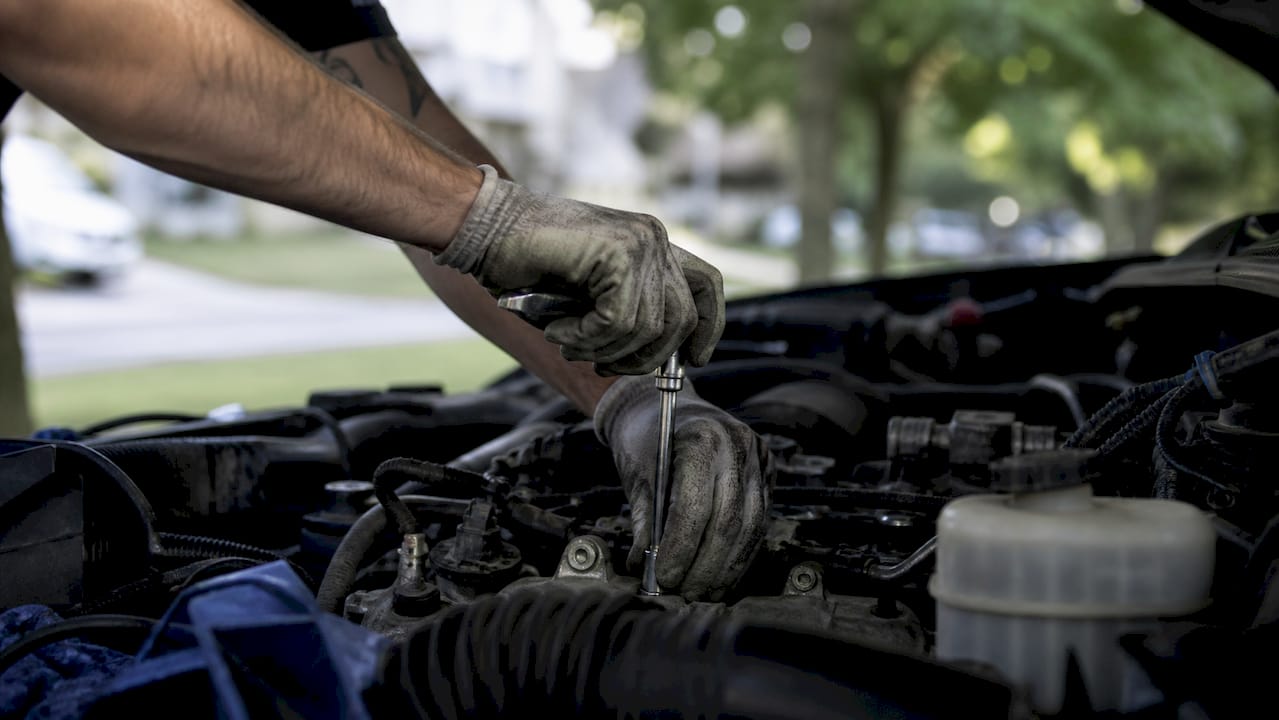
Catalytic converter codes almost always require professional diagnosis first. The code could point to the converter itself or to an upstream sensor feeding it bad data. Replacing a converter without confirming the root cause is an expensive mistake.
Pro Tip: Before spending anything on an EVAP code, check whether you recently filled up with the engine running or opened the gas cap with the engine on. Both can trigger an EVAP fault that clears on its own.
How to read OBD-II codes and get a real diagnosis
Getting the code is step one. Knowing what to do with it is step two.
Reading the code yourself
- Locate the OBD-II port. On virtually every U.S. vehicle, it’s under the dashboard on the driver’s side, within reach of the steering column.
- Plug in a scanner. A basic consumer unit costs $20–$50; Bluetooth dongles like BlueDriver or Innova pair with a smartphone app and offer more detail for $60–$120.
- Turn the ignition to “on” without starting the engine (or start it, depending on your scanner’s instructions).
- Read the codes. You’ll see P-codes (powertrain), B-codes (body), C-codes (chassis), or U-codes (network). Most check engine events are P-codes.
- Note the freeze-frame data if your scanner captures it. Write down the RPM, engine load, and coolant temperature at the time of the fault.
A basic OBD-II reader often pays for itself the first time you use it, especially if it helps you confirm a loose gas cap rather than paying for a shop visit.
Free scans at AutoZone
AutoZone’s free in-store code scan is a solid first step. The service is quick and costs nothing. The limitation is that free in-store scans may not capture pending codes or freeze-frame data, which are often the clues that point to the real fix. Bring a written note of your symptoms and when the light appeared to get more out of the conversation.
Professional diagnosis
A professional scan with live-data capture gives a technician the full picture: real-time sensor readings, fuel trim values, misfire counts per cylinder, and the ability to command actuators on and off. For anything beyond a gas cap or a single obvious code, professional diagnosis with live data is the difference between fixing the right part and guessing.
Pro Tip: Record your symptoms in a voice memo the moment the light appears. Note speed, load, weather, and whether you just fueled up. That 30-second recording can cut diagnostic time significantly.
- DIY scanner: best for simple, single-code faults (gas cap, O2 sensor, spark plugs)
- Free parts-store scan: good triage, limited depth
- Professional scan with live data: necessary for intermittent faults, misfires, EVAP, and transmission codes
Why the light is on but your car feels completely fine
This is the most common source of confusion. The car drives normally, nothing sounds wrong, but the light is on. Here’s why.
Pending codes haven’t crossed the threshold for a stored fault yet. The ECU noticed something off once but needs confirmation. The light may appear and disappear over a few drive cycles.
Intermittent sensor glitches are real faults that only occur under specific conditions, such as a cold start, high load, or after fueling. The car feels fine because the condition isn’t present right now.
EVAP leaks are the classic “no-feel” fault. A small leak in the evaporative emissions system doesn’t affect how the car drives at all. You’d never know without a code read.
Loose gas cap is the simplest version of this. The car runs perfectly; the light is just flagging an emissions-system integrity issue.
The risk of ignoring a no-feel fault is that small problems compound and can lead to costly repairs without proper clean engine bay safety and care to prevent further damage. An aging O2 sensor that costs a few hundred dollars to replace can, over months, damage the catalytic converter and turn a manageable repair into a major one. The light being on but the car feeling fine is not a reason to wait indefinitely.

On many vehicles, a stored code will self-clear after a set number of drive cycles if the fault doesn’t recur. But the readiness monitors reset too, which matters for emissions testing.
Pro Tip: Log the exact conditions when the light appeared: outside temperature, how long the engine had been running, whether you’d just filled the tank, and your speed. Intermittent faults that vanish before a shop appointment are much easier to reproduce with that information.
How to turn off the check engine light the right way
The light turns off when the fault is repaired and the ECU confirms the system is working correctly again. There are two ways to clear it faster: use a scanner to erase the code, or disconnect the battery. Both work. Neither is a good idea without fixing the underlying problem first.
What you lose when you clear codes:
- Freeze-frame data, the snapshot of conditions at the fault moment
- Pending codes that haven’t stored yet
- Readiness monitor completion status
Clearing codes resets all readiness monitors, which means your car needs several complete drive cycles before it’s ready for an emissions test. Show up to a smog check too soon after clearing codes and you’ll fail, not because the car is broken, but because the monitors haven’t finished running.
Do this after a confirmed repair:
- Clear the code with a scanner (or let the ECU clear it automatically after enough clean drive cycles).
- Drive normally for several days, covering a variety of conditions: highway, city, cold starts.
- Check readiness monitor status with your scanner before scheduling an emissions test.
- If the light returns, the repair didn’t address the root cause.
Don’t do this:
- Clear codes before a diagnosis to “see if it comes back.” You erase the freeze-frame clues a technician needs.
- Clear codes the day before an emissions test. You’ll likely fail the readiness check.
- Disconnect the battery as a shortcut. It works, but it also resets other learned settings (idle, transmission shift points) and loses all diagnostic history.
Pro Tip: If you’re buying a used car and the seller recently cleared the codes, the readiness monitors will show “incomplete.” That’s a red flag. A clean-running car with nothing to hide has completed monitors.
When to call a professional and which option fits your situation
Not every check engine situation needs the same response. Here’s how to match the problem to the right service level.
DIY with a scanner: Works well for single, obvious codes on accessible components. Spark plugs, a loose gas cap, a MAF sensor that needs cleaning, or a straightforward O2 sensor replacement are all reasonable DIY territory if you’re comfortable with basic tools.
Free parts-store scan (AutoZone): The right first move when you have no scanner and the car feels fine. Get the code, write it down, research it, and decide whether you need a technician.
Independent shop: Good for most general repairs. An ASE-certified technician with professional scan tools can handle the majority of check engine causes efficiently.
Dealership: Worth the premium for manufacturer-specific codes, software updates, or warranty-covered repairs. For a generic P0420 or a misfire code, an independent shop or mobile mechanic is usually faster and less expensive.
Mobile mechanic: The practical choice for urban drivers who can’t easily get to a shop, or when the car shouldn’t be driven. Mobile engine diagnostics bring professional scan tools and live-data capability to your location. Many common repairs, spark plugs, battery replacement, O2 sensors, brake work, can be completed on-site without a tow.
When to tow, not drive:
- The check engine light is flashing and the car is misfiring or shaking.
- Oil pressure or temperature gauges are in the red.
- You smell burning or see smoke.
- The car has entered limp mode and the nearest shop is more than a few miles away.
- Any combination of the above.
Pro Tip: For Los Angeles drivers, a mobile mechanic often beats a tow plus shop wait by hours. Many diagnostic and repair jobs that would take a full shop day can be done in your driveway or parking lot the same morning.
Onsite Los Angeles Mobile Mechanic handles on-site diagnostics and common repairs across the greater Los Angeles area, with phone booking and upfront pricing. Call 213-583-4159 to schedule.
What most drivers get wrong about the check engine light
The most common mistake isn’t ignoring the light entirely. It’s the half-measure: clearing the code without fixing the problem, or waiting weeks because the car “still drives fine.”
A code cleared without a repair is just a timer reset. The fault returns, usually faster the second time, and now the freeze-frame data that would have pointed to the root cause is gone. Technicians see this regularly: a car comes in with a recurring code and no history, and the diagnosis takes longer because the clues were erased.
The second mistake is treating a code as a parts list. P0420 does not mean “replace the catalytic converter.” It means the catalyst efficiency monitor failed a self-test. The actual cause could be an upstream O2 sensor, an exhaust leak, or contaminated fuel. Replacing the converter without confirming the root cause is a common and expensive error, one that ASE-certified technicians specifically warn against when recommending professional live-data diagnosis over a code-only read.
Mobile diagnostics change the math on this. When a technician comes to your location with professional scan tools, captures live data, and can inspect the vehicle in person, the diagnosis is faster and more accurate than a parts-store code read followed by a parts-store parts purchase. The role of mobile diagnostic tools is precisely this: getting the right answer before spending money on the wrong part.
Get your check engine light diagnosed without leaving home
When the check engine light comes on and you’re in the greater Los Angeles area, Onsite Los Angeles Mobile Mechanic brings professional OBD-II diagnostics directly to your driveway, parking lot, or office. No tow, no waiting room. A technician arrives with professional scan tools, reads live data, and gives you a clear explanation of what’s wrong and what it costs to fix, before any work begins.
Common on-site repairs include engine diagnostics, battery replacement, spark plug replacement, O2 sensor replacement, brake service, and oil changes. Many of these are completed within an hour. Pricing is upfront with no hidden fees.
To book, call 213-583-4159. You can also review the full list of mobile repair services and auto repair pricing before you call.
Sources
- What Does the Check Engine Light Look Like, and What Does It Mean?
- Check engine light
- Check Engine Light Flashing vs Solid: What Each Means (and When to Stop Driving)
- Check Engine Light Blinking vs Steady: What to Do for Each – Steer