A burning oil smell almost always means oil is dripping onto a hot exhaust part, though it can also mean oil is burning inside the engine itself. Check your dipstick and dashboard lights immediately. If you see blue smoke, an oil pressure warning, or a fast-dropping oil level, stop driving and get the car inspected before you go any farther.
TL;DR:
- Most burning oil smells are caused by oil leaking onto hot engine parts, not internal oil combustion, and external leaks are cheaper to repair.
- Checking for fresh oil drips, low dipstick readings, and the smell location helps identify the leak source before it worsens.
- Serious signs like blue exhaust smoke, rising oil levels, or warning lights require immediate stopping and professional inspection to prevent engine damage or fire risks.
- External leak repairs can cost under $500, while internal engine work, such as replacing piston rings, may exceed $1,500, making early detection crucial.
- Regular maintenance, prompt leak repairs, and avoiding overfilling oil can prevent most causes of burning oil smells and reduce repair costs.
Table of Contents
- Burning Oil Smell Checklist: What to Check Right Now
- What Causes an Engine to Smell Like Burning Oil
- How to Diagnose the Smell Yourself
- When a Burning Oil Smell Means Stop Driving Now
- What Repairs Cost for Common Burning Oil Problems
- Preventing a Burning Oil Smell Before It Starts
- How a Mechanic Actually Tracks Down the Smell
- What Most Guides Get Wrong About This Smell
- Get an On-Location Inspection for a Burning Oil Smell
- Sources
- FAQ
Burning Oil Smell Checklist: What to Check Right Now
Run through these checks in order before you decide whether to keep driving.
- Check the dipstick. Look for a low reading and note whether any warning lights are on.
- Park on clean, dry pavement. Fresh drips show up clearly, and the color tells you a lot: amber to black usually means oil.
- Map the smell. Is it strongest near the exhaust under the hood, coming through the cabin vents, or both? Cabin-vent odor often traces back to where the intake pulls air, which can carry even a small leak straight into the car.
- Watch for smoke or fast fluid loss. Blue exhaust smoke, smoke from under the hood, or overheating means it’s time to stop and call for a tow.
Pro Tip: A burning oil smell with no puddle underneath doesn’t mean there’s no leak. Small leaks often vaporize on contact with a hot manifold before they ever reach the ground.
What Causes an Engine to Smell Like Burning Oil
Most burning oil odors trace back to oil leaking onto a hot surface rather than oil burning inside the engine. External leaks are the most common cause overall, and they tend to be the cheaper problem to fix.
- Valve cover gasket: A worn gasket seeps oil down the side of the engine block, often landing on the exhaust manifold below.
- Oil filter or filter housing: A loose filter, damaged seal, or cracked housing lets oil drip onto nearby hot components.
- Oil pan or drain plug: A stripped plug or a pan seam that’s given out drips oil low on the engine, sometimes onto the exhaust pipe.
- Spilled oil from a recent service: Oil poured on the block or dripped near the exhaust during a fill usually burns off over a few drive cycles.
- An overfilled crankcase: Too much oil gets churned up and flung onto hot parts, especially at highway speed.
- A failing PCV valve: A stuck or clogged valve lets oil vapor build up and push its way toward the intake and exhaust.
Internal oil burning is less common but more serious. Worn piston rings, bad valve stem seals, or a failing turbocharger seal let oil slip into the combustion chamber, and blue exhaust smoke is the clearest sign that’s happening. External leaks usually smell strongest in the engine bay or through the vents; internal burning shows up as smoke at the tailpipe, sometimes paired with rising oil consumption between changes.
How to Diagnose the Smell Yourself
Work carefully, and never pop the hood if you smell something acrid or see smoke pouring out. If in doubt, back away from the car.
- Park and look underneath. Fresh drips on clean pavement point you toward a location, and the fluid color rules coolant and power steering fluid in or out.
- Pull the dipstick. A level that’s noticeably low suggests either an active external leak or oil being consumed internally. Compare it against your last fill.
- Start the engine briefly and pay attention. Sniff near the vents, watch the tailpipe for any blue tint, and shine a flashlight around the valve cover and filter area for wet spots.
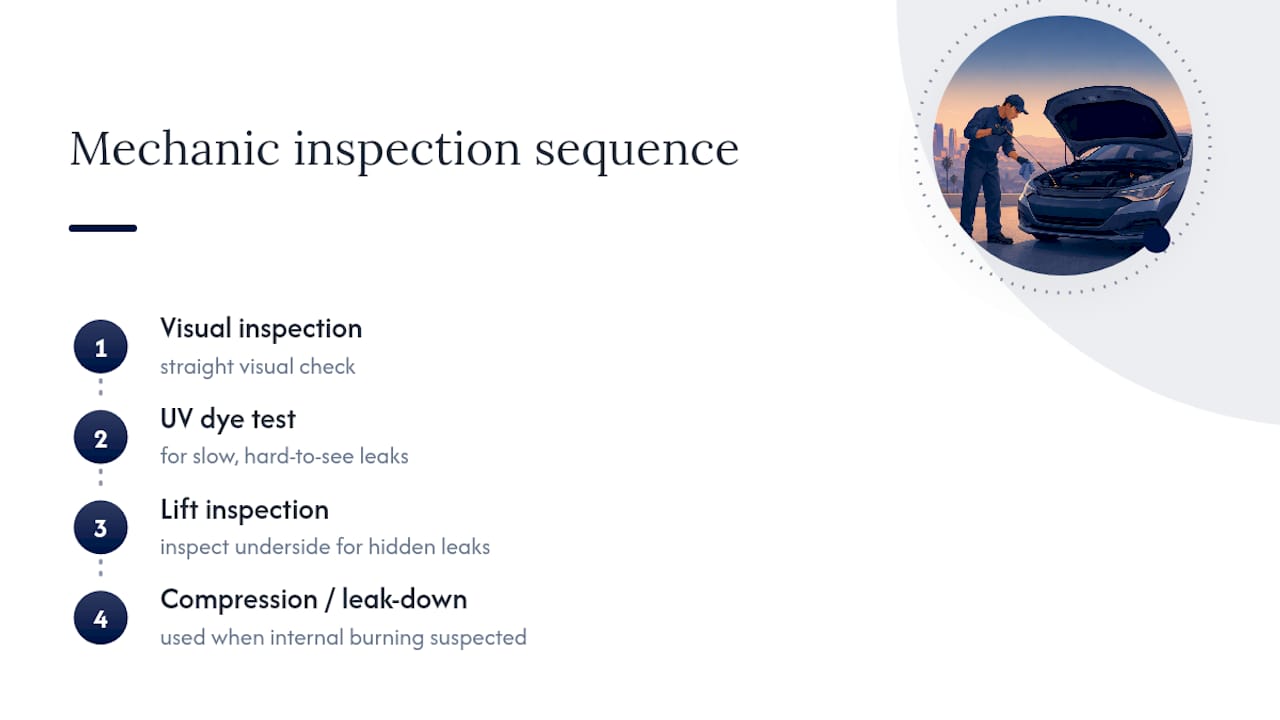
- Bring in a mechanic when the source stays hidden. A shop can add UV dye to trace a slow leak, put the car on a lift for a full undercarriage look, or run a compression or leak-down test if internal burning is suspected.
Pro Tip: Note whether the smell peaks right after you shut the engine off or stays constant while driving. A smell that spikes after shutdown usually points to an external leak vaporizing on a hot part, while a constant smell in the cabin points more toward intake-side contamination or internal burning.
When a Burning Oil Smell Means Stop Driving Now
Some signs mean the car needs to stop moving, not just get looked at soon.
- Blue smoke coming from the tailpipe.
- Smoke or haze rising from under the hood.
- An oil pressure warning light or a temperature gauge climbing toward the red.
- Oil level dropping fast between checks, or visible dripping onto a hot exhaust pipe.
- Any flame, glowing metal, or a sharp acrid smell. Get away from the vehicle and call emergency services if you see this.
If none of those apply but the smell is still strong and persistent, skip long trips and get the car checked soon. Oil that reaches a catalytic converter or manifold carries a real fire risk, and catching the source early almost always costs less than waiting. If a low oil pressure light shows up alongside the smell, it’s worth verifying the reading with a gauge rather than guessing.
What Repairs Cost for Common Burning Oil Problems
Cost depends almost entirely on whether the source is an external leak or internal wear.
- Cheap fixes: Tightening or replacing a drain plug, swapping a loose or damaged oil filter, or just cleaning up spilled oil from a recent service. These jobs run low, often under $100 in parts and labor.
- Mid-range repairs: A valve cover gasket, an oil filter housing seal, or a PCV valve replacement typically lands between $100 and $500, depending on labor time and how buried the part is in your particular engine.
- Higher-cost repairs: An oil pan gasket or rear main seal job takes more labor to access. Internal fixes for worn piston rings or a failing turbo seal are a different category entirely; these engine-level repairs can run from roughly $1,500 to $3,000 or more depending on the vehicle, and sometimes the repair cost starts competing with the value of the car.
- Diagnostic time: When the leak source isn’t obvious from a quick look, the labor to actually find it, not the part itself, often ends up being the biggest line item on the invoice.
Preventing a Burning Oil Smell Before It Starts
Most of the causes above are avoidable with a handful of habits.
- Fill to the correct level every time and double check the dipstick after a top off; overfilling causes its own problems.
- Wipe down any spilled oil immediately after a service instead of letting it bake onto the exhaust.
- Replace the PCV valve and its hoses on the schedule your maintenance interval calls for, since a clogged valve pushes oil where it doesn’t belong.
- Have the valve cover, filter area, and undercarriage checked during every oil change, not just when something already smells wrong.
- Deal with small leaks as soon as you spot them. A drip that’s cheap to fix today can turn into a bigger repair, and a bigger bill, in a few months.
How a Mechanic Actually Tracks Down the Smell
A shop typically starts with a straight visual check, then moves to UV dye for leaks too slow to see with the naked eye, a lift inspection for anything hidden underneath, and a compression or leak-down test only when internal burning is on the table. External leaks stay cheap if you catch them early; left alone, they tend to worsen with heat cycles and vibration. One detail owners miss: cabin air intake placement means even a minor leak can fill the vents with odor long before it’s serious. A mobile mechanic can run these oil checks, clean up minor spills, and handle many common leak repairs right where your car is parked. Call to schedule one.
What Most Guides Get Wrong About This Smell
Most advice online treats a burning oil smell as either “nothing” or “replace your engine,” and both extremes miss the point. The honest reality sits in the middle: the majority of these smells trace back to a leak that’s cheap to fix if you catch it early, and expensive only if you ignore it for months while it drips onto the same hot spot over and over.

The bigger mistake I see is people either panicking and towing the car for a smell that clears up after a service, or ignoring blue smoke because the car “still runs fine.” Blue smoke at the tailpipe is not a wait-and-see symptom. Everything else, a smell in the engine bay with no smoke, no warning lights, and a steady oil level, usually buys you a few days to get it checked properly instead of guessing at parts.
If you take one thing from this: don’t skip the dipstick check. It’s the fastest way to tell a cosmetic spill apart from a real problem, and it takes thirty seconds.
— Aaron
Get an On-Location Inspection for a Burning Oil Smell
A mobile mechanic service skips the tow truck and the waiting room by coming to your driveway, your office lot, or wherever the car is parked to check the oil level, trace the smell to its source, and quote the fix upfront before any work starts.

For a burning oil smell specifically, that means an on-location oil check, PCV valve service, valve cover gasket repair, or a spill cleanup, all handled without you driving anywhere while the smell keeps getting worse. Every job comes with transparent upfront pricing, so there’s no surprise labor charge once the mechanic pops the hood. Browse the full list of mobile repair and diagnostic services to see what’s covered, then call to book. When you call, mention exactly when the smell shows up (right after shutdown, while driving, or through the vents) and whether you’ve seen any smoke. That detail alone speeds up the diagnosis before the mechanic ever arrives.
Sources
The diagnostic steps and cost ranges above draw from a handful of practical automotive references. Motor Triage’s breakdown of burning oil causes, The Motor Guy’s repair-cost guide, Car Reformer’s engine bay smell analysis, and The Daily Automotive’s oil-smell comparison. Readers dealing with lingering cabin odors after a leak is fixed may also find Diamond Brite’s guide to removing car odor useful for the cleanup side.
- Burning Oil Smell: Causes, Symptoms & How to Fix It
- Car smells like burning oil: causes, fixes, and costs | The Motor Guy
- Burning smell from engine bay after driving: causes & fixes
- What does car oil smell like? Normal vs. burning oil smells
FAQ
What Does It Mean When You Smell Burnt Oil?
It usually means engine oil has landed on a hot surface, most often the exhaust manifold or turbocharger, and is vaporizing on contact. External leaks account for most cases, though a persistent smell paired with blue exhaust smoke can mean oil is burning inside the engine.
Can I Still Drive My Car If It Smells Like Burning Oil?
If there’s no smoke, no warning lights, and the oil level is holding steady, a short drive to get it checked is usually fine. Stop immediately if you see blue smoke, an oil pressure light, or the oil level dropping fast between checks.
How Do You Fix a Burning Oil Smell?
The fix depends entirely on the source: a loose filter or drain plug is a quick, cheap repair, while a valve cover gasket or PCV valve replacement typically falls in the $100 to $500 range. Internal issues like worn piston rings can cost $1,500 to $3,000 or more since they involve deeper engine work. A mobile mechanic service can inspect and handle most external leak repairs at your location; current pricing is available when you call.
Is a Burning Oil Smell Bad for You to Breathe?
Breathing oil fumes for short periods with a window cracked isn’t typically an emergency, but it’s not something to make a habit of on a long drive. Beyond the health nuisance, oil reaching a catalytic converter or manifold carries a real fire risk, which is the bigger reason to get it checked quickly rather than just cracking a window and ignoring it.