A rhythmic pulsing in the brake pedal that gets stronger with speed and disappears when you let off is the clearest sign of what most drivers call warped rotors. If you feel it through the steering wheel, the problem is up front. If it shows up in the seat or floor, it’s the rear. Either way, drive gently to a shop soon, and stop driving immediately if the shaking is severe or paired with grinding.
TL;DR:
- Warped rotors are caused mainly by disc thickness variation or pad material transfer, not actual bending, often detectable with as little as 0.002 inches of variation.
- Symptoms include pulsation only during braking, with front-end vibrations indicating front rotors and seat or floor shudders pointing to rear rotors.
- Proper diagnosis involves checking runout, rotor thickness, and lug torque, with safety warnings requiring immediate stopping if pulsation is severe or accompanied by grinding.
- Resurfacing is often ineffective on modern thin rotors, making replacement the preferred fix, especially if thickness is below minimum or hot spots are visible.
- Regular maintenance, correct installation, and avoiding hard stops prolong rotor life and prevent early warping, with mobile mechanics able to diagnose and repair most issues onsite.
Table of Contents
- Warped Rotors Symptoms: What You’ll Feel and Hear
- What Actually Causes That “Warped” Feeling
- How to Diagnose Warped Rotors Before You Pay for Repairs
- Fixing It: Resurface, Replace, or Just Clean Up the System
- Keeping New Rotors From Warping Again
- What a Mobile Mechanic Actually Checks on Your Driveway
- Get Your Brakes Checked Where You Park
- Sources
- FAQ
Warped Rotors Symptoms: What You’ll Feel and Hear
The giveaway is a pulsation that only happens when you press the brake pedal and gets more intense as your speed increases before a stop. Take your foot off the brake and the shudder vanishes. That on/off pattern is what separates rotor trouble from a suspension problem, which tends to vibrate regardless of braking.
Where you feel it tells you which end of the car needs attention. A shaking steering wheel almost always points to the front rotors, while a pulse felt through the seat, floor, or chassis usually means the rear rotors are the problem, according to AutoZone.
Sound matters too. A rhythmic groan or thump that rises and falls with wheel speed often lines up with the same rotor issue causing the pulsation. A steady grinding noise is different and more urgent. It usually means the pads have worn through and metal is contacting metal.
Watch for these secondary clues as well:
- Stopping distances that feel noticeably longer than normal
- Bluish or discolored patches on the rotor face, visible through the wheel spokes
- One front tire’s brake dust pattern looking heavier than the other, suggesting uneven pad wear
- A faint burning smell after repeated hard stops in traffic
Quick fact: according to NRS Brakes, pedal pulsation can show up with as little as 0.002 inches of rotor thickness variation. That’s roughly a third the thickness of a sheet of paper, and it’s enough for your foot to notice on every stop.
What Actually Causes That “Warped” Feeling
Here’s something that surprises most drivers: a rotor that’s physically bent or warped from heat is fairly rare. What you’re feeling is almost always disc thickness variation, known in the trade as DTV, or lateral runout. Thin and thick spots rotate through the caliper thousands of times a mile, and each thick spot shoves the pad back slightly, which you feel as a pulse.
Pad material transfer is the other major culprit. When brakes get hot enough, pad compound can bake onto the rotor surface in an uneven ring. That imprinted pad material acts just like a thickness variation, even though the rotor’s actual metal was never bent, a pattern confirmed by 1A Auto’s diagnostic breakdown.
A few other conditions mimic true warping:
- A caliper piston or slide pin that’s sticking, dragging one pad against the rotor even when you’re not braking
- Uneven lug-nut torque, which pulls the rotor slightly off-center against the hub
- Debris or rust between the rotor and hub face, creating runout before the car even moves
Pro Tip: If your brakes pulsate right after a tire rotation or new tire install, check lug-nut torque before assuming the rotors are bad. An impact gun run too hot can warp the rotor’s mounting surface in seconds.
Mechanics increasingly treat brake trouble as a system issue rather than a single bad part, since a seized caliper pin or dirty hub can undo a brand-new rotor within a few hundred miles, per AutoZone’s technical guidance.
How to Diagnose Warped Rotors Before You Pay for Repairs
Start with what you can check in your driveway, then know what a technician measures to confirm the diagnosis.
- Note exactly when it happens. Vibration only under braking points to the rotors or pads. Vibration all the time points to tires, wheel balance, or suspension.
- Identify which controls shake. Steering wheel means front rotors. Seat or floor means rear rotors.
- Look through the wheel spokes. Scoring, blue discoloration, or an obviously grooved surface are visible red flags.
- Check the lug-nut torque pattern. Loose or unevenly torqued lugs are a common, cheap-to-fix cause of runout.
A technician takes it further with tools a driveway inspection can’t replace. A dial indicator measures lateral runout, and a micrometer checks rotor thickness at several points around the disc. Most manufacturers set acceptable runout somewhere in the 0.002 to 0.003 inch range, and every rotor has a minimum thickness stamped into its edge.
The decision rule is simple once those numbers are in hand. Pulsation with runout above spec means the rotor needs to be resurfaced or replaced. Pulsation with runout inside spec usually points to pad transfer or a dragging caliper instead, exactly the distinction 1A Auto uses to separate a rotor problem from a pad problem.
Safety comes down to severity. A light shudder only at highway speeds can often wait for a scheduled service appointment. Strong pulsation at any speed, or any grinding, means stop driving and get the car looked at right away, based on the safety triage Direct Brakes lays out for drivers in exactly this situation. If your dashboard brake light is also on, run through a quick safety check before you get back on the road.
Fixing It: Resurface, Replace, or Just Clean Up the System
Machining, or resurfacing, used to be the default fix, and it’s still fine when a rotor has plenty of thickness left above the minimum stamped on its edge. The catch is that most modern rotors are made thinner than older designs to save weight, so there’s often not enough material left to machine safely without dropping below spec.
That’s why many shops now default to replacement, and it’s worth doing both rotors on an axle at once, even if only one side is showing symptoms. Mismatched thickness or runout side to side changes how each wheel grabs, which can pull the car during hard stops, a balance issue Direct Brakes flags as a real safety concern, not just a comfort one.
A few situations call for immediate replacement rather than a wait-and-see approach:
- Rotor thickness already at or below the stamped minimum
- Visible hot spots or discoloration from severe overheating
- Deep grooves or scoring you can feel with a fingernail
One more thing worth knowing before you pay for a repair: swapping in new brake pads alone rarely fixes pulsation if the rotor surface or thickness problem is still there, since fresh pads riding over the same uneven surface will just start the same cycle again, according to AutoZone.
Keeping New Rotors From Warping Again
New rotors that start pulsating again within a few thousand miles almost always trace back to installation shortcuts, not bad luck. A clean hub face and correctly torqued lug nuts in a star pattern prevent the runout that dirty mating surfaces cause. Even a thin layer of rust or debris on the hub can throw off a brand new rotor.
Caliper slide pins deserve attention too. A sticking pin drags one pad unevenly and bakes material onto the rotor in weeks, undoing the repair you just paid for.
- Bed in new pads gradually with a series of moderate stops, not repeated hard braking from highway speed
- Avoid stacking hard stops back to back when rotors are already hot, like in stop-and-go traffic on a hot day
- Replace rotors before thickness gets close to the stamped minimum instead of waiting for symptoms
Pro Tip: Brake dust that’s baked onto the wheel face can hint at how hot your brakes are running. Removing it with a short dwell time protects the wheel finish and gives you a cleaner look at rotor condition next time you check.
What a Mobile Mechanic Actually Checks on Your Driveway
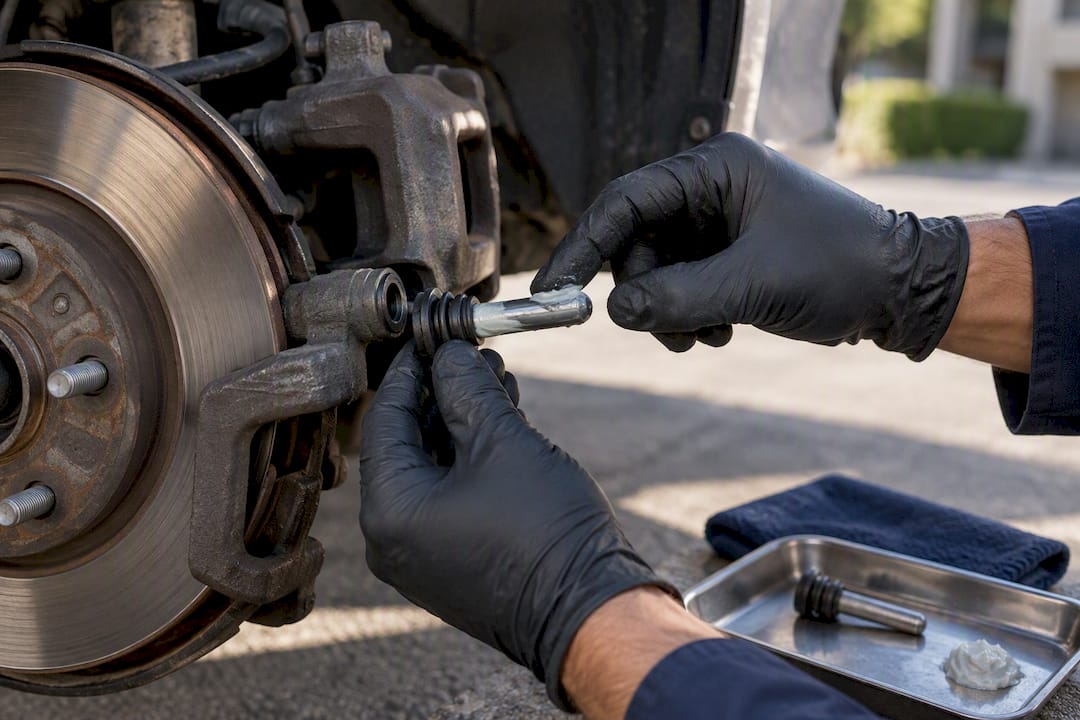
When we roll up to diagnose a pulsating pedal, the first things we look at are the ones drivers can’t easily see themselves: a visual pass on rotor surface condition, lug-torque verification, caliper slide pin lubrication, and a preliminary runout check.
A lot of the fix can happen right there. Caliper service, pad replacement, and hub cleanup are all onsite jobs. Full rotor replacement or precision machining is the exception; that typically needs shop equipment we don’t carry in a service van. Either way, transparent upfront pricing means you know the number before we start, and same-day availability means you’re not losing a whole day to a brake problem.
Get Your Brakes Checked Where You Park
Onsite Los Angeles Mobile Mechanic is the alternative to sitting in a shop waiting room for a brake diagnosis: we come to your driveway, your office lot, or wherever your car is parked in the greater Los Angeles area, and diagnose the pulsation on the spot. Caliper service, pad replacement, and hub cleanup happen right where you’re parked, with an upfront quote before any work starts and no hidden fees added later.
Appointments are available seven days a week, which matters when a shaking pedal isn’t something you want to put off. Mechanics handle the diagnostic, explain whether the issue is a pad, a caliper, or a rotor needing shop-level work, and quote the job before starting any work. Call to book a mobile brake repair appointment, or check the full list of mobile mechanic services if your car’s giving you more than one warning sign.
Sources
- Signs of a Warped Brake Rotor — AutoZone
- Steering wheel shakes when braking — 1A Auto blog
- Diagnosing warped rotors: symptoms and repair options — NRS Brakes
- Warped rotors: Can you drive safely? — Direct Brakes
FAQ
What Does Driving With Warped Rotors Feel Like?
It feels like a rhythmic pulsing in the brake pedal that intensifies as your speed drops toward a stop, often paired with a shudder in the steering wheel or seat. The vibration disappears the moment you release the brake, which distinguishes it from a tire or suspension problem.
What Happens if You Keep Driving With Warped Rotors?
Stopping distance gets longer as the uneven surface reduces consistent contact between pad and rotor, and the vibration typically worsens over time. Direct Brakes notes that violent shaking or grinding means you should stop driving immediately rather than continuing to a scheduled appointment.
How Long Should Rotors Last Before Warping?
There’s no fixed mileage for rotors, since it depends heavily on driving habits, pad quality, and how often the brakes get hot. Frequent hard stops, towing, or mountain driving accelerate the thickness variation that causes pulsation, while gentle city driving on quality rotors and pads can go tens of thousands of miles without issue.
How Do I Fix Warped Rotors?
Most cases require professional resurfacing or replacement of the affected rotors, plus new pads, since swapping pads alone rarely stops the pulsation, per AutoZone. A technician confirms the fix with a runout measurement, and it’s best practice to replace both rotors on the same axle for even braking.
Can a Mobile Mechanic Diagnose Warped Rotors?
Yes. Onsite Los Angeles Mobile Mechanic can run a visual inspection, check lug torque, service caliper slide pins, and take a preliminary runout check right at your location. Full rotor replacement or machining beyond that point typically needs shop equipment, but many of the underlying causes get fixed on the spot.