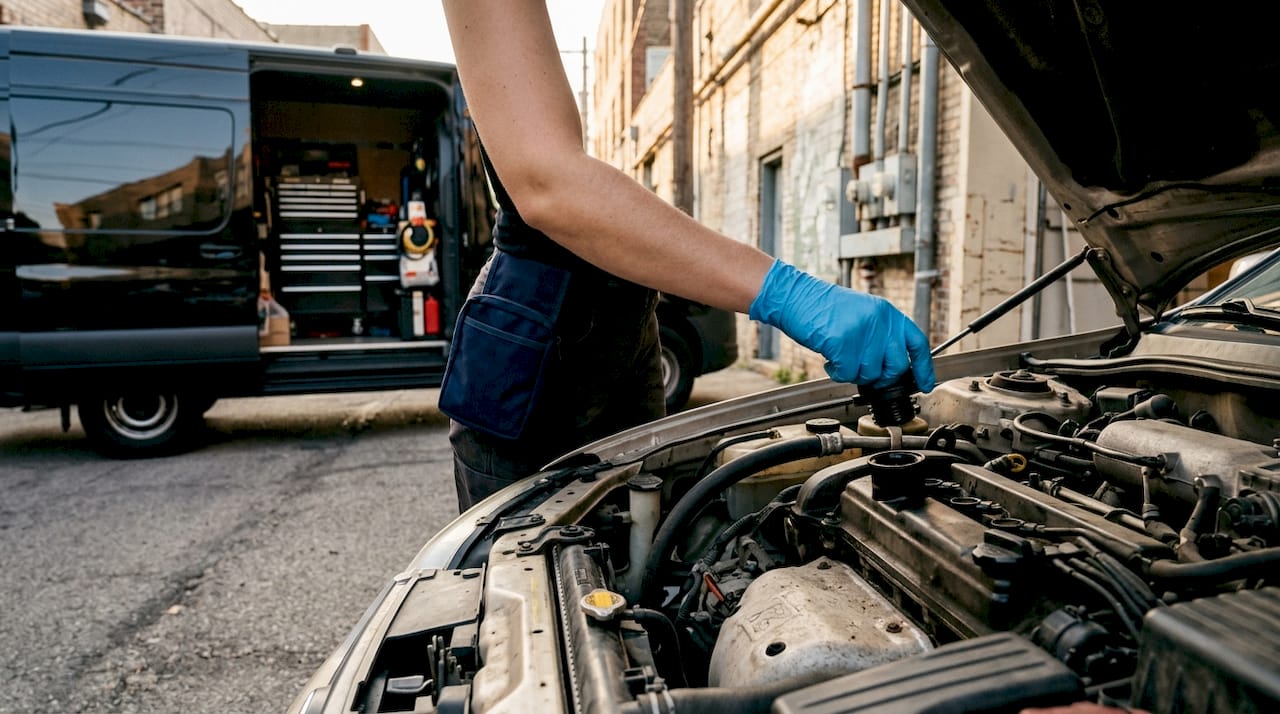
Curbside vehicle repair is a mobile auto service where certified technicians travel to your location and perform maintenance or repairs directly at your vehicle, with no shop visit required. The industry term for this model is mobile auto repair, and the two phrases describe the same service. A technician arrives equipped with tools, diagnostic equipment, and parts to handle your specific issue on the spot. Onsite Los Angeles Mobile Mechanic delivers this service across the greater Los Angeles area, offering upfront pricing and no hidden fees. For car owners who cannot afford hours at a traditional shop, this model changes the math entirely.
What is curbside vehicle repair and what services does it cover?
Mobile auto repair covers a wider range of services than most car owners expect. Routine maintenance makes up the bulk of curbside work, and many of these jobs finish in roughly one hour.
Common services performed on-site include:
- Oil and filter changes with manufacturer-recommended fluids
- Battery testing and replacement, including terminal cleaning
- Brake pad and rotor inspection, plus pad replacement on most vehicles
- Air filter replacement for both engine and cabin filters
- Spark plug replacement on accessible engine configurations
- Serpentine belt replacement on standard layouts
- Coolant flush and top-off
- Diagnostic scans using OBD-II readers to pull fault codes
Routine services like battery replacements and oil changes can be completed in approximately one hour, which cuts the downtime that traditional shop visits typically demand. That time savings matters most to drivers who cannot leave a vehicle at a shop for half a day.
Mobile repair does have firm limits. Major mechanical failures such as extensive engine work, transmission rebuilds, and suspension repairs requiring heavy lift equipment must be handled in a shop. The same applies to fluid leaks that require the vehicle to be raised safely for extended periods. A curbside technician carries portable tools, not a full shop floor.
Pro Tip: Ask the technician upfront whether your repair falls within mobile scope. A good technician will tell you honestly if a shop visit is the safer option, rather than attempting a repair that requires equipment they do not have on the truck.
How does curbside repair differ from roadside assistance?
Car owners frequently confuse mobile auto repair with roadside assistance. The distinction matters because choosing the wrong service wastes time and money.
Roadside assistance is a temporary fix. Its goal is to get your vehicle moving again so you can reach a shop or your destination. Mobile auto repair is a permanent solution performed at your location. Here is how the two services compare across common situations:
- Dead battery. Roadside assistance jump-starts the vehicle. Mobile repair tests the battery, identifies whether it is the battery or the alternator causing the failure, and replaces the faulty component on the spot.
- Flat tire. Roadside assistance installs your spare. Mobile repair can mount and balance a new tire if the technician carries the right equipment, or diagnose a slow leak and plug it.
- Check engine light. Roadside assistance cannot address this. Mobile repair runs a full diagnostic scan, reads fault codes, and in many cases completes the repair during the same visit.
- Overheating engine. Roadside assistance adds coolant and sends you on your way. Mobile repair identifies the source, whether it is a failed thermostat, a cracked hose, or a coolant leak, and fixes the root cause.
- Brake noise. Roadside assistance does not cover mechanical inspections. Mobile repair measures pad thickness, inspects rotors, and replaces worn components before the problem becomes a safety issue.
Mobile repair moves from temporary relief to actual problem-solving by diagnosing and repairing issues at the vehicle’s location. Roadside assistance is a bridge to get you somewhere. Mobile repair is the destination.
What are the advantages and practical considerations of on-site auto repair?
The core advantage of on-site auto repair is time. You do not drive to a shop, wait for a service writer, leave your car, arrange a ride, and return hours later. The technician comes to your home, office, or parking lot.
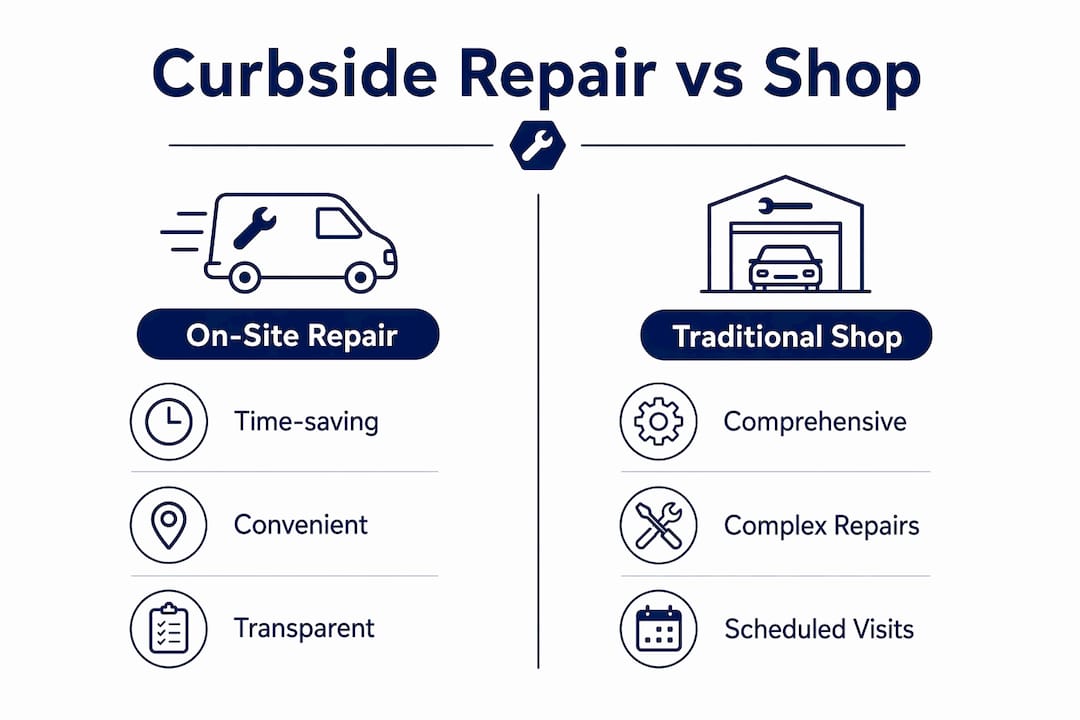
A less obvious benefit is transparency. Direct technician interaction empowers car owners to make better-informed decisions about their vehicle’s health. When a technician works on your car in front of you, you can ask questions, see the worn part being removed, and understand exactly what was done. That kind of visibility is rare in a traditional shop environment.
Practical considerations to check before booking:
- Parking access. The technician needs enough space to open the hood and move around the vehicle safely.
- Location rules. Apartment parking rules or HOA policies may prohibit on-site repairs. Confirm with your building management before scheduling.
- Ground conditions. Soft ground, steep inclines, or gravel surfaces can limit what a technician can safely perform.
- Weather. Heavy rain or extreme heat affects both the technician’s safety and the quality of certain repairs.
| Situation | Mobile repair works well | Shop visit makes more sense |
|---|---|---|
| Oil change or battery swap | Yes | No |
| Brake pad replacement | Yes, on most vehicles | If rotors need turning |
| Engine or transmission rebuild | No | Yes |
| Diagnostic scan | Yes | If specialized equipment is needed |
| Suspension overhaul | No | Yes |
For fleet operators, mobile fleet maintenance programs that include quarterly brake, tire, and fluid inspections with documentation show how well the on-site model scales beyond individual car owners.
Pro Tip: Before your appointment, clear the area around your vehicle and make sure the hood release works from inside the cabin. Small preparations like these prevent delays and help the technician start work immediately.
How to schedule and prepare for a curbside repair appointment
Booking a curbside repair appointment is straightforward. Scheduling and quick service are priorities that minimize your downtime, so the process is designed to be fast from the first call.
Follow these steps to get the most from your appointment:
- Describe your symptoms clearly. Note when the problem started, any warning lights on the dashboard, unusual sounds, and whether the issue is constant or intermittent. The more detail you provide, the better the technician can prepare.
- Call to book. Onsite Los Angeles Mobile Mechanic takes bookings by phone. A representative will ask about your vehicle’s year, make, model, and the symptoms you described, then confirm availability and provide an upfront quote.
- Confirm your location. Give a specific address and note any access restrictions such as gated parking or building rules. Check with your HOA or building management if you are unsure whether on-site repairs are permitted.
- Prepare the vehicle. Park in a flat, accessible spot with enough room on all sides. Have your vehicle registration and any recent repair records available in case the technician needs them.
- Be present during the repair. You do not need to stand over the technician, but being available to answer questions speeds up the process and gives you the chance to see the work firsthand.
A typical appointment for a routine service runs 45 minutes to 90 minutes. More complex diagnostics or multi-part repairs may take longer. The technician arrives with the parts most likely needed based on your symptom description, which reduces the chance of a second visit. Initial mobile diagnostics can also determine whether a follow-up shop repair is needed for complex problems, so you leave the appointment with a clear picture of next steps.
Key Takeaways
Curbside vehicle repair is the most time-efficient option for routine maintenance and common repairs, provided the location is accessible and the job falls within mobile scope.
| Point | Details |
|---|---|
| Definition | Mobile auto repair sends certified technicians to your location to perform permanent repairs on-site. |
| Service scope | Routine jobs like oil changes, battery swaps, and brake pads are well-suited; major engine or transmission work requires a shop. |
| Not roadside assistance | Mobile repair fixes the root cause; roadside assistance only gets the vehicle moving temporarily. |
| Practical limits | HOA rules, weather, and ground conditions can affect whether on-site repair is feasible at your location. |
| Booking process | Call with a clear symptom description, confirm your address, and be present during the appointment for best results. |
Why mobile repair earns more trust than most car owners expect
The part of mobile auto repair that surprises people most is not the convenience. It is the transparency. When a technician works on your car in your driveway, you are not handing your vehicle over to a stranger behind a closed door. You can watch, ask questions, and hold the worn part in your hand before it goes in the trash. That dynamic fundamentally changes the relationship between a car owner and a mechanic.
Traditional shops are not dishonest by design, but the structure creates distance. You drop off the car, a service writer relays information, and you get a call hours later with a repair total. You have no way to verify what was done or why. Mobile repair collapses that gap entirely.
The quality of mobile repair has also improved significantly as technicians invest in better portable diagnostic tools and carry a broader inventory of common parts. A well-prepared mobile mechanic today handles jobs that would have required a shop lift just a few years ago.
My honest advice: use mobile repair for anything that fits within its scope, and do not try to push it beyond that. If a technician tells you a job needs a shop, believe them. That honesty is a sign of a good technician, not a limitation of the service. The cost savings of mobile service are real, but only when the service matches the repair.
— Aaron
Onsite Los Angeles Mobile Mechanic brings the shop to you
Car owners in the Los Angeles area do not need to rearrange their day around a shop appointment. Onsite Los Angeles Mobile Mechanic sends certified technicians directly to your home, office, or parking lot with the tools and parts needed to get the job done.
Every job comes with an upfront quote and no hidden fees, so you know the cost before work begins. From oil changes and battery replacements to brake service and diagnostics, the full range of routine and common repairs is available wherever your vehicle is parked in the greater Los Angeles area. Call 213-583-4159 to book your appointment and get a same-day quote.
FAQ
What is curbside vehicle repair in simple terms?
Curbside vehicle repair is a mobile auto service where a certified technician travels to your location and performs repairs or maintenance at your vehicle, with no shop visit needed.
What repairs can a mobile mechanic perform on-site?
Mobile technicians handle oil changes, battery replacements, brake pad swaps, diagnostic scans, air filter changes, and spark plug replacements. Major engine, transmission, or suspension work requires a traditional shop with specialized equipment.
How long does a curbside repair appointment take?
Most routine services finish in 45 minutes to 90 minutes. The technician arrives prepared with parts based on your symptom description, which keeps the appointment as short as possible.
Can a mobile mechanic come to an apartment or office parking lot?
Yes, in most cases. Confirm with your building management or HOA first, since some parking rules prohibit on-site vehicle repairs. A flat, accessible parking space is all the technician needs.
How do I book a curbside repair with Onsite Los Angeles Mobile Mechanic?
Call 213-583-4159 with your vehicle’s year, make, model, and a description of the symptoms. A representative will confirm availability, provide an upfront quote, and schedule a technician to come to your location.