AI car diagnostic tools are systems that analyze vehicle fault codes, sensor readings, and repair history databases to identify the most probable cause of a problem, usually within 30–60 seconds. These tools, formally called AI vehicle diagnostic systems, connect to your car’s OBD-II port and cross-reference live data against millions of repair records, technical service bulletins (TSBs), and manufacturer recalls. Understanding how AI car diagnostic tools work gives you real leverage, whether you fix things yourself or just want to walk into a shop without getting overcharged. Onsite Los Angeles Mobile Mechanic uses this technology to deliver fast, accurate diagnoses directly at your location across the greater Los Angeles area.
How do AI car diagnostic tools process vehicle data?
AI vehicle diagnostic systems start with a data connection. A scanner plugs into the OBD-II port, which has been standard on all American vehicles since 1996, and pulls diagnostic trouble codes (DTCs) along with live sensor readings like coolant temperature, oxygen sensor voltage, and fuel trim values.
The AI then matches those codes and readings against a structured database of repair outcomes. These tools analyze scan data against repair cases, TSBs, and recalls to deliver likely causes and guidance fast, usually within 30–60 seconds. That speed matters because a technician manually searching the same databases could spend 20 minutes reaching the same shortlist.
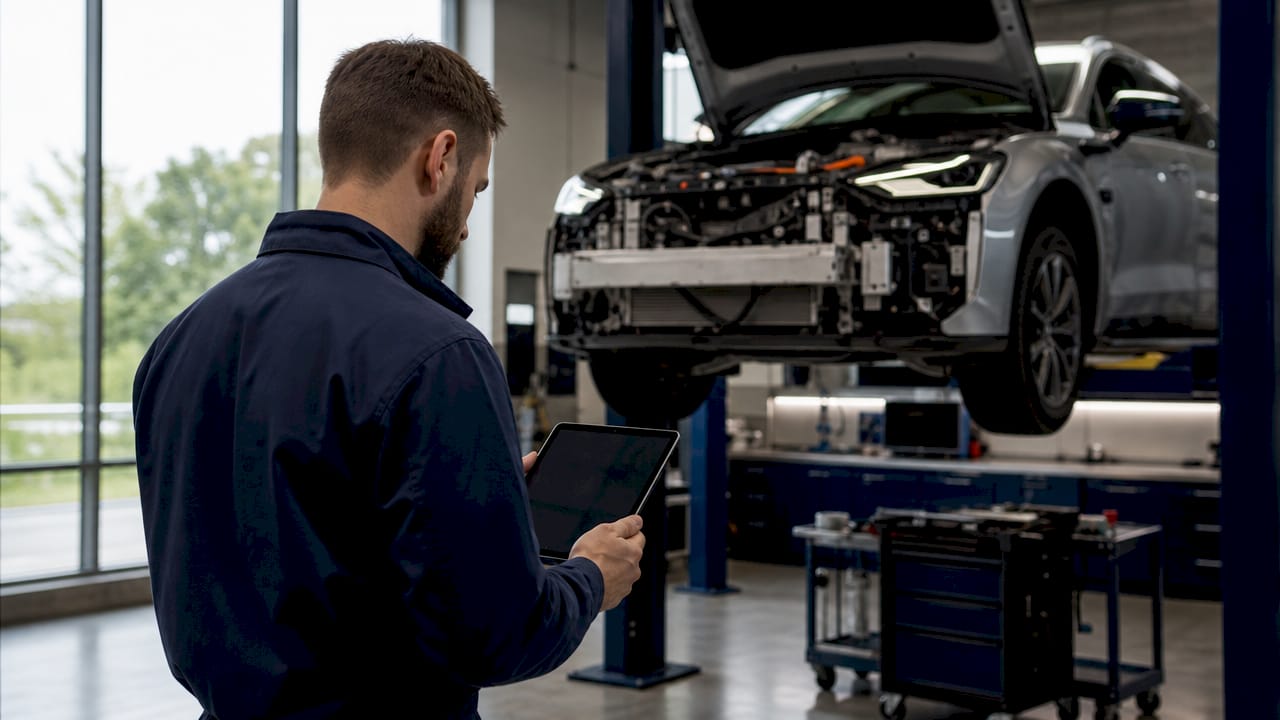
What makes modern systems more capable than a basic code reader is multimodal input. AI diagnostic assistants combine text symptom descriptions, dashboard photos, and raw OBD-II data to build comprehensive, step-by-step diagnostic workflows. You can describe a noise, upload a photo of a warning light cluster, and the system factors all of it in.
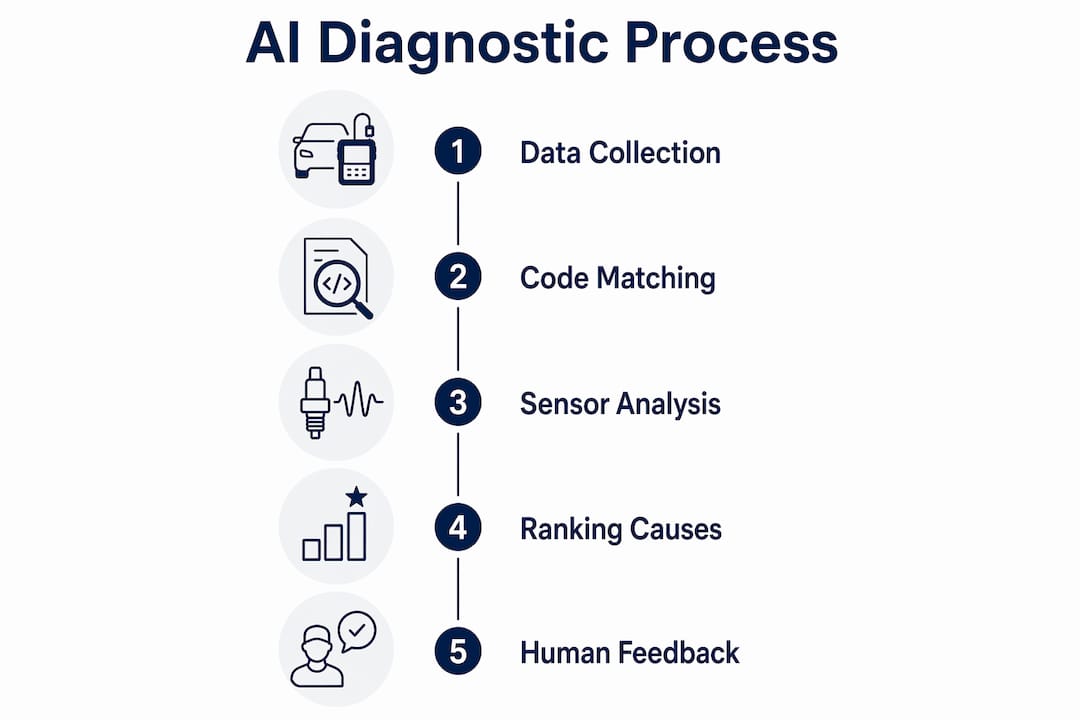
The process follows a clear sequence:
| Step | What happens |
|---|---|
| 1. Data collection | Scanner reads DTCs and live sensor data via OBD-II |
| 2. Database matching | AI cross-references codes against TSBs, recalls, and repair records |
| 3. Probabilistic ranking | System ranks probable causes by vehicle make, model, year, and region |
| 4. Multimodal input | User adds symptom descriptions or images for deeper context |
| 5. Output | Ranked cause list with plain-language explanations and repair guidance |
The ranking step is where AI earns its value. A P0420 code on a 2015 Toyota Camry with 110,000 miles has a very different probability profile than the same code on a 2019 Subaru Outback. The AI weights those differences using vehicle-specific repair history data, not generic averages.
What advantages does AI bring over traditional diagnostics?
Traditional troubleshooting relies on a technician’s memory, experience, and access to service manuals. AI diagnostics replace that bottleneck with instant pattern recognition across far more data than any individual could hold.
The most direct benefit is speed. What once took hours of manual cross-referencing now takes under a minute. AI tools explain fault codes with “what, why, and how to fix” in plain language, including cost estimates for both DIY and professional repairs. That plain-language output is significant because it closes the knowledge gap between mechanics and car owners.
The practical benefits for car owners include:
- Faster diagnosis. Probable causes appear in seconds, not hours.
- Plain-language explanations. No need to decode cryptic code definitions yourself.
- Cost estimates. Know the likely repair cost before you call a shop.
- Urgency guidance. The system tells you whether it is safe to keep driving or whether you need to stop immediately.
- Fewer unnecessary visits. Multimodal inputs help identify simple fixes you can handle yourself, reducing shop trips.
Pro Tip: Before your next service appointment, run an AI diagnostic scan and note the ranked causes and cost estimates. Walk into the shop with that information and you will have a much more productive conversation with the technician.
AI also helps car owners avoid the most expensive mistake in auto repair: replacing parts based on a code alone. A P0300 random misfire code could point to spark plugs, ignition coils, fuel injectors, or a vacuum leak. AI ranks those possibilities by statistical likelihood for your specific vehicle, so you address the most probable cause first.
How do AI tools use human input and feedback to get better?
AI diagnostic systems improve through a process called a feedback loop. When a suggested repair resolves the issue, that outcome gets recorded. AI tools improve through a “service truth” feedback loop that captures outcomes to enhance future diagnostic accuracy. Without that structured outcome data, the model stays frozen at its training set quality.
Your input as a car owner directly affects the quality of the diagnosis you receive. Vague descriptions like “it makes a noise” produce generic results. Detailed descriptions like “a rattling sound from the front left wheel at speeds above 40 mph that disappears when turning right” give the AI enough context to narrow the field significantly.
The most reliable AI diagnostic platforms use a hybrid model architecture. Leading platforms combine decision trees with machine learning to create transparent, auditable workflows. Decision trees handle known, rule-based logic. Machine learning handles pattern recognition across large, messy datasets. Together, they produce results that are both reliable and traceable, unlike pure black-box AI systems where you cannot see why a conclusion was reached.
Practical steps for getting the most accurate AI diagnosis:
- Connect a quality scanner. The richer the live data stream, the better the AI’s input.
- Describe symptoms in detail. Include when the problem occurs, under what conditions, and how long it has been happening.
- Add visual context. Upload dashboard photos or short video clips if the platform supports it.
- Verify before replacing parts. Human validation remains essential; use live sensor data and physical inspection to confirm the AI’s top hypothesis.
- Report outcomes. If a fix works or does not work, log it. That feedback trains the system for the next user with the same vehicle.
Pro Tip: Treat the AI’s output as a ranked shortlist, not a final verdict. Run a live data test on the top suspect before buying any parts. This single habit saves most DIYers from expensive misdiagnoses.
What are the current limitations of AI car diagnostic tools?
AI diagnostics are powerful, but they are not universal. The biggest constraint is hardware. Basic OBD-II scanners only read standard engine and emission codes, lacking access to proprietary systems without professional-grade tools. Body control modules, transmission control units, and advanced driver assistance systems (ADAS) often require manufacturer-specific scanners to read at all.
The second constraint is input quality. AI diagnostic accuracy depends heavily on input quality and vehicle-specific data. Freeze-frame sensor readings at the moment a fault occurred produce far more accurate diagnoses than a code pulled days later with no supporting data. Vague symptom input leads to less reliable results, full stop.
Common misconceptions car owners hold about AI diagnostics:
- “It can diagnose any noise instantly.” Mechanical noises require physical inspection. AI can suggest probable causes based on symptom descriptions, but it cannot hear your car.
- “One code equals one fix.” A single DTC often has five or more probable causes. AI ranks them; it does not eliminate the need for testing.
- “Generic scanners cover everything.” They do not. Proprietary vehicle systems require specialized scanners beyond generic OBD-II adapters for full diagnostic coverage.
- “AI replaces the mechanic.” AI accelerates diagnosis. A trained technician still performs the physical work and makes the final call.
The gap between entry-level and professional-grade tools is significant. Entry-level OBD-II adapters read generic powertrain codes. Professional-grade platforms access all vehicle modules, read live bidirectional data, and run active tests like commanding a fuel injector on and off. The AI layer on top of a professional scanner produces dramatically more accurate results than the same AI layer on a $30 Bluetooth dongle.
For car owners who want a deeper look at how mobile diagnostic tools fit into modern vehicle maintenance, the hardware question is the first place to start.
Key Takeaways
AI car diagnostic systems deliver accurate, fast troubleshooting by combining OBD-II scan data, multimodal user inputs, and extensive repair databases, but their accuracy depends directly on scanner quality and the detail of your symptom descriptions.
| Point | Details |
|---|---|
| Speed of diagnosis | AI cross-references fault codes against repair databases in 30–60 seconds. |
| Input quality matters | Detailed symptom descriptions and freeze-frame data produce the most accurate results. |
| Hybrid AI models | Combining decision trees with machine learning creates traceable, reliable diagnostic outputs. |
| Hardware limits accuracy | Generic OBD-II scanners cannot access proprietary modules like ADAS or body control units. |
| Human validation is required | Always confirm AI-suggested causes with live sensor tests before replacing any parts. |
What I’ve learned from watching AI diagnostics in the field
The car owners who get the most out of AI diagnostic tools are the ones who treat them as a starting point, not a finish line. The technology is genuinely impressive. It synthesizes more repair data in one minute than most technicians encounter in a month. But the car owners who walk away frustrated are almost always the ones who gave the system a vague symptom, got a generic result, and blamed the tool.
The more interesting shift I have watched is how AI changes the conversation between car owners and mechanics. When you arrive at a shop already knowing the top three probable causes and the cost range for each, you are no longer negotiating blind. That information asymmetry used to sit entirely on the shop’s side of the table. AI tools for vehicle health are moving it toward the middle.
The limitation worth taking seriously is the hardware gap. A consumer-grade Bluetooth scanner feeding an AI platform is not the same as a professional scan tool doing the same. The AI is only as good as the data it receives. If you are serious about using these tools, invest in a mid-range scanner that reads all modules, not just powertrain codes. The difference in diagnostic depth is not marginal. It is the difference between a useful shortlist and a guess.
AI diagnostics are becoming a standard part of how mobile mechanics use digital tools to work faster and more accurately. That trend is not slowing down. Car owners who learn to use these tools well will spend less money, make better decisions, and communicate more effectively with every mechanic they ever hire.
— Aaron
AI-powered diagnostics, delivered to your location
Onsite Los Angeles Mobile Mechanic brings professional-grade AI diagnostic technology directly to your driveway, office, or roadside location across the greater Los Angeles area. No towing, no waiting rooms, and no guessing at repair costs.
Every diagnostic visit starts with a full scan using professional-level tools that access all vehicle modules, not just generic engine codes. You get a clear explanation of what the system found, what it means, and what it will cost to fix, before any work begins. Call 213-583-4159 to book a mobile diagnostic appointment, or visit the mobile mechanic services page to see the full list of repairs available at your location.
FAQ
How fast does an AI car diagnostic tool produce results?
AI diagnostic tools typically deliver a ranked list of probable causes within 30–60 seconds of connecting to the vehicle’s OBD-II port. That speed comes from real-time cross-referencing against large databases of repair records and TSBs.
Can AI diagnostic tools read all vehicle systems?
No. Basic OBD-II scanners only access standard engine and emission codes. Proprietary systems like body control modules and ADAS require professional-grade, manufacturer-specific scan tools to read fully.
Do I still need a mechanic if I use an AI diagnostic tool?
AI diagnostics narrow down probable causes and explain them in plain language, but physical inspection, live sensor testing, and the actual repair still require a trained technician. AI accelerates the diagnostic process; it does not replace hands-on work.
What makes an AI diagnostic result more accurate?
Accuracy improves with detailed symptom descriptions, freeze-frame sensor data captured at the moment of the fault, and a professional-grade scanner that reads all vehicle modules. Vague inputs consistently produce less reliable outputs.
How do AI diagnostic systems improve over time?
These systems use a feedback loop that records whether suggested repairs resolved the issue. That outcome data trains the model to produce better-ranked results for similar vehicles and fault combinations in the future.