Mobile oil change convenience is the practice of delivering professional oil change services directly to a car owner’s location, eliminating the need to drive to a shop, wait in a lobby, or rearrange a workday around a service appointment. This model, sometimes called on-demand or mobile car maintenance, has grown sharply as car owners prioritize time over minor cost differences. Onsite Los Angeles Mobile Mechanic operates exactly this way, bringing certified technicians, all necessary equipment, and full-service capability to driveways, parking lots, and office spaces across the greater Los Angeles area. The role of mobile oil change convenience is not just about skipping a waiting room. It is about reclaiming hours that traditional auto service routinely takes from your day.
What does a mobile oil change service actually include?
A standard mobile oil change covers every task a traditional shop performs, and often adds more. Service components include oil replacement, a new oil filter, fluid top-offs, a multi-point inspection, tire pressure checks, and proper disposal of used oil. That scope matches or exceeds what most quick-lube shops deliver, with one key difference: the technician does it at your location.
Oil type selection follows the same standards used in any professional shop:
- Conventional oil: Suitable for older vehicles or those with lower mileage and simpler engine tolerances.
- Full synthetic oil: Recommended for modern engines, turbocharged vehicles, and cars with tight manufacturer specifications.
- Synthetic blend: A middle-ground option for drivers who want better protection than conventional without the full synthetic price.
- High-mileage oil: Formulated for vehicles over 75,000 miles, with additives that reduce seal wear and oil consumption.
The filter replacement process uses the correct filter for your vehicle’s make, model, and engine. Technicians also check and top off windshield washer fluid, coolant, brake fluid, and power steering fluid during the same visit. Waste oil goes into sealed recovery containers, meeting environmental compliance standards.
Multi-point inspections give car owners direct condition awareness that a traditional shop visit rarely provides. The technician walks you through findings on the spot, which means you leave knowing the actual state of your vehicle, not just that the oil was changed.
Pro Tip: Ask the technician to note any findings in writing before they leave. A quick photo or written summary of the inspection gives you a record to reference at your next service interval.
How does mobile oil change convenience compare to traditional shop service?
The clearest difference between mobile and traditional oil change service is time. A traditional shop visit requires driving to the location, waiting for an open bay, sitting in a lobby for 30–60 minutes, then driving back. A mobile appointment runs concurrently with your existing schedule. You work, cook, or handle other tasks while the service happens outside.

Pricing reflects the added value. Mobile oil change pricing ranges from $60–$85 for conventional oil and $85–$130 for full synthetic, with a $10–$20 convenience premium compared to traditional shops. That premium covers the technician’s travel, specialized equipment, and the time you save. For most car owners, the math favors mobile service when you factor in the value of the hours you keep.
| Factor | Mobile oil change | Traditional shop |
|---|---|---|
| Location | Your driveway or parking lot | Fixed shop address |
| Wait time | None (service runs alongside your schedule) | 30–60 minutes on average |
| Scheduling | Flexible, often same-day | Depends on shop availability |
| Pricing (conventional) | $60–$85 plus convenience fee | $40–$75 |
| Pricing (full synthetic) | $85–$130 plus convenience fee | $70–$120 |
| Transparency | You watch the service happen | Work done in a closed bay |
| Inspection included | Yes, multi-point with direct communication | Varies by shop |
| Waste oil disposal | Handled by technician | Handled by shop |
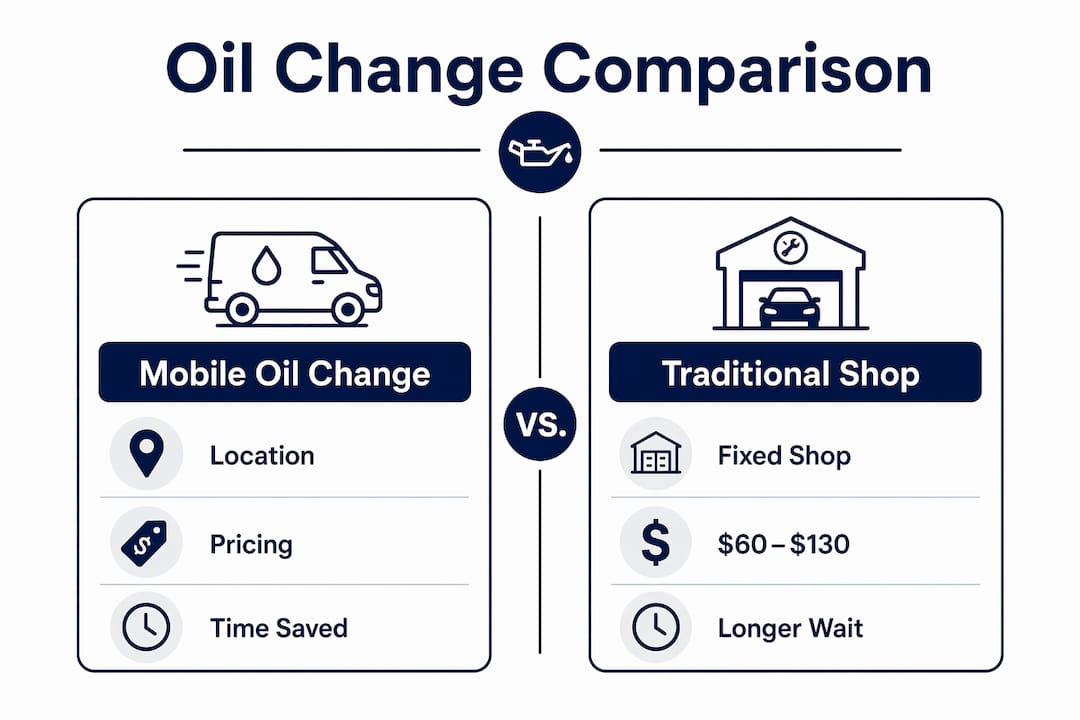
Transparency is a real advantage that car owners often underestimate. When a technician works on your car in front of you, you see exactly what gets replaced and why. Certified mobile technicians meet the same environmental and mechanical standards as shop-based mechanics, and the open-air setting makes it harder to recommend unnecessary services.
Pro Tip: Schedule your mobile oil change for a time when your car is already parked and you have 45–60 minutes of desk work ahead. The service finishes before you look up from your screen.
What are the best practices for using mobile oil change services?
Getting the most from a mobile oil change appointment starts before the technician arrives. Preparation is straightforward, but skipping these steps can cause delays.
Provide accurate vehicle information at booking. Mobile technicians carry limited inventory and rely on your vehicle’s year, make, model, and engine size to bring the correct oil and filter. A wrong detail means a return trip or a rescheduled appointment.
Confirm your VIN if asked. The Vehicle Identification Number removes all ambiguity about oil specification and filter fitment. Most car owners find it on the driver’s side dashboard or inside the door jamb.
Arrange accessible parking. Professional mobile services arrive fully equipped with spill-containment mats and waste-oil recovery systems. You need to provide a flat, accessible parking space. A driveway, parking garage, or open lot all work well.
You do not need to provide any tools or supplies. The technician brings everything, including oil, filter, drain pan, and disposal containers. Your only job is to be reachable by phone when the technician arrives.
For fleet accounts, coordinate vehicle availability in advance. Fleet managers benefit most when multiple vehicles are staged and ready, allowing the technician to move through the fleet without gaps between appointments.
Confirm the service address matches where the car will actually be parked. A mismatch between the booking address and the actual location is the most common cause of appointment delays.
Safety protocols follow professional standards. Technicians use wheel chocks, work on level ground, and follow manufacturer torque specifications for drain plugs and filter housings. The process is identical to shop work, just relocated.
Who benefits most from mobile oil change convenience?
Mobile oil change services align directly with the convenience economy, helping car owners reclaim time by removing the shop visit entirely. Certain groups gain the most from this model.
Busy professionals and remote workers. A car owner who works from home or a fixed office can schedule service during work hours without losing productivity. The oil change happens in the parking lot while the workday continues. This is the core use case for mobile car maintenance that fits around a schedule rather than disrupting it.
Parents with young children. Taking a child to a shop waiting room for an hour is genuinely difficult. A mobile appointment removes that entirely. The car gets serviced in the driveway while the household routine stays intact.
Fleet managers and business owners. A company with five or ten vehicles loses significant productivity when drivers take cars off-site for service. Mobile bulk oil changes keep vehicles on location and reduce total downtime across the fleet.
Car owners with multiple vehicles. Servicing two or three cars in a single appointment block at one location is far more efficient than separate shop visits for each vehicle.
Drivers with limited shop access. Car owners in dense urban areas, those without reliable transportation to a shop, or anyone whose vehicle is not drivable benefits from a technician who comes to them.
The common thread across all these groups is the same: the convenience of oil changes delivered on-site removes a logistical problem that traditional service creates.
Key Takeaways
Mobile oil change convenience delivers professional-grade service at your location, saving time and removing the logistical burden of traditional shop visits without sacrificing quality or compliance.
| Point | Details |
|---|---|
| Service scope matches shops | Mobile oil changes include oil, filter, fluid top-offs, multi-point inspection, and waste disposal. |
| Pricing includes a convenience premium | Expect $10–$20 more than a shop visit; the time saved typically justifies the difference. |
| Accurate vehicle info prevents delays | Always provide your year, make, model, and engine size at booking to avoid rescheduling. |
| Transparency is a built-in advantage | Watching the service happen gives you direct condition awareness that closed-bay shops rarely offer. |
| Fleet and multi-vehicle owners gain the most | Bulk on-site service eliminates repeated shop trips and keeps vehicles productive longer. |
Why the quality argument against mobile service no longer holds up
The most persistent misconception about mobile oil changes is that they cut corners on quality or professionalism. That view was never well-founded, and it is even less accurate now. Certified mobile technicians operate under the same environmental and mechanical standards as any licensed shop. They carry the same oil grades, the same filter brands, and the same inspection checklists.
What actually changes with mobile service is the setting, not the standard. The technician works in your driveway instead of a bay, but the drain plug torque spec, the filter thread engagement, and the waste oil handling procedure are identical. If anything, the open setting creates more accountability, not less. You can watch every step.
The lifestyle integration angle is what I find most underappreciated. Mobile oil change is not just a time-saving trick. It is a structural shift in how car maintenance fits into a week. When mobile auto service removes the need to plan around a shop’s hours, find a ride home, or lose a lunch break, maintenance actually happens on schedule. Cars that are easy to service get serviced on time. That is a real safety and longevity benefit that rarely gets mentioned in the convenience conversation.
— Aaron
Onsite Los Angeles Mobile Mechanic brings the oil change to you
Car owners in Los Angeles no longer need to work around a shop’s schedule or sit in a waiting room to keep their vehicles maintained.
Onsite Los Angeles Mobile Mechanic sends a certified technician directly to your home, office, or parking lot anywhere in the greater Los Angeles area. Mobile mechanic services include conventional and full synthetic oil changes, filter replacement, fluid top-offs, and a multi-point inspection, all completed within an hour in most cases. Pricing is upfront with no hidden fees, and the convenience premium is explained before any work begins. Car owners in Long Beach, Pasadena, Burbank, and across the LA metro can call 213-583-4159 to book an appointment or get a quote. No app required.
FAQ
What is included in a mobile oil change service?
A mobile oil change typically includes oil replacement, a new filter, fluid top-offs, tire pressure checks, a multi-point inspection, and proper disposal of used oil. Customers need only provide accessible parking.
How much does a mobile oil change cost compared to a shop?
Mobile oil change pricing runs $60–$85 for conventional oil and $85–$130 for full synthetic, plus a $10–$20 convenience premium over traditional shop rates.
Do mobile oil change technicians meet professional standards?
Yes. Certified mobile technicians meet the same environmental and mechanical standards as shop-based mechanics, and the on-site setting provides greater service transparency.
What do I need to prepare before a mobile oil change appointment?
Provide your vehicle’s year, make, model, and engine size at booking, and arrange a flat, accessible parking space. The technician brings all tools, oil, filters, and disposal equipment.
Can businesses use mobile oil change services for their vehicle fleets?
Yes. Fleet managers use mobile bulk oil change services to reduce vehicle downtime and service multiple vehicles on-site in a single appointment block.