Car maintenance between meetings is defined as a set of quick, essential vehicle checks completed during short breaks in a professional’s workday, without requiring a shop visit or significant time away from work. Professional mechanics recommend a 15-minute monthly check as the gold standard for catching early issues before they become costly repairs. Onsite Los Angeles Mobile Mechanic completes services like oil changes and battery replacements within 60 minutes, making professional-grade upkeep possible even on a packed calendar. This guide covers the exact tasks, tools, scheduling methods, and common mistakes that define efficient vehicle maintenance for busy professionals.
What are the essential quick car maintenance tasks between meetings?
The fastest wins in vehicle upkeep take under five minutes each and require no mechanical training. Fluid checks take 3–5 minutes, light checks take about 2 minutes, and a full monthly routine runs roughly 15 minutes. That means a single lunch break covers everything your car needs to stay reliable for weeks.
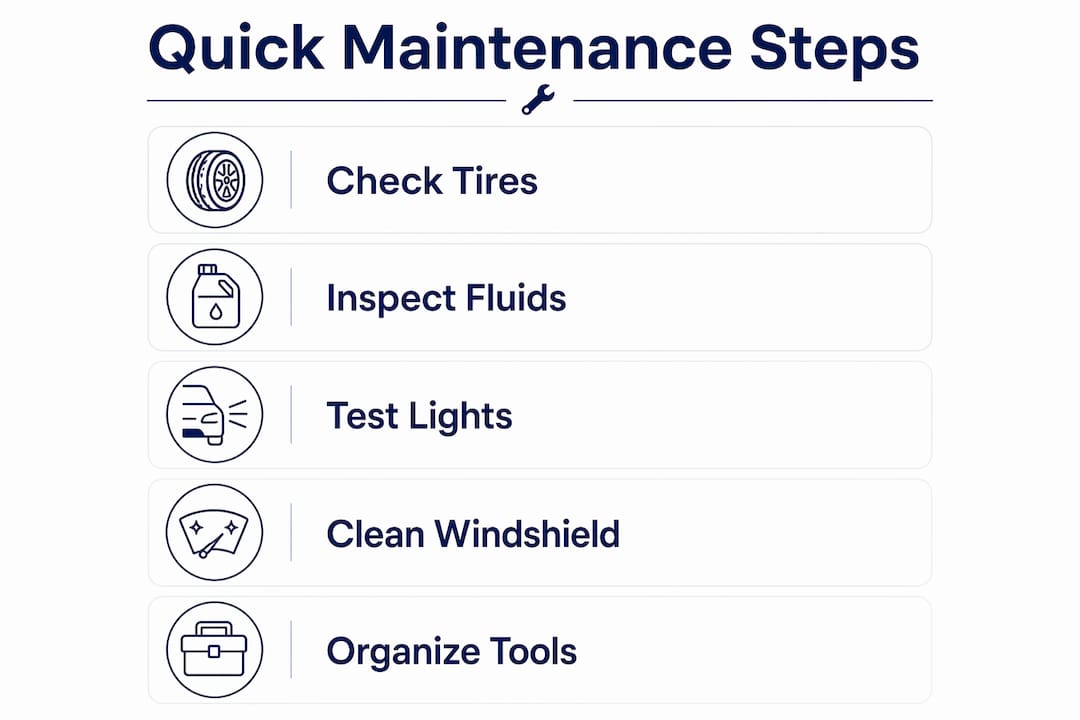
Here are the core tasks to rotate through your short breaks:
- Engine oil level. Pull the dipstick, wipe it clean, reinsert it, and read the level. Low oil causes engine wear faster than almost any other neglected item.
- Tire pressure. Use a digital gauge on all four tires. Most passenger vehicles call for 32–35 PSI, but always check your driver’s door jamb sticker for the exact spec.
- Exterior and interior lights. Park near a reflective surface or use your phone camera to check brake lights and turn signals without needing a second person. Phone cameras and portable mirrors make solo light checks fast and reliable.
- Windshield washer fluid. Pop the hood and top it off with pre-mixed fluid. Running dry is a safety issue, not just an inconvenience.
- Cabin cleanup. Remove trash, wipe down the dash with a microfiber cloth, and clear the floor of anything that could slide under the pedals. A clean cabin reduces distraction and keeps your car presentable for client rides.
Pro Tip: Set a recurring 15-minute calendar block on the first Monday of each month labeled “Car Check.” Treat it like a client call. You will not skip it.
The key insight here is that none of these tasks require a lift, a shop, or specialized knowledge. They require only a few minutes and the right supplies already in your car.
What tools and supplies should you keep in your car for fast maintenance?
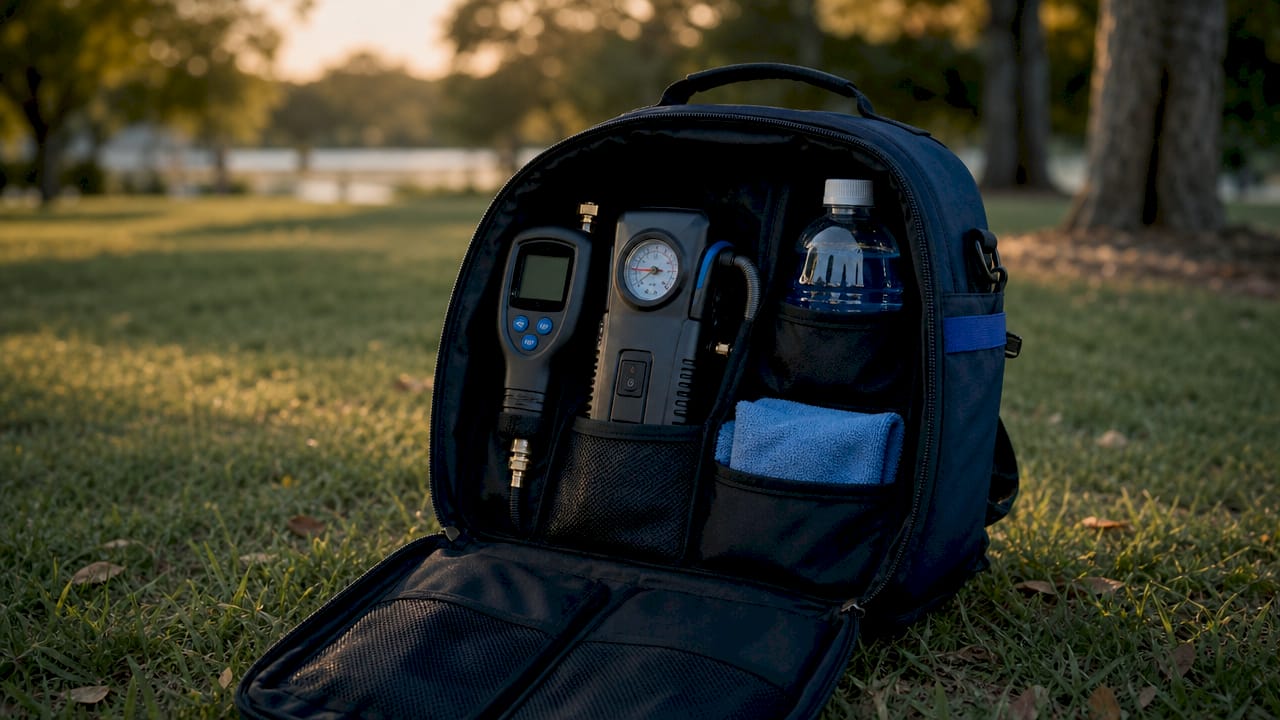
A dedicated portable kit is the difference between a productive 5-minute check and a wasted trip to a gas station. Experts advise keeping a kit that includes a digital tire pressure gauge, pre-mixed windshield washer fluid, a funnel, and microfiber cloths. That combination covers the majority of quick checks a professional can realistically perform between appointments.
| Tool | Purpose | Time to use |
|---|---|---|
| Digital tire pressure gauge | Accurate PSI reading on all four tires | Under 2 minutes |
| Pre-mixed windshield washer fluid | Top up reservoir without diluting | Under 1 minute |
| Funnel | Prevents spills when adding fluids | Saves cleanup time |
| Microfiber cloths | Wipe dipstick, clean dash, dry surfaces | Under 2 minutes |
| Portable flashlight | Inspect under hood in low light | As needed |
| Portable tire inflator | Correct low pressure without finding a gas station | 5–10 minutes |
Store everything in a small zip bag or compact organizer in your trunk. The goal is zero friction. If you have to search for a tool, you will skip the check.
Pro Tip: Buy two sets of pre-mixed washer fluid. Keep one in the trunk and one at your office parking spot. Refilling takes 30 seconds when the bottle is already there.
A portable tire inflator is worth the investment for urban commuters. Los Angeles roads are hard on tires, and a slow leak caught early costs nothing. A flat tire on the way to a client meeting costs you the meeting.
The mobile mechanic workforce that supports on-the-go vehicle care relies on exactly this kind of compact, purpose-built toolkit. Professionals who mirror that approach at the personal level see fewer surprise breakdowns.
How do you schedule car maintenance into a busy workday?
Viewing car maintenance as an extension of professional scheduling rather than a personal chore is the mindset shift that makes the habit stick. When maintenance lives on your calendar alongside client calls and project deadlines, it gets done. When it lives in the back of your mind, it gets skipped.
Here is a practical schedule that fits a standard professional workweek:
- Daily (2 minutes). Glance at your dashboard before starting the engine. Note any warning lights. Check that nothing looks off visually around the tires.
- Weekly (5 minutes). Check tire pressure on all four tires and the spare. Top up windshield washer fluid if needed. Wipe down the interior.
- Monthly (15 minutes). Full fluid check including engine oil, coolant, and brake fluid. Inspect all exterior lights. Clean the cabin thoroughly.
- Quarterly (schedule with a professional). Oil change, tire rotation, and a general inspection. This is where mobile mechanic services save the most time.
Calendar alerts and mobile apps that track service intervals keep maintenance scheduled during off-peak hours or routed through professional mobile pickup services. The app-free version of this is a simple recurring reminder in your phone’s native calendar. No special software required.
Task bundling is the most underused scheduling technique for vehicle maintenance for busy professionals. Schedule your monthly 15-minute check during a lunch break you already block for eating at your desk. You are not adding time to your day. You are using time that already exists.
For tasks that take longer, like oil changes or tire replacements, mobile mechanic services complete them in about 60 minutes at your location. That means a mechanic can service your car in the office parking lot while you are in back-to-back meetings. You lose zero work time. This is the core value of fitting car repair into your work schedule rather than working around a shop’s hours.
What mistakes should busy professionals avoid during quick car checks?
The most common mistake is treating a persistent warning light as a low-priority item. If a warning light stays on or low tire pressure persists, booking a mechanic visit is the right call rather than guessing or delaying. A $20 sensor issue left unaddressed can become a $400 repair within weeks.
Watch for these specific pitfalls:
- Overfilling engine oil. More is not better. Oil above the MAX line on the dipstick causes foaming and can damage seals. Fill slowly and recheck.
- Ignoring uneven tire tread. Uneven wear signals an alignment or suspension issue, not just tire age. Rotating tires without fixing the root cause wastes money.
- Forgetting the spare tire. Spare tire pressure is often overlooked but is critical for emergency readiness. A flat spare is useless when you need it most. Check it monthly alongside your road tires.
- Skipping the owner’s manual. Every vehicle has specific fluid types and pressure specs. Using the wrong oil viscosity or washer fluid concentration causes damage over time.
- Performing checks in unsafe locations. Never check fluids or tires in a moving traffic lane or on a steep incline. A level, well-lit parking spot is the minimum safe standard.
Preemptive quick checks prevent broken-down vehicle downtime that can disrupt professional commitments and damage your reputation. A vehicle that fails on the way to a client meeting is not just an inconvenience. It is a professional liability.
Knowing when to stop and call a professional is a skill, not a failure. Mobile mechanic services offer professional-quality work onsite, removing the need for dealership appointments and lost work hours. If a check reveals something beyond your kit or knowledge, the right move is a phone call, not a guess.
Key Takeaways
The most effective car maintenance strategy for busy professionals combines a 15-minute monthly self-check routine with mobile mechanic services for longer tasks, keeping vehicles reliable without losing work time.
| Point | Details |
|---|---|
| Monthly 15-minute check | Professional mechanics call this the gold standard for catching early vehicle issues. |
| Portable kit is non-negotiable | A digital gauge, pre-mixed fluid, funnel, and microfiber cloths cover most quick checks. |
| Schedule it like a meeting | Calendar blocks for maintenance get done; mental notes do not. |
| Mobile mechanics save work hours | Oil changes and battery replacements completed onsite in about 60 minutes. |
| Act on warning lights immediately | Persistent lights or low pressure require a professional visit, not a delay. |
What I have learned from watching professionals ignore their cars
The professionals who end up stranded are almost never the ones who skipped a single oil change. They are the ones who treated every small warning as something to deal with “next week” for six months straight. That pattern is more common than most people admit, and it is entirely avoidable.
The mindset shift that actually works is treating your car like a client account. You would not let a client account go unreviewed for three months. Your car is the tool that gets you to every meeting, every site visit, and every client dinner. It deserves the same calendar discipline.
What I have seen work consistently is the combination of a simple monthly self-check and a mobile mechanic for anything beyond that. The self-check keeps you aware of your vehicle’s condition. The mobile mechanic handles the rest without pulling you out of your workday. That combination covers car maintenance without missing work in a way that no other approach matches for urban professionals.
The professionals who adopt this system stop thinking about car maintenance as a problem. It becomes background noise, handled and forgotten until the next scheduled check. That is exactly where it belongs.
— Aaron
How Onsite Los Angeles Mobile Mechanic fits into your workday
Busy professionals in the Los Angeles area do not need to choose between a reliable car and a full workday.
Onsite Los Angeles Mobile Mechanic comes to your office, your home, or wherever your car is parked and handles oil changes, tire replacements, battery swaps, and diagnostics on the spot. Most services are completed within 60 minutes. There are no hidden fees. You get an upfront quote before any work begins. You can book by calling 213-583-4159 to schedule around your meetings. For a full list of available mobile mechanic services, visit the services page. If you are in Long Beach or Pasadena, Onsite Los Angeles Mobile Mechanic also covers Long Beach and Pasadena with the same on-site model.
FAQ
What is a car maintenance between meetings guide?
A car maintenance between meetings guide is a structured plan for completing quick vehicle checks, like tire pressure and fluid levels, during short breaks in a professional’s workday. The goal is to maintain vehicle reliability without scheduling separate shop visits.
How long do quick car checks actually take?
Fluid checks take 3–5 minutes, light checks take about 2 minutes, and a full monthly routine runs roughly 15 minutes. Most essential checks fit comfortably into a standard lunch break.
Can a mobile mechanic really finish an oil change during a meeting?
Yes. Mobile mechanic services complete tasks like oil changes and battery replacements in about 60 minutes at your location. That means the work happens while you are inside, with no commute or waiting room time lost.
What is the most overlooked item in a quick car check?
Spare tire pressure is the most commonly skipped item. A spare with no air is useless in an emergency, and most drivers never check it until they need it.
How do I remember to check my car regularly?
Set a recurring calendar alert on the first Monday of each month for 15 minutes. Treat it as a fixed appointment. Pairing it with an existing habit, like a lunch break, makes it easier to maintain consistently.