Most car owners assume the dealership is the safe, reliable choice and that a mobile mechanic is a budget compromise. That assumption costs people hundreds of dollars every year. The mobile mechanic vs dealership explained debate is more nuanced than price alone. It comes down to the type of repair, your vehicle’s warranty status, how much time you can spare, and what you actually need done. Once you understand those factors, the right choice becomes obvious rather than stressful.
Table of Contents
- Key takeaways
- Mobile mechanic vs dealership explained: what drives the cost gap
- What each service can and cannot do
- Warranty and recall considerations
- How the customer experience actually differs
- Choosing the right option for your situation
- My take on this after years in the field
- Get your car serviced where you are in Los Angeles
- FAQ
Key takeaways
| Point | Details |
|---|---|
| Price gap is significant | Dealership labor runs $125–$175/hour versus $75–$125/hour at independent or mobile shops. |
| Mobile repair fits most routine jobs | Oil changes, battery swaps, brake work, and diagnostics are all well within mobile mechanic capability. |
| Your warranty stays protected | The Magnuson–Moss Warranty Act prevents dealers from voiding your coverage just because you used an independent mechanic. |
| Recalls still go through dealerships | Manufacturer recall fixes require dealer coordination and are covered at no cost to you. |
| Vetting matters more than format | Whether mobile or dealership, your experience depends heavily on who is actually doing the work. |
Mobile mechanic vs dealership explained: what drives the cost gap
The biggest practical difference between mobile auto repair and a dealership visit is price. Dealership labor rates run between $125 and $175 per hour, while independent and mobile mechanics typically charge between $75 and $125 per hour. That is not a small gap. On a two-hour job, you could be paying $100 to $200 more at the dealership before parts even enter the picture.
Why do dealerships charge so much more? It is not because their technicians are necessarily more skilled on common repairs. Dealership pricing premiums largely reflect overhead rather than repair quality for everyday jobs. Franchise fees, a physical facility with a waiting room, service advisors, loaner car programs, and a large payroll all get baked into the hourly rate you pay.
Parts pricing adds another layer. Dealerships stock Original Equipment Manufacturer parts, which carry a premium. Mobile mechanics often source quality aftermarket or OEM-equivalent parts at lower cost, and they pass some of that savings to you. On something like a brake job, the total price difference can be dramatic. A dealership brake job might run $850, while a mobile mechanic completing the same work with parts and labor can come in around $395.
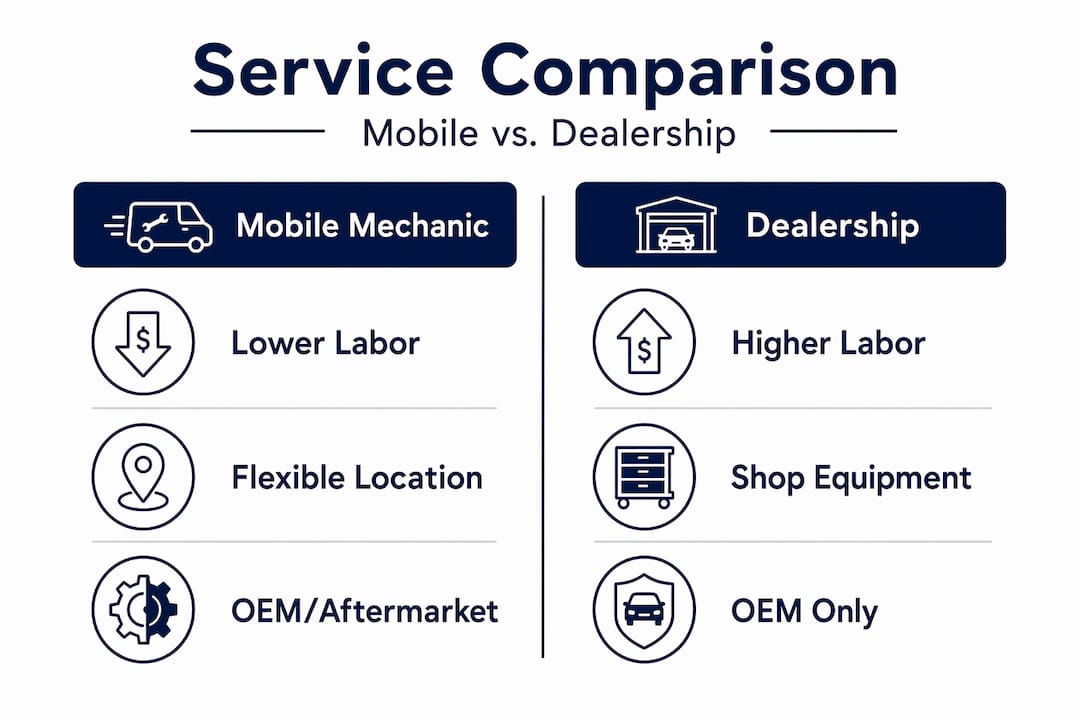
One detail that trips people up: get complete quotes that itemize labor, diagnostics, and parts before comparing prices. A low headline number from either source can look different once fees are added.
Pro Tip: Always ask for a written breakdown of parts cost, labor cost, and any diagnostic fee separately. This is the only way to do an honest apples-to-apples comparison.
Some mobile mechanics also offer warranties that rival or exceed dealership coverage. Certain providers offer lifetime parts warranties and six-month labor warranties on common repairs like brakes, which challenges the assumption that dealerships automatically offer better protection on the work they perform.
What each service can and cannot do
Understanding the practical scope of mobile auto repair helps you book the right service the first time. Mobile mechanics are genuinely excellent for a wide range of jobs. Here is where they perform well:
- Oil and filter changes
- Battery testing and replacement
- Brake pad and rotor replacement
- Spark plug replacement
- Alternator and starter replacement
- Diagnostic code reading and interpretation
- Serpentine belt replacement
- Minor cooling system work
These services cover the majority of what most drivers need in any given year. A capable independent mechanic can handle all routine maintenance as well as a dealership but at significantly lower cost.
That said, there are real limits to what can be done without a shop. Engine swaps and major transmission work require hydraulic lifts and controlled environments that a mobile setup simply cannot replicate. Suspension overhauls, complex electronic calibrations tied to manufacturer-specific software, and certain airbag system repairs fall into the same category.
Dealerships are also the right call when your specific vehicle model has known issues requiring proprietary manufacturer tools. Some advanced driver assistance system recalibrations, for example, require factory-level equipment that only franchised dealers carry.
Pro Tip: Before booking any service, describe your repair in detail and ask directly whether it can be completed on-site. Any good mobile mechanic will tell you honestly if it needs a shop.
It is also worth knowing that some dealerships now run mobile fleets as part of their service offerings, though these programs are constrained by manufacturer rules and are not universally available. The independent mobile mechanic model still offers far more scheduling flexibility and geographic coverage in most markets.
Warranty and recall considerations
This is the area where misinformation does the most damage. Many drivers avoid independent and mobile mechanics specifically because they fear losing their factory warranty. That fear is largely unfounded.
The Magnuson-Moss Warranty Act is a federal law that protects you as a consumer. Under this law, a manufacturer must actually prove that an independent repair caused a specific failure before they can deny a warranty claim related to it. They cannot simply void your coverage because you did not use their dealership for routine maintenance.
Here is what that means practically:
- Getting your oil changed by a mobile mechanic does not void your powertrain warranty.
- Using quality aftermarket brake pads does not eliminate your coverage for an unrelated electrical fault.
- Keeping your own service records is smart. Document who performed each service, what was done, and what parts were used.
The one area where dealerships remain necessary is recall repairs. Recall fixes go through authorized dealers, are covered entirely at no cost to you, and are backed by the manufacturer. You cannot get a recall remedy done by a mobile mechanic or an independent shop, and you should not try to. Toyota’s 2026 recall update on certain Tundra vehicles is a recent example where owners were urged to contact dealers immediately when symptoms appeared, even as the fix was still being rolled out in phases.
To check whether your vehicle has any open recalls, visit the National Highway Traffic Safety Administration’s website and search by your VIN. It takes two minutes and could save you from a serious safety issue.
How the customer experience actually differs
Dealerships have invested heavily in the service experience. Digital multi-point inspections, video walkthroughs of your vehicle’s condition, text message updates, and loyalty reward programs have become standard at many stores. A Mazda vice president noted that a positive service experience makes customers 70% more likely to buy their next vehicle from that same dealer. That investment in experience is real. It is also designed to keep you coming back and spending more.
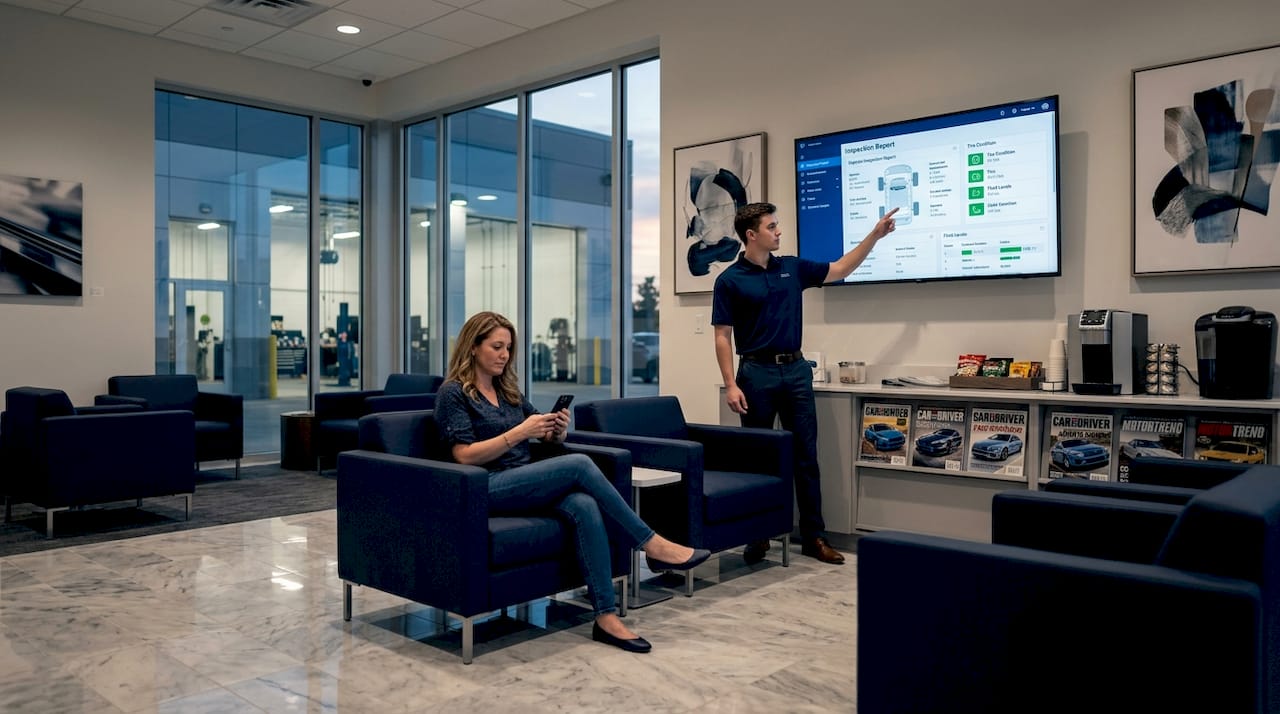
Mobile mechanics offer a very different kind of experience. The mechanic comes to your home, your office, or wherever your car is sitting. You do not drive to a shop. You do not wait in a lounge for hours. For busy people in urban areas, that time you save is genuinely valuable, not just a minor convenience.
The trade-off is consistency. Dealership technicians work within a quality control structure with service advisors reviewing work orders. Mobile mechanics vary widely. Some are ASE-certified professionals with years of experience. Others are not. The format itself does not guarantee quality.
Here is how to vet a mobile mechanic before you commit:
- Check for ASE certification or verifiable manufacturer-specific training.
- Read recent reviews across multiple platforms, not just their own website.
- Ask for a written quote before any work begins and confirm warranty terms on parts and labor.
- Verify they carry liability insurance. Any professional will have it.
- Ask specifically about their experience with your vehicle’s make and model.
Pro Tip: A mechanic who answers your questions clearly and without pressure is almost always a better choice than one who rushes you to book. Confidence in their trade shows.
Choosing the right option for your situation
The choice between mobile and dealership service is not universal. It depends on your specific situation. Use these factors to make the call:
A side-by-side look helps make this concrete:
| Factor | Mobile mechanic | Dealership |
|---|---|---|
| Labor cost | $75–$125/hour | $125–$175/hour |
| Routine maintenance | Excellent fit | Available but pricier |
| Recall repairs | Not available | Required channel |
| Convenience | Comes to you | You go to them |
| Warranty risk | Protected by federal law | Assumed safe but not always faster |
| Complex repairs | Limited by equipment | Full capability |
| Service vetting | Research required | Brand accountability applies |
If your car is out of warranty and needs a brake job, oil change, battery, or alternator, a qualified mobile mechanic will almost always save you money and time. If you have an open recall, need a major transmission rebuild, or your vehicle requires manufacturer-specific recalibration, the dealership is the right call. For everything in between, read your repair type, check the quote breakdown, and ask about warranty on the work before deciding.
Learning how onsite car repair works before your first mobile appointment removes the uncertainty that keeps many drivers from trying it.
My take on this after years in the field
I have seen both sides of this conversation play out countless times. The honest truth is that most drivers pay dealership prices for work that does not require a dealership. Routine maintenance and common repairs do not demand a franchise facility. They demand a competent, experienced technician with the right tools.
What I find genuinely frustrating is the warranty myth. Drivers spend real money out of fear of something that federal law already protects them from. Once you understand the Magnuson-Moss Warranty Act, that argument for always using the dealer on routine work largely falls apart.
That said, I have seen mobile mechanics who should not be doing certain jobs. A lift is not optional for a proper suspension overhaul. Some work genuinely needs a shop. The mistake is treating this as all-or-nothing. Most cars can be served almost entirely by a good mobile mechanic for years, with the occasional dealership visit for recalls or genuinely specialized repairs.
The thing drivers most often overlook is documentation. Keep a simple log of every service. Who did it, what was done, what parts were used. That record protects your warranty, helps the next mechanic understand your car’s history, and gives you leverage if anything is ever disputed.
— Aaron
Get your car serviced where you are in Los Angeles
Onsite Los Angeles Mobile Mechanic brings professional auto repair directly to your driveway, parking lot, or workplace throughout the greater Los Angeles area. Whether you need an oil change, brake service, battery replacement, or a diagnostic check, the work gets done on-site, on your schedule, without a trip to the shop. Pricing is upfront with no hidden fees, and many common services are completed within an hour. To see the full list of available repairs or to book an appointment, visit the Onsite Los Angeles services page or call 213-583-4159 directly. If you are in the Long Beach area, local mobile service is available there as well.
FAQ
How much cheaper is a mobile mechanic than a dealership?
On typical repairs, mobile mechanics charge $75–$125 per hour in labor compared to $125–$175 per hour at dealerships. On a job like a brake replacement, the total savings can exceed $400 including parts.
Will using a mobile mechanic void my car warranty?
No. The Magnuson-Moss Warranty Act protects consumers who use independent or mobile mechanics for repairs. A manufacturer must prove the independent repair directly caused a failure before denying a warranty claim.
What repairs can a mobile mechanic not do?
Jobs requiring a hydraulic lift, such as engine swaps, major transmission rebuilds, and full suspension overhauls, are not feasible for mobile mechanics. Recall repairs must also go through authorized dealerships.
How do I find a trustworthy mobile mechanic?
Look for ASE certification, confirmed liability insurance, transparent written quotes, and recent reviews across multiple platforms. Ask about experience with your specific vehicle make and model before booking.
Do I still need to go to the dealership for recalls?
Yes. Recall repairs are handled exclusively through authorized dealerships, are free of charge, and are backed by the manufacturer. Check your recall status by searching your VIN on the NHTSA website.