Your car won’t start after a long shift. You’re sitting in a crowded office parking lot, phone in hand, dreading the tow truck wait and the day lost at a traditional garage. That scenario plays out thousands of times a day across Los Angeles, and it’s exactly why the mobile mechanic parking lot service model has taken off. Professionally called on-site vehicle repair, this service brings a certified mechanic directly to wherever your car sits, whether that’s a shopping center, office park, or apartment complex, so you can skip the shop entirely and get back on the road faster.
Table of Contents
- Key takeaways
- What to prepare before your mobile mechanic parking lot service
- How an on-site vehicle repair actually works, step by step
- Common repairs mobile mechanics handle in parking lots
- Common mistakes to avoid with parking lot repairs
- After the repair: confirming your car is truly road-ready
- My take on why this service model actually works
- Get reliable parking lot car service from Onsite Los Angeles Mobile Mechanic
- FAQ
Key takeaways
| Point | Details |
|---|---|
| Book with full details ready | Have your vehicle’s year, make, model, symptoms, and exact location ready before calling to speed up the booking process. |
| Expect a service call fee | Mobile mechanic pricing typically runs $150 to $350 or more, including call-out fee and labor, so always request an upfront quote. |
| Most common repairs work on-site | Battery replacements, oil changes, brake work, and diagnostics are all routinely handled in parking lots without a shop ramp. |
| Verify credentials before booking | Ask for ASE certification and check reviews to confirm you are hiring a trustworthy, qualified technician. |
| Document everything post-repair | Request written service documentation and any warranty details immediately after the repair is complete. |
What to prepare before your mobile mechanic parking lot service
Getting a mechanic to your car is only half the equation. The other half is showing up prepared, because a disorganized booking call costs you time and can delay service significantly.
Have this information ready when you call:
- Year, make, model, and trim level of your vehicle
- Your exact parking location, including the lot name, address, and any landmark details like “Row C near the north entrance”
- A clear description of symptoms, such as clicking on startup, warning lights, or fluid puddles under the car
- Your availability window, since some providers respond within about 2 hours depending on demand
Location and safety considerations matter more than most people realize. A parking lot needs to give the mechanic room to work. Tight spots between two SUVs make it difficult to access the engine bay or lift wheels safely. Whenever possible, choose or request a spot at the end of a row, near a curb, or in an area with good lighting if the service extends into evening hours. Some private lots, like gated office complexes, may require permission from building management before a third-party technician can work on the property.
Pricing clarity is another place where preparation pays off. Visit fees plus labor can add up quickly, and some providers charge an initial call-out fee that covers only dispatch, not diagnostics. Ask directly: does the service fee include diagnosis, or is that billed separately? Transparent providers give you a firm quote upfront.
Pro Tip: Before the mechanic arrives, move any loose items from around or under your car, and make sure the hood latch is accessible. A clear workspace lets the technician start immediately rather than spending the first ten minutes reorganizing.
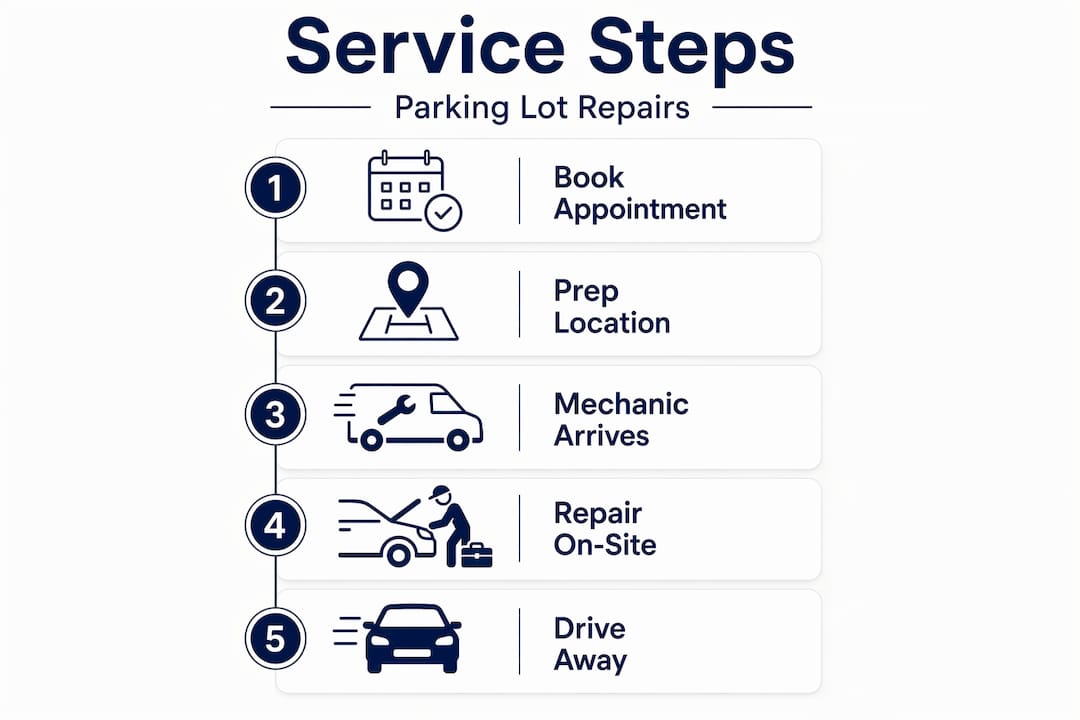
How an on-site vehicle repair actually works, step by step
Most people have never watched a mobile mechanic work, and not knowing what to expect can make the whole experience feel uncertain. Here is a clear picture of how the process typically unfolds.
- Booking and confirmation. You call the provider, describe your issue and location, and receive a quote. A time window for arrival is confirmed, and you stay with or near the vehicle.
- Mechanic arrival and initial assessment. The technician pulls up in a fully equipped service van loaded with diagnostic tools, replacement parts for common failures, fluids, and hand tools. They start with a visual inspection and, in many cases, connect an OBD-II scanner to read fault codes from your car’s computer.
- Diagnosis shared with you directly. Unlike a shop where you get a phone call later, the mechanic explains what they found while standing next to your car. You approve any additional work on the spot, with full pricing discussed before anything is touched.
- Repair or maintenance performed. For straightforward jobs, this happens right there in the lot. Over 4,000 repair types can be completed without a workshop ramp, according to large mobile fleets, covering everything from battery swaps to brake replacements.
- Post-repair check and documentation. The mechanic runs a final check, clears any fault codes if applicable, and provides you with a service summary. You inspect the work and ask any remaining questions before they leave.
Here is a quick overview of what typically falls within or outside the scope of parking lot car maintenance:
| Service type | Can be done on-site? | Notes |
|---|---|---|
| Battery replacement | Yes | One of the fastest on-site jobs, often under 30 minutes |
| Oil and filter change | Yes | Requires a fluid collection pan; most mobile mechanics carry one |
| Brake pads and rotors | Yes | Needs enough space to safely remove wheels |
| Serpentine belt replacement | Usually yes | Depends on engine layout and accessibility |
| Transmission rebuild | No | Requires a lift and a controlled shop environment |
| Air conditioning recharge | Sometimes | Requires refrigerant handling equipment |
| ADAS sensor calibration | Rarely | Specialized dealer tools often needed |
The honest truth about limitations: some repairs still require towing to a traditional garage. If your engine needs to come out, or if your car requires a four-post lift for suspension work, no parking lot service can substitute for a full shop setup.
Common repairs mobile mechanics handle in parking lots
The practical range of work a mobile auto repair service can accomplish on-site is broader than most car owners expect. Battery failure, alternator issues, cooling system problems, and serpentine belt replacement are among the most common breakdown causes that mobile mechanics resolve without requiring a tow.
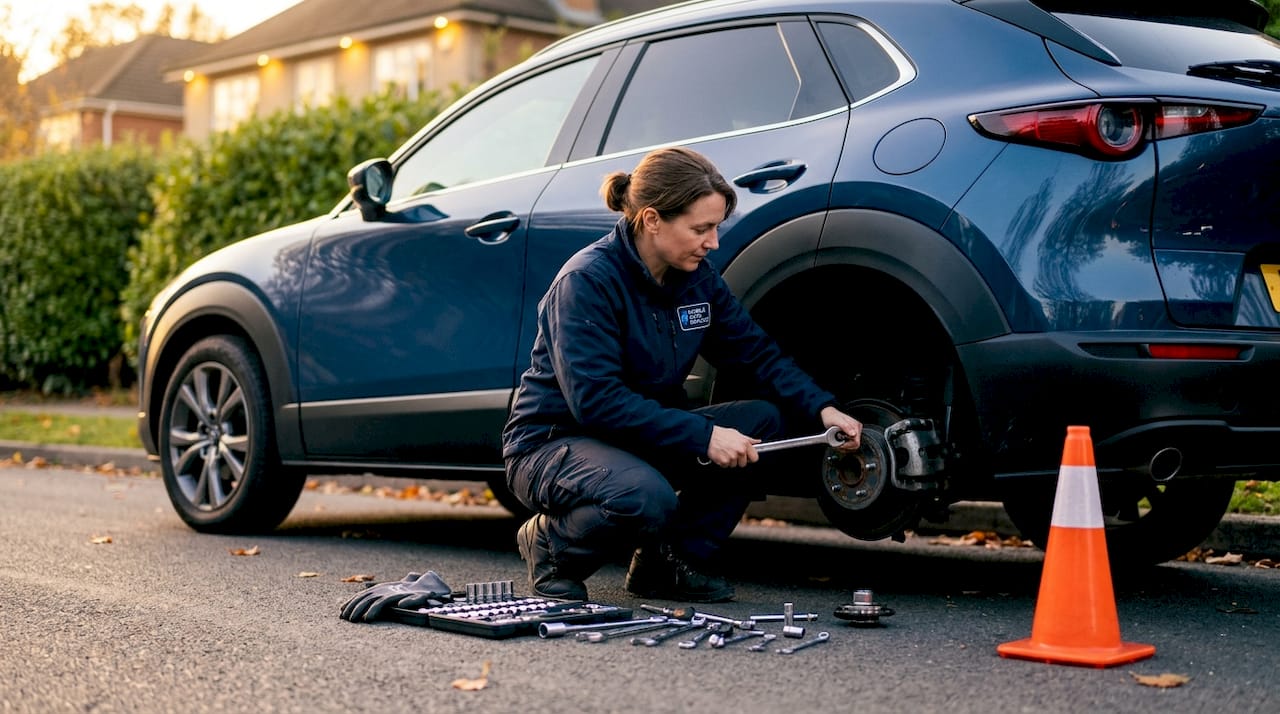
Brake jobs are another sweet spot. Pad and rotor replacements on most sedans and crossovers take about 45 to 90 minutes per axle, and the work translates cleanly to a parking lot environment as long as the surface is level and there is enough clearance to safely remove the wheel. Oil changes and fluid top-offs, including power steering fluid, coolant, and brake fluid checks, are equally routine.
What surprises many car owners is the growing role of dealer-backed mobile programs. Some manufacturers have launched programs where factory-trained technicians use genuine parts to handle oil changes, tire rotations, brake services, and software updates at a customer’s home or workplace. These technicians carry manufacturer-specific diagnostic software that independent mobile mechanics may not have access to, which matters for TPMS resets, ADAS calibration, and warranty-compliant service records.
Pro Tip: If your car is still under manufacturer warranty, confirm that your mobile mechanic uses parts that meet OEM specifications. Using non-approved parts for certain services can create warranty complications down the road.
Here is a practical breakdown of repair categories and their typical on-site viability:
- Electrical issues: Battery, alternator, and starter motor replacements rank among the most common and straightforward on-site fixes
- Fluid services: Oil changes, coolant flushes, and transmission fluid checks are well within scope for parking lot settings
- Brake system: Pad and rotor replacement is doable in most open lots with level pavement
- Tires: Mounting, rotation, and basic repairs can be performed if the mechanic carries the right equipment
- Diagnostics: Reading and clearing fault codes is quick and requires no special environment
For saving work hours, getting these services handled during your workday in a nearby parking lot beats spending half a Saturday at a traditional garage.
Common mistakes to avoid with parking lot repairs
A smooth experience depends on a few things most people only learn the hard way. Avoid these pitfalls before and during your service call.
- Skipping credential checks. ASE-certified mechanics have demonstrated competency through standardized testing. Ask for certification details before booking, and check online reviews on Google or Yelp to confirm consistent quality.
- Not clarifying the full price upfront. Some services advertise low base rates but add fees for diagnostics, parts markup, or disposal. Get the complete quote in writing or via text before the mechanic rolls out.
- Choosing an unsafe or illegal spot. Fire lanes, handicap spaces, and loading zones are not appropriate for repair work. Beyond the obvious ticket risk, working in a restricted area puts the mechanic in a difficult position and can end the service call prematurely.
- Attempting DIY fixes right before the mechanic arrives. Disconnecting your battery, adding random additives to your oil, or pulling fuses to “help” with a diagnosis often makes the mechanic’s job harder and can obscure the root cause of the problem.
- Expecting every repair to be possible on-site. Go in with realistic expectations. Complex repairs requiring dealer software or a vehicle lift belong in a shop. A trustworthy mobile mechanic will tell you this upfront rather than attempting a job they cannot complete safely.
- Not verifying response times before committing. If you need emergency roadside assistance and the provider cannot arrive for six hours, you may need a different solution. Confirm the estimated arrival time during your booking call.
After the repair: confirming your car is truly road-ready
The service call ending does not mean your job is done. A few quick checks on your end help confirm the work was completed correctly and give you documentation if anything needs follow-up.
- Visual inspection before the mechanic leaves. Look for anything obviously out of place: loose wires, missing fasteners, fluid pooling under the vehicle, or a dashboard warning light still illuminated after the repair.
- Request written documentation. A reputable provider gives you a service receipt listing what was done, parts used, and any warranty terms. Map and review apps can help you find providers known for thorough documentation practices.
- Ask about warranty on parts and labor. Legitimate mobile mechanics typically offer at least a 90-day warranty on parts and labor. Get the specific terms in writing.
- Test drive before leaving the area. If the repair involved brakes, steering, or an electrical system, take a slow lap around the parking lot to confirm everything feels and sounds right while the mechanic is still nearby.
- File the receipt with your vehicle records. Service history matters for warranty claims and adds measurable value when it is time to sell the car. A single missing oil change record has cost sellers hundreds of dollars at the negotiating table.
My take on why this service model actually works
I’ve worked alongside enough traditional garage setups to know exactly what the friction points are. You drop the car off, arrange a ride, wait for a diagnosis call that sometimes never comes before 4 p.m., approve work you can’t see happening, and then find time to retrieve the vehicle. Every step in that chain assumes your schedule is flexible. Most people’s schedules are not.
What I’ve observed with on-site vehicle repair done well is that it removes four of those five friction points in one shot. You stay with the car. You watch the work. You approve costs in real time. And you drive away from the same spot you were standing in when the problem started.
That said, I think people sometimes expect too much from a van-based setup. A mobile mechanic carries a very good toolkit, but not a full shop. The mechanics who earn long-term customer loyalty are the ones who are upfront about what they can and cannot do, rather than attempting repairs beyond their on-site capability just to close the job. When you find one who communicates clearly, holds certifications, and gives you a firm quote before touching anything, stick with them. That relationship is worth more than saving ten dollars by trying a different provider each time.
The convenience advantage is real. Reducing lost work hours is one of the most underappreciated benefits for people who commute daily. But convenience only holds value when the work is done right.
— Aaron
Get reliable parking lot car service from Onsite Los Angeles Mobile Mechanic
If you need a trusted mobile mechanic in the greater Los Angeles area, Onsite Los Angeles Mobile Mechanic brings certified, experienced technicians directly to your location, whether you’re parked at work, at a shopping center, or anywhere across LA.
Onsite Los Angeles Mobile Mechanic offers a fully transparent pricing model, meaning you receive an upfront quote before any work begins, with no surprise fees. From battery replacements and brake jobs to oil changes and full diagnostics, the available services cover the most common needs car owners face on any given day. Serving communities across Los Angeles including Pasadena and surrounding areas, the team is built around your schedule, not the other way around. Call (213) 583-4159 to book your appointment and get a same-day quote.
FAQ
What is a mobile mechanic parking lot service?
A mobile mechanic parking lot service, also called on-site vehicle repair, sends a certified mechanic directly to your parked car to perform diagnostics, maintenance, or repairs without requiring you to visit a traditional garage.
What repairs can a mobile mechanic do in a parking lot?
Mobile mechanics routinely handle battery replacements, oil changes, brake pad and rotor replacements, alternator swaps, serpentine belts, and diagnostic scanning. Some providers complete over 4,000 repair types without a shop ramp.
How much does a mobile mechanic parking lot visit cost?
Pricing typically ranges from $150 to $350 or more, depending on the repair, parts needed, and provider. Always ask for an itemized quote that separates the call-out fee from labor and parts costs.
How do I find a trustworthy mobile mechanic near me?
Check for ASE certification and verified reviews on Google or Yelp, and confirm the provider gives upfront pricing before arriving. A quick phone call to ask about their certifications and service scope tells you a lot about how they operate.
Can a mobile mechanic provide emergency roadside assistance?
Many mobile mechanics offer emergency roadside assistance for common failures like dead batteries, flat tires, and no-start conditions. Response times vary by provider, so confirm estimated arrival time when you call, especially in urgent situations.