Reading mobile mechanic reviews effectively means focusing on statistical significance, recency, and patterns in customer feedback rather than a single star score. Car owners who skip this process often end up with a mechanic who looked great online but delivered poor service. Consumer Reports recommends seeking 100+ reviews with a rating above 4.2 to ensure the data is statistically meaningful. Onsite Los Angeles Mobile Mechanic earns trust through transparent pricing and consistent, detailed customer feedback that reflects real service quality. The difference between a good and a bad repair experience often comes down to how well you read the reviews before you call.
How to read mobile mechanic reviews effectively: volume and recency
Review volume is the first filter to apply. Experts recommend ignoring businesses with fewer than 30–50 reviews because that sample size lacks the statistical depth needed to spot patterns. A provider with 100 or more reviews gives you enough data to distinguish consistent quality from a lucky streak.
Recency matters just as much as volume. Reviews older than 3 months may no longer reflect current performance because staff changes, ownership shifts, and pricing updates all affect service quality. A shop that was excellent two years ago may have declined, or a newer provider may have improved dramatically.
Here is what to check when filtering by volume and recency:
- Filter your review platform to show only the last 90 days before reading anything else.
- Count the total number of reviews. Fewer than 30 means the data is unreliable.
- Check whether the review count has grown steadily or spiked suddenly. Sudden spikes can signal fake reviews.
- Look for a rating of 4.0 or above across a large sample. A perfect 5.0 from fewer than 10–20 reviews is a warning sign, not a green flag.
- Note whether recent reviews mention the same mechanic or technician. Consistency in personnel often predicts consistency in service.
Pro Tip: Sort reviews by “most recent” on Google or Yelp before reading anything. This single step eliminates outdated feedback that no longer reflects the business you are about to call.
What do star ratings actually tell you about a mechanic?
Star ratings give you a quick snapshot, but they rarely tell the full story. A 4.6-star average across 200 reviews is meaningful. A 4.9-star average across 8 reviews is not. The number behind the star matters more than the star itself.

The most useful reviews sit in the middle of the rating scale. Mid-range 2 and 3-star reviews often contain the most specific, actionable complaints. These reviewers are frustrated enough to explain what went wrong but not so angry that they exaggerate. They describe real situations: a mechanic who arrived 45 minutes late, a charge that appeared after the quote, or a repair that needed to be redone within a week.
Five-star reviews confirm what went right. One-star reviews often reflect extreme situations or personal conflicts. The 2 and 3-star reviews reveal how the business handles ordinary friction.
Written reviews with specific descriptions offer better insights than star ratings. Keywords like “on time,” “communicative,” “hidden fees,” and “re-repair” reveal service integrity far more clearly than any numerical score.
When scanning written feedback, search for these specific terms:
- Punctuality: “arrived on time,” “showed up late,” “called ahead”
- Pricing transparency: “upfront quote,” “hidden fees,” “charged more than quoted”
- Communication: “explained the repair,” “kept me updated,” “hard to reach”
- Repair quality: “fixed it right,” “had to come back,” “problem returned”
Consistency in punctuality and pricing transparency across multiple reviews signals trustworthiness far more than a single glowing testimonial. One five-star review means someone had a great day. Twenty reviews praising clear communication means the business operates that way by design.
What red flags should you watch for in mechanic reviews?
Red flags in reviews fall into two categories: what customers report about the service, and how the business responds to complaints. Both matter equally.
On the customer side, watch for these patterns across multiple reviews:
- Vague pricing complaints. Multiple reviewers mentioning unexpected charges after the job is done signals a pricing problem, not a one-time mistake.
- Refusal to show old parts. Reviewers who mention they never received their replaced parts back have no way to verify the repair was actually done.
- No written invoice. A mechanic who does not provide written documentation leaves you with no recourse if something goes wrong.
- Fear-based upselling. Reviews describing pressure to approve additional repairs on the spot, without time to consider, indicate aggressive sales tactics that cost car owners money.
- Upfront full payment demands. Requiring full payment before any work begins removes your leverage if the repair is incomplete or incorrect.
The business response to negative reviews is equally revealing. A professional, non-defensive response to a complaint shows the business takes accountability seriously. A response that argues with the customer, dismisses the complaint, or blames the car owner signals the opposite. Look for responses that acknowledge the issue, offer a resolution, and thank the reviewer for the feedback.
Pro Tip: Search the review page for the word “response” or scroll to any 1 or 2-star review. If the business never responds to negative feedback, treat that silence as a red flag. Accountability shows up in the reply section.
A mobile mechanic’s accountability in review replies reflects how they handle problems in real life. A business that defends itself professionally online is far more likely to make things right when something goes wrong at your driveway.
A step-by-step process for evaluating mobile mechanic reviews
A structured approach saves time and produces better decisions. The table below outlines the criteria for a credible review profile before you start reading individual comments.
| Criteria | Minimum threshold | Ideal target |
|---|---|---|
| Total review count | 30–50 reviews | 100+ reviews |
| Star rating | 4.0 and above | 4.2 and above |
| Review recency | At least 10 reviews in the last 6 months | Active reviews in the last 90 days |
| Business responses | Responds to some negative reviews | Responds to most negative reviews |
| Written review detail | Some reviewers describe specific experiences | Majority of reviews include specific details |
Once the profile clears those thresholds, follow this process:
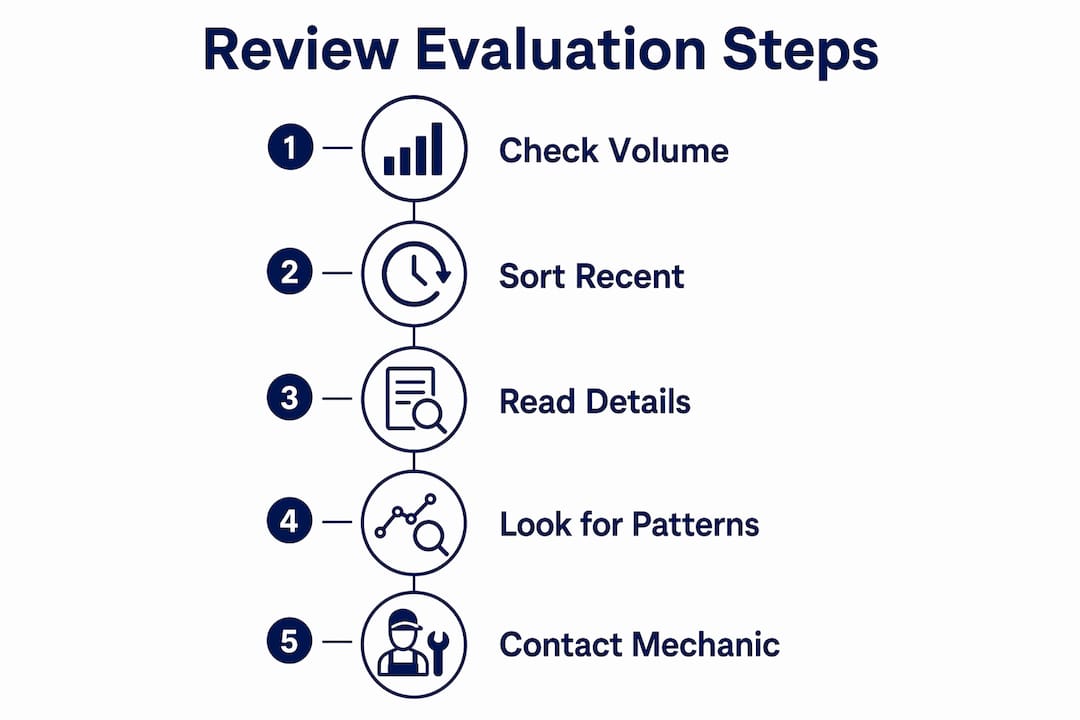
- Step 1. Filter to the most recent 90 days and read 10–15 reviews in full. Note any repeated complaints or repeated praise.
- Step 2. Read all 2 and 3-star reviews. These contain the most useful detail about real service issues.
- Step 3. Search the review text for keywords: “on time,” “hidden fees,” “explained,” “called back,” and “re-repair.”
- Step 4. Check the business responses to negative reviews. Look for professionalism and resolution, not defensiveness.
- Step 5. Cross-reference what you read with a direct phone call. Two minutes on the phone reveals pricing transparency and communication style that reviews alone cannot confirm.
The phone call step is underused. Ask for an estimate before the mechanic arrives. A provider who gives clear estimates before work starts and avoids surprise charges after the job is done has already passed the most important test. Reviews tell you what past customers experienced. The phone call tells you what you are about to experience.
Pro Tip: Prepare two or three questions from your review research before calling. If reviewers mentioned unclear pricing, ask directly: “Do you provide a written quote before starting?” The answer tells you everything.
Understanding why punctuality and transparency matter in mobile mechanic reviews becomes clearer when you see how often those two factors appear in positive feedback across hundreds of reviews.
Key Takeaways
Reading mobile mechanic reviews effectively requires checking volume, recency, written detail, and business responses before making any decision based on star ratings alone.
| Point | Details |
|---|---|
| Prioritize volume and recency | Seek 100+ reviews and filter to the last 90 days before reading anything. |
| Read mid-range reviews first | Two and three-star reviews contain the most specific, useful complaints. |
| Search for keyword patterns | Terms like “hidden fees,” “on time,” and “re-repair” reveal real service quality. |
| Check business responses | Professional replies to complaints signal accountability and customer focus. |
| Verify with a phone call | A direct call confirms pricing transparency and communication style that reviews cannot. |
What I have learned from years of watching car owners choose mechanics
Most car owners spend more time reading restaurant reviews than mechanic reviews. That gap is expensive. A bad meal costs you an hour. A bad mechanic can cost you hundreds of dollars and a week without your car.
The single biggest mistake I see is trusting a perfect score with almost no reviews behind it. A 5.0 from six people means six people had a good day. It does not mean the business is reliable. Statistical reliability requires volume, and volume takes time to build. A mechanic with 150 reviews and a 4.4 rating has earned that number across real, varied experiences.
The second mistake is skipping the mid-range reviews entirely. Most people read the five-star reviews to feel good about their choice and the one-star reviews to check for disasters. The 2 and 3-star reviews sit in the middle, ignored, and they contain the most honest information available. That is where you find out a mechanic consistently runs 30 minutes late, or that the quote always changes after the job starts.
The phone call step changes everything. Reviews tell you about the past. A two-minute call tells you about right now. Ask for a quote. Ask if they provide a written invoice. Ask how they handle a repair that does not fix the problem. The answers reveal more than 50 reviews ever could. Onsite Los Angeles Mobile Mechanic provides upfront quotes before any work begins, which is exactly the behavior you should be screening for when you call any mobile mechanic. For families weighing safety alongside service quality, understanding why mobile mechanics are safer for families adds another layer to the decision.
— Aaron
Onsite Los Angeles Mobile Mechanic: service that holds up under scrutiny
Car owners who apply the review-reading process described here will find that Onsite Los Angeles Mobile Mechanic consistently meets the criteria that matter. Transparent upfront pricing, clear communication, and professional accountability show up repeatedly in customer feedback across the greater Los Angeles area.
Onsite Los Angeles Mobile Mechanic comes directly to your location, whether that is your home, office, or parking lot. Services like oil changes and battery replacements are completed within an hour, with no hidden fees added after the job. The full list of mobile repair services covers the most common repairs Los Angeles drivers need. Call 213-583-4159 to get an upfront quote and book your appointment directly. No app required.
FAQ
How many reviews should a mobile mechanic have before I trust them?
Experts recommend a minimum of 30–50 reviews for basic reliability, with 100 or more reviews needed for a statistically meaningful assessment of service quality.
Are star ratings enough to evaluate a mobile mechanic?
Star ratings alone are not sufficient. Written reviews with specific details about punctuality, pricing, and communication provide far more reliable insight than a numerical score.
What keywords should I search for in mechanic reviews?
Search for terms like “on time,” “hidden fees,” “explained the repair,” and “re-repair.” These phrases reveal real service patterns that star ratings do not capture.
How do I spot fake or unreliable reviews?
A perfect 5.0 score from fewer than 10–20 reviews is a warning sign. Also watch for sudden spikes in review volume, generic praise with no specific details, and no business responses to any negative feedback.
Should I call a mechanic before booking, even after reading reviews?
A two-minute phone call before booking confirms pricing transparency and communication style. Ask for an estimate upfront and confirm they provide a written invoice before work begins.