Mobile mechanic ratings systems are the primary trust filter car owners use to evaluate repair quality before a technician ever touches their vehicle. Unlike a traditional shop where you can walk in and read the room, a mobile mechanic arrives at your home or office with no physical storefront to judge. That makes online ratings and customer reviews the closest thing to a personal recommendation most car owners will ever get. Between 88% and 93% of consumers read online reviews before hiring a local service provider. That figure alone explains why mobile mechanic ratings systems matter far beyond a simple star count. Onsite Los Angeles Mobile Mechanic operates in this exact environment, where every review shapes the next customer’s decision.
Why do mobile mechanic ratings systems matter so much?
Ratings systems function as a public accountability record for every mechanic who works outside a traditional shop. When a car owner in Los Angeles searches for a mobile mechanic, the first thing they see is a star rating and a review count. That combination tells a story about reliability, communication, and technical skill before a single word is read.
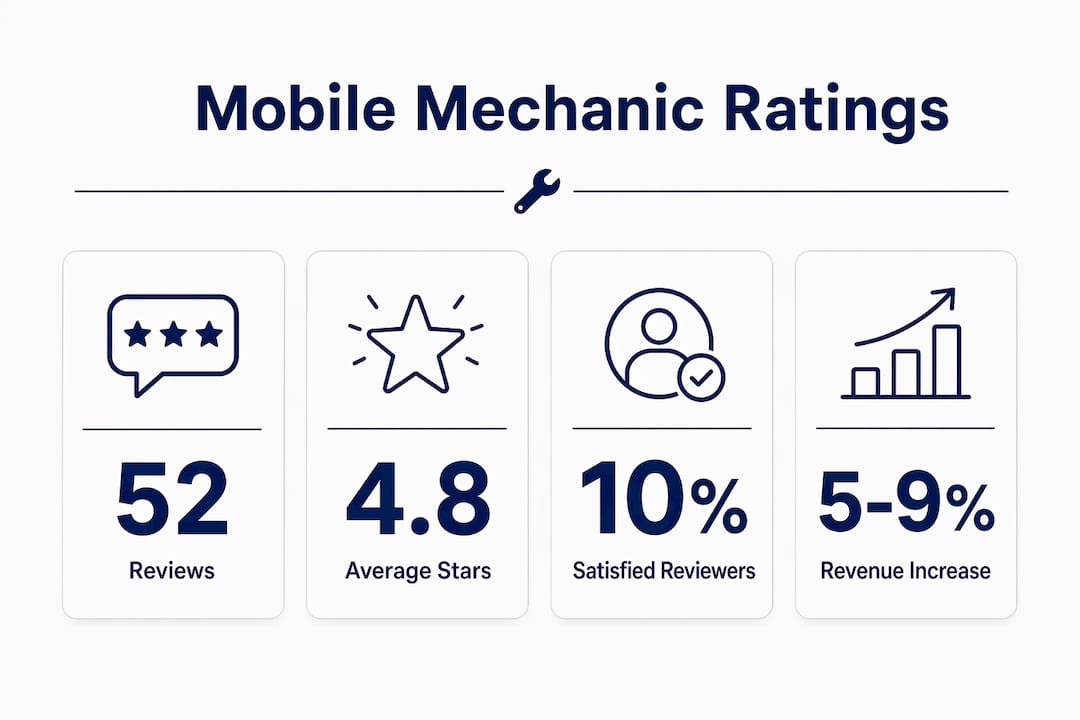
The financial stakes behind ratings are real. A one-star increase in online rating correlates to a 5–9% increase in total revenue for service businesses. That is not a marginal gain. It reflects how directly customer perception drives purchasing behavior in a service market where trust is the product.
Review volume amplifies that effect. Businesses with 50 or more reviews typically generate 4.6 times more service inquiries than those with fewer. More reviews mean more data points, and more data points mean car owners feel confident they are reading a representative picture of the mechanic’s work, not a lucky streak.
Ratings also affect digital visibility. Search engines treat review volume and recency as signals of business activity and credibility. A mechanic with consistent, recent reviews ranks higher in local search results. That means the importance of mechanic ratings extends beyond customer trust directly into how easy it is to find a service provider in the first place.
- Revenue impact: A one-star rating improvement drives 5–9% more revenue.
- Inquiry volume: 50+ reviews produce 4.6 times more customer inquiries.
- Search visibility: Review activity improves local search rankings.
- Trust shortcut: Ratings replace the physical storefront as the first credibility signal.
- Feedback loop: Higher ratings attract more customers, who leave more reviews.
Does review volume matter more than a perfect star average?
A mechanic with 52 reviews at 4.8 stars is statistically more trustworthy than one with 4 reviews at 5.0 stars. High review volume shows sustained consistency across many different customers and situations. Four perfect scores could reflect four friends, four unusually easy jobs, or four reviews from the same week. Fifty reviews reflect a pattern.
The challenge is that most satisfied customers never leave a review without being asked. Only about 10% of satisfied customers leave unsolicited feedback. That means a mechanic’s rating, left to chance, reflects a small and often unrepresentative sample of their actual work. Unhappy customers are far more motivated to write than happy ones, which skews averages downward for mechanics who never ask for feedback.
Automated review requests sent 24 hours after job completion solve this problem directly. When mechanics use systems that prompt customers shortly after service, review rates climb to 40–60%. That is a representative sample. It means the rating you read reflects the actual customer experience, not just the loudest voices.
Pro Tip: When reading reviews, filter by “most recent” rather than “most helpful.” A mechanic who was excellent two years ago may have changed staff, pricing, or quality. Recency tells you what to expect next week, not what happened last year.
The content of reviews matters as much as the count. Filtering for keywords like “communication” and “fixed right the first time” gives you a faster read on service quality than scanning star averages. Those phrases signal that the mechanic diagnosed correctly, explained the work clearly, and did not create a return visit.
What trust factors matter beyond the star rating?
Star ratings are a starting point, not a complete picture. Consumer Reports recommends evaluating repair shops on 12 attributes beyond the star average, including honesty, communication quality, and whether the repair was done correctly the first time. Car owners who rely only on a number miss the most important signals.
Licensing and insurance are non-negotiable. A mobile mechanic works on your vehicle at your location, which means any damage or liability falls on you if the mechanic is uninsured. Asking directly whether a mechanic carries liability insurance and holds a valid license is not rude. It is the minimum due diligence for any repair that costs more than a tank of gas.
Transparent pricing is a direct trust signal. Trusted mechanics prioritize transparent communication and accountability over being the cheapest option. A mechanic who gives you an upfront quote and sticks to it demonstrates integrity. One who quotes low and adds fees after the job is done demonstrates the opposite. Understanding honest mechanic pricing before you book protects you from that pattern.
Pro Tip: Before booking any mobile mechanic, ask one diagnostic question about your car’s symptom. A qualified mechanic will engage with the question directly. One who deflects or rushes to quote without asking follow-up questions is a red flag.
The full checklist for evaluating mobile mechanic trust factors includes:
- Licensing: Confirm the mechanic holds a valid state license.
- Insurance: Verify liability coverage before work begins.
- Upfront pricing: Get a written or confirmed quote before the job starts.
- Communication style: Assess how clearly they explain the diagnosis.
- Warranty on work: Ask whether parts and labor carry any guarantee.
- Review content: Look for patterns in written feedback, not just the star count.
How to use rating systems to choose a mobile mechanic
Reading ratings effectively is a skill. Most car owners glance at the star average and move on. The ones who make better decisions spend two extra minutes reading the actual text of recent reviews.
Start by sorting reviews by date. A mechanic’s most recent reviews reflect current service quality more accurately than an overall average built over years. A business that was excellent in 2023 but changed staff in 2025 will still carry a high average that no longer reflects reality.
Next, look for patterns in the language. Reviews that repeatedly mention “showed up on time,” “explained everything,” and “car runs perfectly” signal a mechanic who performs consistently. Reviews that cluster around “took longer than quoted” or “had to come back” signal a recurring problem, even if the star average looks acceptable.
- Sort by recency. Read the last 10–15 reviews before looking at the overall average.
- Scan for recurring phrases. Positive patterns like “on time” and “fixed correctly” carry more weight than isolated praise.
- Check review volume. Fewer than 20 reviews means the sample is too small to trust fully.
- Look for owner responses. A mechanic who responds to negative reviews professionally shows accountability.
- Cross-reference platforms. A consistent rating across multiple review platforms is more credible than a high score on one alone.
Platforms that aggregate verified reviews for mobile mechanics give you a broader picture than a single source. Verified reviews come from confirmed customers, which reduces the risk of fake or incentivized feedback distorting the picture. When you combine verified review data with the qualitative reading approach above, you have a genuinely reliable method for evaluating mobile mechanic services before committing.
Key Takeaways
Mobile mechanic ratings systems matter because they combine volume, recency, and review content to give car owners a reliable picture of service quality that no single star average can provide alone.
| Point | Details |
|---|---|
| Volume beats perfection | 52 reviews at 4.8 stars is more trustworthy than 4 reviews at 5.0 stars. |
| Recency reveals current quality | Filter by newest reviews to assess what the mechanic delivers today, not two years ago. |
| Automation improves accuracy | Automated post-job review requests raise response rates to 40–60%, making ratings more representative. |
| Trust factors extend beyond ratings | Licensing, insurance, and upfront pricing are non-negotiable checks that star averages cannot replace. |
| Keywords signal real performance | Phrases like “fixed right the first time” and “clear communication” predict consistent service quality. |
The part of ratings most car owners skip
The most underused part of any rating system is the written review, not the star count. Car owners spend five seconds on the number and skip the paragraph that actually explains what happened. That paragraph is where the real information lives.
Ratings systems have genuinely changed accountability in the mobile mechanic industry. A mechanic who would have gotten away with sloppy work in 2005 now faces a permanent public record. That shift benefits car owners directly. But the system only works if you engage with it seriously, both as a reader before you book and as a contributor after the job is done.
The balance between digital ratings and direct conversation still matters. No review tells you how a mechanic responds when you ask a hard question about your specific car. Call before you book. Ask about your symptom. The way a mechanic handles that conversation tells you something a review cannot.
Over-relying on star counts without reading the qualitative content is the most common mistake car owners make. A 4.2-star mechanic with 80 detailed, recent reviews describing clear communication and correct first-time repairs is a better choice than a 4.9-star mechanic with 6 reviews from three years ago. The number is a headline. The reviews are the story.
— Aaron
Onsite Los Angeles Mobile Mechanic: rated on what actually matters
Onsite Los Angeles Mobile Mechanic builds its service around the exact factors that experienced car owners look for in reviews: upfront pricing, clear communication, and repairs done correctly the first time. Every job comes with a transparent quote before work begins, no hidden fees, and no pressure.
Car owners across the greater Los Angeles area can book service directly by calling 213-583-4159. Onsite Los Angeles Mobile Mechanic comes to your home, office, or parking lot, covering everything from oil changes to battery replacements, typically completed within an hour. See the full list of available mobile repair services and find out why consistent, verified reviews keep bringing Los Angeles drivers back.
FAQ
Why do mobile mechanic ratings systems matter more than shop ratings?
Mobile mechanics have no physical storefront, so online ratings are the only credibility signal available before the mechanic arrives. Between 88% and 93% of consumers read reviews before hiring a local service provider, making ratings the primary trust filter in mobile auto repair.
How many reviews should a mobile mechanic have before I trust the rating?
Businesses with 50 or more reviews generate 4.6 times more inquiries and provide a statistically reliable picture of service quality. Fewer than 20 reviews means the sample is too small to draw confident conclusions.
What keywords should I look for in mobile mechanic reviews?
Filter for phrases like “fixed right the first time,” “showed up on time,” and “explained the problem clearly.” These patterns signal consistent technical accuracy and communication quality across multiple customers.
Does a 5-star rating always mean the best mechanic?
A perfect 5-star average with very few reviews is less reliable than a 4.7 or 4.8 average built across 50 or more reviews. High volume with consistent positive feedback shows sustained performance, not a lucky streak.
What should I check beyond the star rating when choosing a mobile mechanic?
Consumer Reports recommends evaluating mechanics on 12 attributes including honesty, communication, and whether repairs are done correctly the first time. Always confirm licensing, insurance coverage, and upfront pricing before any work begins.