If your AC is cold on the freeway and turns lukewarm at a red light, the system is usually short on airflow across the condenser, short on refrigerant, or running a compressor that struggles at low engine speed. The most common culprit is a cooling fan that isn’t pulling enough air. You can run one simple test in your driveway to narrow it down, and most of the fixes can be done at your location without a tow.
TL;DR
- At idle there is no wind through the grille, so the condenser depends entirely on its electric fan. A weak or dead fan is the most common reason for warm air at a stop.
- Low refrigerant means a leak. Adding a can of refrigerant without finding the leak is a temporary patch at best.
- The RPM test (raise the engine to 1,500 to 2,000 RPM in park) tells you whether the problem is airflow or something deeper.
- Handling refrigerant legally requires an EPA-certified technician, so leave the recharge and leak repair to a professional.
- In Los Angeles, call Onsite Los Angeles Mobile Mechanic at 213-583-4159 and we will diagnose it where your car is parked.
Table of Contents
- Why the AC gets warm when you stop
- The most likely causes, in order
- Try the RPM test first
- What a healthy system should show
- Why you shouldn’t just add refrigerant
- Our perspective: LA traffic is the real stress test
- When to call a mechanic
- What to expect from a mobile AC visit
- Book an on-site AC diagnosis
- FAQ
- Sources
Why the AC gets warm when you stop
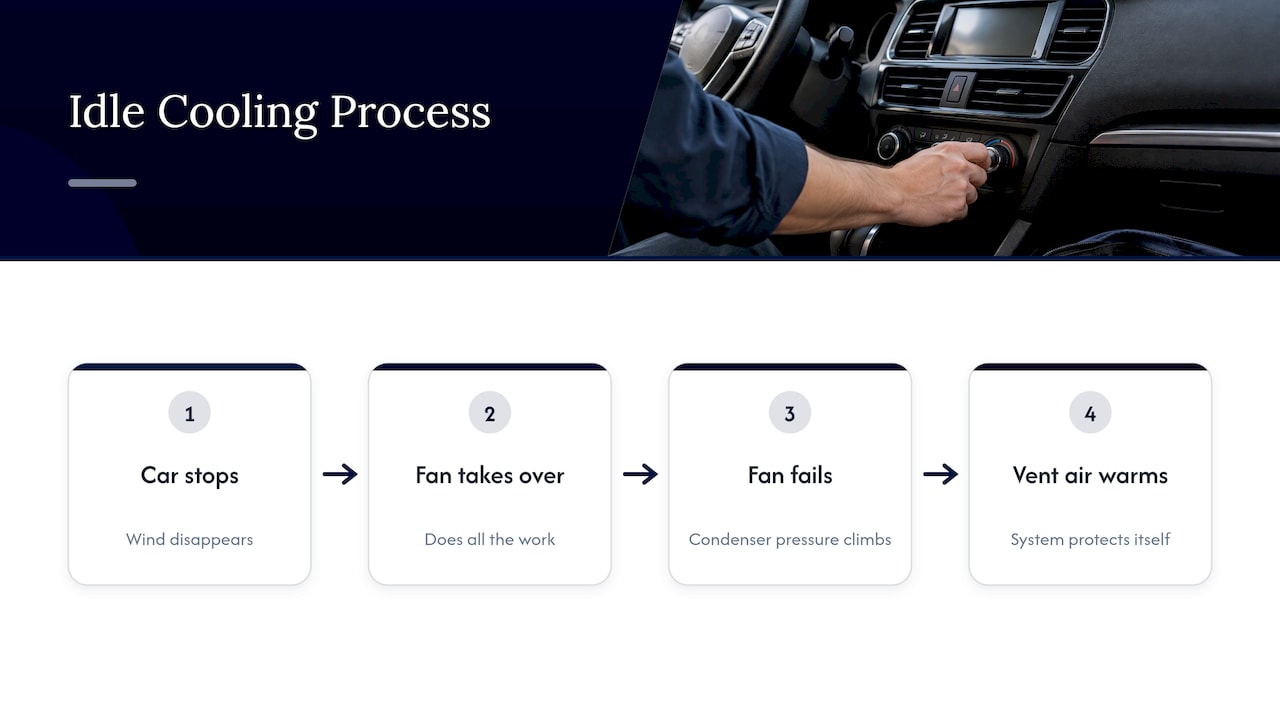
Your AC moves heat from the cabin to the air outside. The part that dumps that heat is the condenser, a small radiator mounted at the front of the car. For it to work, air has to pass through it.
When you drive, the grille does that job for free. When you stop, the wind disappears and the electric cooling fan has to do all the work. According to technicians at Hal’s Auto Care, if those fans fail, condenser pressure climbs quickly and the system gives you warmer vent air to protect itself.
The compressor adds a second factor. It is belt-driven, so at idle it spins slowly. A healthy compressor still copes. A tired one, or a system with a marginal refrigerant charge, does not. That is why the symptom shows up first at the weakest moment: sitting still, in traffic, in the sun.
This pattern matters. A system that never gets cold is a different problem from one that is only warm at idle, and the idle-only version usually means the system is close to working and something specific is holding it back. If your AC fails in other ways, our guide to what to do when your car AC isn’t cooling covers the wider picture.
The most likely causes, in order
One repair shop’s write-up attributes roughly 40% of warm-at-idle cases to failed condenser fans and about 30% to low refrigerant. Treat those as one shop’s rule of thumb, not a national statistic, but the ranking matches what most diagnostic guides say.
| Cause | What you notice | Typical clue |
|---|---|---|
| Condenser or radiator fan weak or dead | Cold at speed, warm at stops | Fan doesn’t spin when AC is on; engine temp may creep up |
| Low refrigerant from a leak | Cooling slowly fades over weeks | Clutch cycles on and off rapidly; oily residue on AC lines |
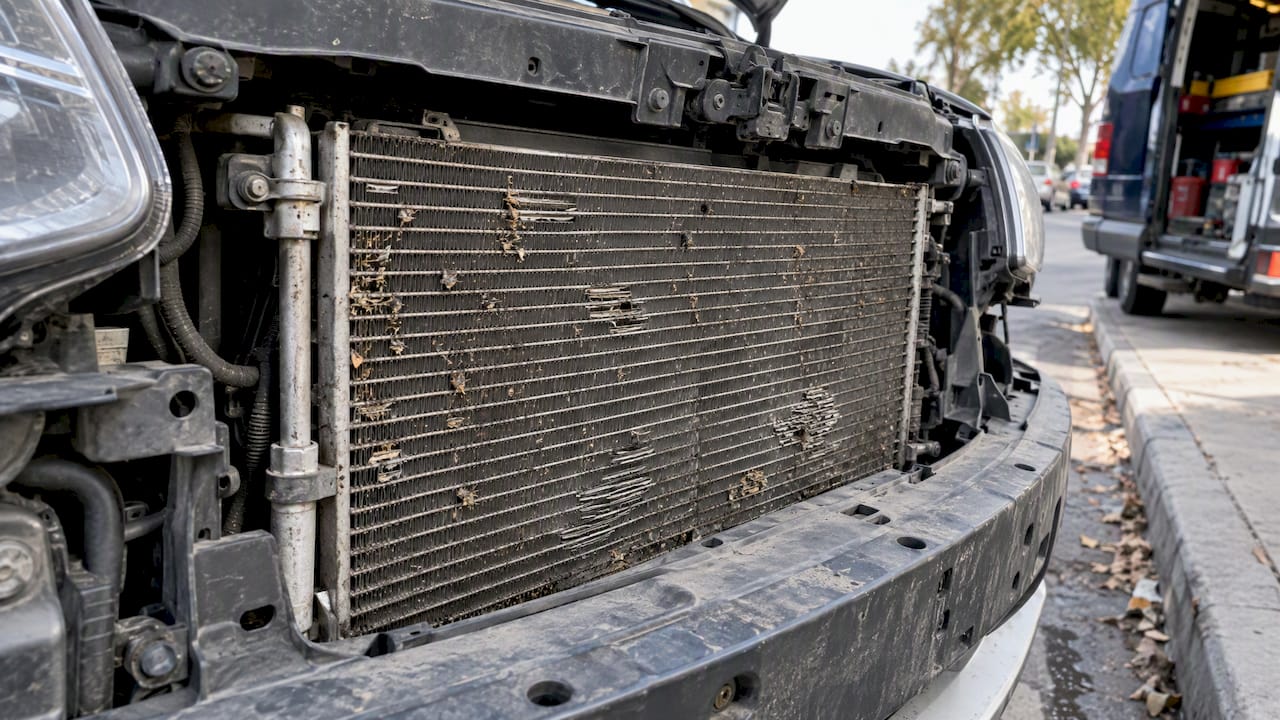
| Dirty or bent condenser fins | Cooling worse in heat and traffic | Bugs, leaves or road debris visible through the grille |
| Worn compressor or slipping clutch | Noise, warm air that improves with revs | Grinding or squealing when AC engages |
| Belt or drive problems | Intermittent cooling | Squeal on startup, worn or glazed belt |
| Engine running hot | Warm AC and a rising temperature gauge | Overheating at stops |
Cooling fans
On most cars the same fan or fans serve the radiator and the condenser. A failed motor, a bad relay, a blown fuse or a corroded connector can each stop the fan. The result is the same: no airflow at idle. A quick visual check is simple. With the engine warm and the AC on max, look through the grille or pop the hood and see if a fan is spinning. Our page on what to check when a cooling fan isn’t working lists safe checks you can do first.
Low refrigerant
Automotive AC is a sealed system. Refrigerant is not a consumable like oil. The EPA notes that recharging without fixing leaks misses the point, because stopping leaks protects both the environment and cooling performance. If the charge is low, something has escaped.
Low charge shows up at idle first because the system has less margin when the compressor is turning slowly. On the highway it can still manage to cool, so many drivers don’t notice until summer.
Blocked condenser
The condenser sits at the very front, exposed to bugs, dirt and debris. If the fins are clogged or bent flat, air can’t pass even when the fan works. A gentle rinse from behind or in front, with low pressure and never aimed hard at the fins, sometimes helps. Heavy damage means replacement.
Compressor and clutch
A failing compressor often announces itself with noise or a clutch that won’t engage consistently. If you hear grinding, or the center of the pulley isn’t spinning when the AC is on, see our guides to AC compressor symptoms you can hear, feel and see and what to check when the AC clutch isn’t engaging.
Engine cooling problems
Because the AC condenser sits in front of the radiator, a hot engine heats the air passing through it. If your temperature gauge rises at stops along with the warm AC, the engine cooling system is part of the story. A leaking hose or a weak thermostat can show up this way. Read about coolant leaks and fast diagnosis if you see drips or smell something sweet.
Try the RPM test first
This takes two minutes and gives you a useful clue. Auto Clima Guide describes it like this:
- Park on level ground, set the parking brake and put the car in park (or neutral for a manual).
- Turn the AC to maximum cold, with the fan on high and recirculation on.
- Let the engine idle for a few minutes and note how the air feels.
- Gently raise engine speed to about 1,500 to 2,000 RPM and hold it for a minute.
- Compare the vent air.
If the air gets much colder when you rev, the likely problem is airflow (a dead fan, a clogged condenser) or a compressor that is weak at low speed. If the air stays warm at any engine speed, you are probably looking at a refrigerant or compressor problem rather than an idle-only one.
Two cautions. Keep your foot steady and don’t hold high revs for long if the temperature gauge is climbing. And do not do this with the hood open while reaching near belts or fans; use the grille to look, not your hands.
What a healthy system should show
A working AC typically blows roughly 35 to 48°F at the center vent in moderate conditions. A cheap thermometer in the vent gives you a number to compare at idle and at 2,000 RPM. Write down both, plus the outside temperature. That information helps a mechanic a great deal.
Proper diagnosis also uses a manifold gauge set to read the high-side and low-side pressures at idle and at raised RPM. The pattern of those readings separates a fan problem from a charge problem from a compressor problem. Guessing is how people end up replacing parts that were fine. Our guide on why AC blows cold then warm covers timing-related checks if your symptom comes and goes while driving.
Why you shouldn’t just add refrigerant
This is the most tempting shortcut and the one most likely to cost you more.
- It hides a leak. If the charge is low, there is a leak. Topping it off buys you days or weeks.
- Overcharging is easy. Without gauges, you can overfill the system. Too much refrigerant creates unstable pressures and can damage the compressor.
- Oil goes with the leak. Compressor oil circulates with the refrigerant, so a worsening leak can starve the compressor of lubrication. Ladson Auto makes this point as the reason a simple recharge can end in a failed compressor.
The same principle applies to other problems on a car. A UK guide on tracing a car smell to its source before treating it makes the same argument about interior odors: find the cause first, or the problem returns. A musty smell from your vents, by the way, can be a sign of moisture in the AC case, so it’s worth mentioning to your mechanic.
There is also a legal side. Under section 609 of the Clean Air Act, venting refrigerant is illegal and recovered refrigerant must be handled with certified equipment. EPA’s overview of motor vehicle AC servicing explains who can do this work. If someone charges you for AC refrigerant work, the technician should be certified. Ask to see it.
Our perspective: LA traffic is the real stress test
We see the same pattern every summer. A driver has an AC that works fine on the 405 at 60 mph, then fails on a stop-and-go afternoon on the 10 or in a parking lot with the car baking in the sun. Los Angeles driving is hard on this system because it asks the AC to perform at idle, in heat, for long stretches.
That shapes how we approach it:
- Start with airflow, not refrigerant. Fans, relays, fuses and the condenser face cost less to check than a full recharge, and they are the most common reasons for the symptom. We confirm the fan actually runs before we touch anything else.
- Measure, then quote. We take vent temperatures and pressures and tell you what we found before any work starts. You get an upfront price with no hidden fees.
- Fix leaks, not symptoms. If the system is low, we want to know why. A recharge that lasts one summer isn’t a repair.
- Do it where you are. A bad fan or a failed relay doesn’t need a tow. We come to your home, your office or the lot where the car sits, which saves you a day without a vehicle.
One honest note: some AC repairs are bigger than a driveway visit suggests. A failed compressor, for example, can mean replacing related parts and flushing the system. We will tell you if a job is more involved and walk you through why.
When to call a mechanic
Call sooner rather than later if:
- The AC cools only when you rev the engine.
- The temperature gauge rises at stops.
- You hear grinding, squealing or rattling when the AC turns on.
- The cooling fan doesn’t spin when the AC is on and the engine is hot.
- You see oily residue on AC lines or fittings.
- The AC cycles on and off rapidly.
- The warm air comes with a rising engine temperature. Pull over safely and turn off the AC if the gauge climbs toward hot. An overheating engine is a bigger problem than a warm cabin.
A weak vent flow with a dead blower is a different issue, covered in our page on what to do when the AC blower is dead.
What to expect from a mobile AC visit
Here is how a typical visit goes with us:
- You call. Tell us the year, make and model, and when the AC fails (at idle, in heat, after a long drive).
- We come to you. Same-day service is possible, and we are available seven days a week.
- We diagnose. We check vent temperature, fan operation, condenser condition, belt and clutch, and system pressures.
- You get a clear quote. We explain the finding and the price before work begins.
- We repair on site where the job allows it, using quality parts and certified mechanics.
Price depends on the cause. A fan relay is a very different bill from a compressor. If the question on your mind is cost, our page on what drives AC recharge cost explains what separates a fair price from an inflated one.
Book an on-site AC diagnosis
Onsite Los Angeles Mobile Mechanic covers auto diagnostics, AC repair, overheating repairs, belt replacement, alternator repair and more across the greater Los Angeles area. We don’t have an app. To book, call 213-583-4159 and tell us your AC only fails at idle. We’ll start with the checks above and tell you what is wrong before you spend anything on parts.
FAQ
Why does my AC get warm when I’m stopped?
At a stop, no air flows through the grille, so the condenser relies on the electric fan. If the fan is weak or the refrigerant is low, the system can’t shed heat and the vents warm up. The compressor also turns more slowly at idle, which exposes any other weakness.
Is it safe to drive with AC that’s warm at idle?
Usually yes, as long as the engine temperature stays normal. If the gauge rises at stops, turn off the AC and pull over safely, because the fan may be failing and the engine could overheat. Have it checked soon either way.
Can I fix it with a store-bought recharge can?
We don’t recommend it. Low refrigerant means a leak, and the EPA warns about recharging without addressing leaks. Overfilling can also harm the compressor. A professional should find the leak and charge the system to the correct amount.
Why is the AC cold on the highway but warm in traffic?
At highway speed, wind forces air through the condenser and the compressor spins faster. In traffic both advantages disappear. That is why the RPM test helps: if revving the engine cools the air, airflow or compressor speed is the likely issue.
Sources
- What Does It Mean When the AC Blows Warm at Idle, Hal’s Auto Care
- Why is My Car AC Blowing Warm Air at Idle? Ladson Auto
- Car AC Not Cold at Idle? Auto Clima Guide
- Options for Recharging Your Air Conditioner, US EPA
- EPA Regulatory Requirements for Motor Vehicle A/C System Servicing, US EPA
- Servicing Motor Vehicle Air Conditioners, US EPA