A failing AC expansion valve usually shows up as warm or fluctuating air from the vents, frost on the AC lines or the evaporator outlet, and a compressor that runs constantly or cycles on and off. Those signs overlap with a low refrigerant charge, a clogged filter and a weak compressor, so the symptom alone is not a diagnosis. Below you will find what each sign means, how to separate the valve from its look-alikes, what the repair involves, and what it typically costs.
TL;DR
- The classic signs are warm vent air, frost on the suction line or near the evaporator, and erratic cooling that comes and goes.
- Low refrigerant, a dirty cabin air filter and a failing compressor can mimic a bad valve, so confirm with pressure readings before replacing parts.
- Expansion valve or orifice tube replacement typically runs $200 to $500 with parts and labor, and the part itself is cheap. Labor is the bulk of the bill.
- Don’t keep driving with the AC running hard: a stuck valve can damage the compressor, which is a far costlier repair.
- AC service on a vehicle legally requires an EPA-certified technician, so this is not a driveway job.
Table of Contents
- What the expansion valve does in your car’s AC
- Bad expansion valve symptoms
- Stuck closed versus stuck open
- Is it the valve, low refrigerant, or something simpler?
- Why this is not a driveway repair
- What replacement involves, and what else gets replaced
- How much does expansion valve replacement cost?
- Our perspective: diagnose first, then replace
- When to call us
- FAQ
- Sources
What the expansion valve does in your car’s AC
Your AC works by moving refrigerant through a loop. The compressor pressurizes it, the condenser sheds heat, and then the refrigerant has to drop sharply in pressure and temperature before it enters the evaporator, the small radiator-like core behind your dash that actually chills the cabin air. The expansion valve (often called a TXV) or, in many cars, a fixed orifice tube is the restriction point that makes that drop happen. R&Y Compressors describes it as exactly that: the point where pressure and temperature fall before the refrigerant reaches the evaporator.
A thermostatic expansion valve does one more thing: it meters how much liquid refrigerant enters the evaporator based on the heat load. Its job is to hold a specific superheat condition at the evaporator outlet, according to a Sporlan field service bulletin. It is not a thermostat in the everyday sense. When it sticks, clogs or drifts out of range, the whole system loses balance.
Not every car has one. Many vehicles use an orifice tube instead, which is a fixed restriction with no moving parts. It can still clog with debris, and it produces similar symptoms. If you are wondering whether an AC can work without either part: no. Without a restriction the refrigerant never drops in pressure and temperature, so the evaporator cannot cool the air.
Bad expansion valve symptoms
The sources that cover this topic agree on a short list. Common signs include warm or fluctuating air, frost forming on the vents or suction line, and inconsistent cooling. All of them trace back to the valve failing to regulate refrigerant flow into the evaporator.
Warm air from the vents
This is the most obvious sign and the least specific. If the AC blows lukewarm air on max cold, the cause could be a refrigerant leak, a failing compressor or a clogged expansion valve. A valve stuck closed starves the evaporator of refrigerant, so there is nothing to absorb the cabin’s heat.
Air that cools, then doesn’t
A valve that is partly sticking can let the AC work for a few minutes and then lose it, or swing between cool and warm. If that sounds like your car, our guide on AC that blows cold then warm walks through the timing and airflow checks that separate a valve problem from a freezing evaporator or a cycling clutch.
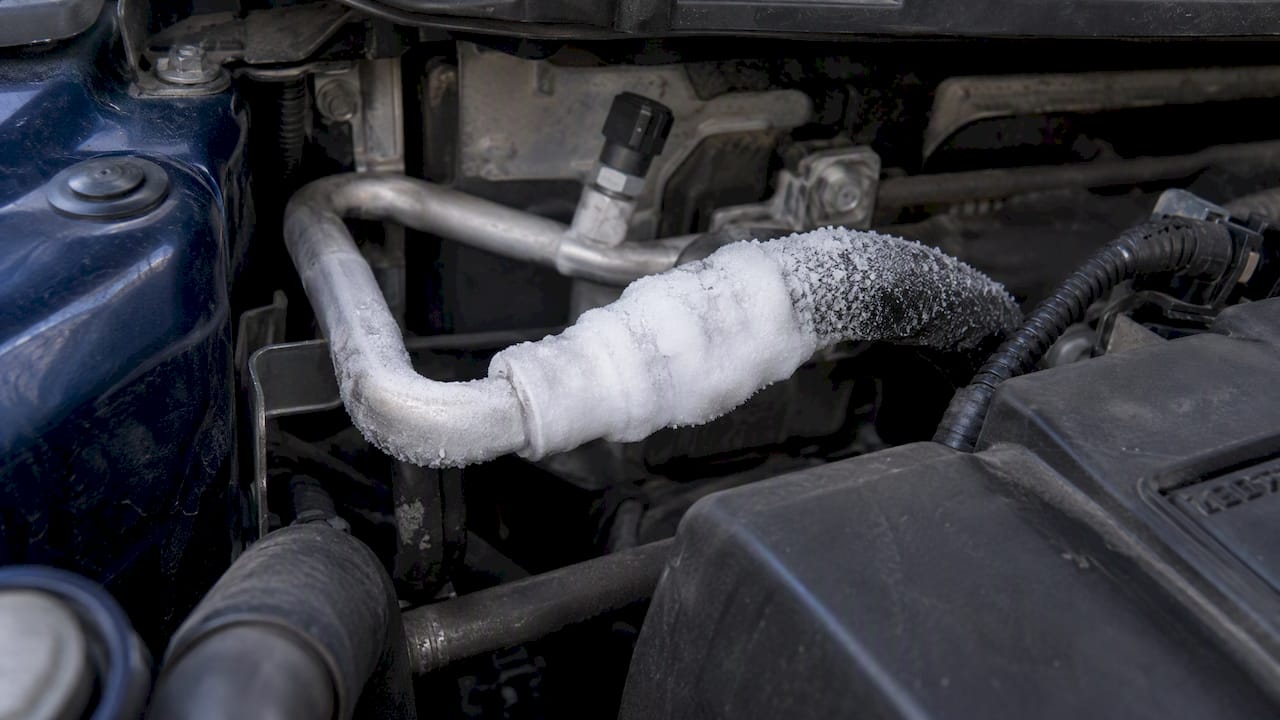
Frost or ice on lines or at the evaporator
Frost on the suction line, on the evaporator outlet, or on or around the valve itself is the sign that points most strongly at the valve. It happens when the pressure drop is wrong and part of the system gets far colder than it should. This is also the key differentiator from a simple low charge: a low charge typically shows high superheat without frosting, per R&Y Compressors.
A compressor that runs nonstop or cycles oddly
When the valve is stuck, pressures on the low and high side go out of range. The compressor may run constantly because the system never reaches its target, or it may cycle on and off as protective switches react to abnormal pressure. If you hear the clutch clicking rapidly or the compressor groaning, read our rundown of AC compressor symptoms as well.
Oil or dye around the valve
Refrigerant oil residue or leak dye at the valve connection suggests a leak at the valve or its seals. That is a different failure from a stuck valve, but it lives in the same spot and is fixed in the same visit.
Abnormal pressure readings
Only a technician with gauges sees this one. Low suction pressure and high superheat are common findings with a restricted valve, as described in HVAC service tech tips. The numbers matter because they separate this problem from a simple recharge.
Stuck closed versus stuck open
The two failure modes hurt in different ways, and both put the compressor at risk. Nissens’ technical support page explains that a valve stuck closed starves the compressor of cooling and lubrication, while a valve stuck open can let liquid refrigerant flood the compressor, a condition called slugging. Either can lead to compressor failure.
| Failure mode | What happens inside | What you notice |
|---|---|---|
| Stuck closed or restricted | Too little refrigerant reaches the evaporator | Warm air, frost on the valve or lines, compressor strain |
| Stuck open | Too much refrigerant, with liquid reaching the compressor | Poor or erratic cooling, risk of slugging |
| Clogged by debris | Flow is partly blocked | Cooling that fades or swings, often after another AC failure |
That risk is the practical reason not to “wait and see” through a Los Angeles summer. A $200 to $500 valve job is a lot cheaper than a new compressor.
Is it the valve, low refrigerant, or something simpler?
A lot of valves get replaced that did nothing wrong. The Sporlan bulletin notes that many valves are needlessly replaced when the real cause of the malfunction isn’t recognized right away. Here is how to think through the look-alikes.
- Dirty cabin air filter or blocked airflow. Weak airflow over the evaporator can mimic valve failure. This is the cheapest thing to rule out. If your filter is overdue, we can handle air and cabin filter replacement at your location.
- Low refrigerant. The system is leaking, and cooling fades gradually. Frost is not typical with a low charge, while it is with a valve problem. Our piece on AC not cooling covers this path, and what drives AC recharge cost explains why a recharge without finding the leak is money wasted.
- Blower or blend door trouble. If air volume is the issue rather than temperature, see AC blower motor not working.
- Clutch not engaging. If the compressor never kicks in at all, start with the AC clutch checks.
- Condenser fan not running. Poor heat rejection produces warm air at idle and better cooling on the highway. See cooling fan not working.
How a technician confirms a bad valve
A technician connects a gauge set and watches how the system responds. On a TXV system, one function test is to change the blower speed and watch low-side pressure. According to Bergstrom’s service manual, a working system should show low-side pressure fluctuating noticeably within one to two minutes as the evaporator’s heat load changes. A valve that doesn’t respond is a suspect. Visual checks for frost, oil and dye add to the picture.

You can do a few non-invasive things before the appointment: note whether frost appears, whether the problem comes on after the car runs for a while, and whether the compressor clutch cycles. Write down what you see. It shortens diagnosis.
Why this is not a driveway repair
Swapping the valve is not the hard part. The system has to be opened, and that is regulated. Under Section 609 of the Clean Air Act, anyone who repairs or services a motor vehicle AC system for payment must be trained and certified through an EPA-approved program. Venting refrigerant is illegal, so the existing charge has to be recovered first.
The full job also includes pulling a vacuum and verifying system integrity, per this repair overview, which all requires specialized equipment. Skipping the vacuum leaves moisture in the system, and moisture is a good way to ruin your new parts.
When you hire anyone for AC work, it’s reasonable to ask whether their technician holds Section 609 certification.
What replacement involves, and what else gets replaced
A proper repair is more than a new part:
- Recover the refrigerant, then remove and replace the expansion valve or orifice tube.
- Use new O-rings lubricated with the correct oil. Damaged or poorly seated O-rings are a common cause of leaks after the repair, and often lead to a comeback visit.
- Evacuate the system, recharge to spec and check pressures.
- Look at the receiver-drier or accumulator. R&Y Compressors notes that replacing a compressor without also replacing the expansion valve and receiver-drier is a primary cause of repeat compressor failure, because debris from the damaged unit clogs the new valve.
The flip side matters too. If your valve clogged because the compressor shed debris, replacing only the valve will not fix the underlying problem. A good technician looks at the whole loop.
How much does expansion valve replacement cost?
The expansion valve itself is usually inexpensive. Industry data puts replacement at $200 to $500 total, with parts around $15 to $70 and labor typically one to three hours. Labor drives the price. Where the valve sits matters: on many vehicles it is tucked at the firewall or behind the dash, so access takes time.
Treat these as ballpark figures from a national source, not a quote. Your price depends on the vehicle, whether it uses an orifice tube or a TXV, whether the receiver-drier needs replacing, and the cost of refrigerant. Costs are higher if the compressor needs replacing too.
We don’t publish a flat price for AC repair, because it depends on what the diagnosis finds. What we do commit to is an upfront quote before work starts, with no hidden fees.
Our perspective: diagnose first, then replace
The most common mistake we see described in AC complaints is jumping to a part. A driver sees warm air, reads that the valve is bad, and orders one. The better path is slower for ten minutes and cheaper overall: check the filter and airflow, read pressures, look for frost, and only then condemn a part.
We also think timing matters more than most drivers realize. A weak AC in LA is easy to live with in October and miserable in July. But a stuck valve can quietly put the compressor under stress, so we’d rather you book the diagnosis when the symptoms first show up than after the compressor has failed.
The reason we do this work at your location is simple. An AC fault on a hot day is not a reason to lose half a day to a shop drop-off. We come to your home, office or wherever you park, with certified mechanics and quality parts, and many routine services finish within an hour. Some AC jobs take longer, and we’ll tell you that up front.
When to call us
Book a visit if you see any of the following:
- Warm air that doesn’t improve after a new cabin filter
- Frost on AC lines or around the valve
- A compressor that cycles rapidly or runs without cooling
- Cooling that fades after several minutes of driving
- AC trouble that appeared right after another AC component failed
Our Automotive AC Repair and Auto Diagnostic services are performed where your car is parked anywhere in the greater Los Angeles area, seven days a week, with same-day service available. We provide a transparent upfront quote before any work begins. There is no app: call us to book.
If you are still comparing options and wondering what to expect from a mobile AC service in general, read this overview of mobile AC repair options.
FAQ
How can I test if my AC expansion valve is faulty?
A reliable test needs a gauge set. A technician watches how low-side pressure responds when blower speed changes, and checks for frost and abnormal superheat. At home, you can only note symptoms like frost, warm air and compressor cycling, then rule out a dirty cabin filter. Because AC service legally requires a certified technician, bring in a professional for the pressure check.
What happens if my expansion valve is stuck closed?
Little or no refrigerant reaches the evaporator, so the air stays warm. The compressor is also starved of cooling and lubrication, which can shorten its life. Frost may form at the valve or on the lines. Stop running the AC and have it checked.
How much does it cost to replace an AC expansion valve?
National industry data suggests $200 to $500 including parts and labor, with the part itself usually costing $15 to $70. Your actual price depends on your vehicle and the other parts that need replacing. Call us for an upfront quote based on your car.
Can an AC work without an expansion valve?
No. The valve or an orifice tube creates the pressure drop that makes refrigerant cold enough to cool the evaporator. Without that restriction, the system can’t cool the cabin properly and the compressor can be damaged.
Can I fix it myself?
Not legally or practically in most cases. Servicing a vehicle AC for payment requires EPA Section 609 certification, and the refrigerant must be recovered rather than vented. The job also needs vacuum and charging equipment.
Sources
- Car AC Blowing Warm Air? R&Y Compressors
- Troubleshoot a defective expansion valve, R&Y Compressors
- How Much Does Car AC Repair Cost in 2026? Empire Auto Protect
- Faulty Expansion Valve (TXV), Nissens Support
- Thermostatic Expansion Valves, Sporlan bulletin
- HVAC All-In-One Unit General Service Manual, Bergstrom
- Section 609 Technician Training and Certification Programs, US EPA
- AC Expansion Valve Replacement: Costs & Hiring a Pro