A mobile mechanic is a licensed, insured automotive professional who performs vehicle repairs at your home, driveway, or workplace, making mobile auto repair for families a measurably safer choice than driving to a traditional shop. The core safety advantage is control. Your family stays in a familiar environment, you watch the repair happen, and you never need to load kids into a car to sit in a crowded waiting room. For busy Los Angeles families managing school pickups, work schedules, and unexpected breakdowns, that control is not a luxury. It is a genuine risk reduction strategy.
Why mobile mechanics are safer for families than traditional shops
Traditional repair shops create a chain of logistical risks that most families underestimate. You have to drive a potentially unsafe vehicle to the shop, arrange a ride home, manage children in a waiting room, and then repeat the trip to collect the car. Each of those steps adds exposure, stress, and opportunity for something to go wrong.
Mobile mechanics eliminate that chain entirely. Repairs happen at a location you choose, typically your home driveway or a flat parking area at your workplace. You stay put. Your kids stay put. The mechanic comes to you.
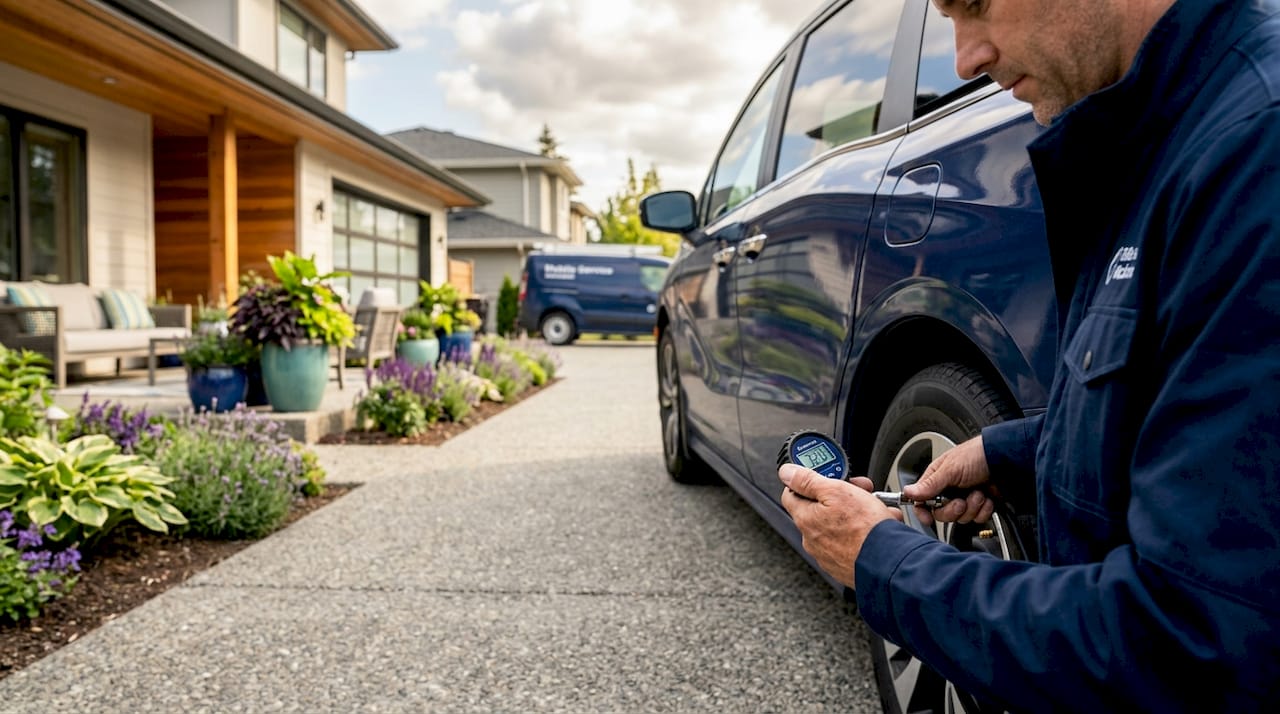
The safety conditions for mobile repair are specific. Repairs require a safe, flat area away from busy roads, which means you are actively selecting a controlled environment rather than handing your car off to an unknown shop floor. That single requirement forces a level of intentionality that traditional shop visits never demand.
Here is what a safe mobile repair environment looks like in practice:
- A residential driveway with enough clearance for the mechanic to work on all four sides of the vehicle
- A flat, paved parking lot at an office building or shopping center
- A quiet side street with no active traffic lanes adjacent to the work area
- Adequate lighting if the repair extends into evening hours
- Children and pets kept inside or at a safe distance from the work zone
Pro Tip: Before your appointment, walk the repair area and remove any obstacles. A clear, dry surface is the single most important factor in a safe mobile repair.
Reducing interaction with strangers in a shop environment also matters for families with young children. Mobile mechanics work one on one with you. There is no front desk staff, no other customers, and no shared waiting space. That direct interaction model is one of the clearest mobile mechanic family safety advantages available to parents today.
How licensing and insurance protect your family
The question “is mobile mechanic safe?” almost always comes down to credentials. A mobile mechanic without insurance or licensing is not a safer option than a shop. The safety benefit only exists when the professional is properly certified and covered.
Fully insured and licensed mobile mechanics with transparent pricing structures are the standard to look for, not the exception. Licensing confirms the mechanic has met state or national competency requirements. Insurance protects your property and your family if something goes wrong during the repair. Without both, you carry the liability.
ASE certification (Automotive Service Excellence) is the recognized national standard for mechanic competency in the United States. ASE-certified and background-vetted technicians provide the clearest signal that a mobile mechanic meets professional standards. Always ask for proof of both before booking.
| Factor | Mobile mechanic | Traditional shop |
|---|---|---|
| Insurance verification | Ask directly; reputable providers confirm upfront | Covered under shop’s general liability policy |
| Licensing | Individual mechanic holds state license | Shop license covers all employees |
| Pricing transparency | Upfront quotes before work begins | Estimates often revised after teardown |
| Accountability | Direct one-on-one with the technician | Work may be delegated to junior staff |
| Complaint resolution | Direct contact with the professional | Filtered through service desk |
Pro Tip: Request proof of insurance and ASE certification before any mobile mechanic begins work on your vehicle. Any reputable professional will provide this without hesitation.
Transparent pricing is also a safety factor, though it is rarely framed that way. Hidden fees create financial stress, and financial stress leads families to defer maintenance. A mechanic who gives you an upfront quote removes that barrier and keeps your vehicle in safer operating condition over time.
How on-site repairs reduce breakdown risks for busy families
The time pressure families face during a vehicle breakdown is a real safety risk. A parent stranded on the side of a Los Angeles freeway with children in the car is in a dangerous situation. A mobile mechanic addresses that risk directly.
Mobile mechanics eliminate towing needs for many common breakdowns, which removes both the cost and the hazard of waiting roadside for a tow truck. Battery failures, belt replacements, alternator issues, and cooling system problems are all diagnosable and repairable onsite in a driveway or parking lot. These are among the most common reasons cars stop working, and none of them require a shop lift or specialized floor equipment.
Here is how the on-site repair process reduces risk at each stage for a family:
- Breakdown occurs at home or nearby. The mechanic comes to you. No towing, no roadside exposure, no arranging a second vehicle.
- Diagnosis happens in front of you. You see the problem identified in real time, which eliminates the information gap that leads to unnecessary repairs.
- Parts are sourced and brought to the location. Many mobile mechanics carry common replacement parts, reducing turnaround time to under an hour for routine services.
- Repair is completed at your location. Your family’s schedule is disrupted for the minimum possible time.
- Vehicle is test-driven or inspected before the mechanic leaves. You confirm the repair is complete before the job is closed.
The home-based car service model also removes the need for families to arrange transportation while the car is in the shop. That is a practical safety gain. Borrowing a car, using rideshare with children, or relying on public transit in Los Angeles all introduce variables that a mobile repair eliminates entirely.
What to know before using a mobile mechanic for your family
Mobile mechanics are not the right solution for every repair, and knowing the limits is part of using the service safely. Major engine or multi-day repairs are better handled in a shop with a lift, specialized diagnostic equipment, and a controlled environment. Transmission rebuilds, structural body work, and complex electrical diagnostics often fall into this category.
The safest approach is to treat mobile mechanics as the primary solution for maintenance and minor to mid-range repairs, and to use traditional shops for work that genuinely requires their infrastructure. That division of labor keeps your family safe and your vehicle properly maintained.
Practical guidance for using mobile mechanics safely:
- Verify ASE certification and insurance before booking, not after
- Read recent reviews on Google or Yelp, focusing on reliability and communication
- Choose a repair location that meets the safe, flat area requirement away from traffic
- Avoid booking repairs on busy streets or in locations with limited visibility
- Get a written or digital quote before work begins, and confirm it covers parts and labor
- For complex repairs, ask the mechanic directly whether the job is suited to a mobile environment
Pro Tip: If a mobile mechanic hesitates to give you a written quote or cannot show proof of insurance, treat that as a clear signal to find a different provider.
The onsite car repair process works best when both the family and the mechanic are prepared. A well-chosen location and a credentialed professional together create the conditions where mobile repair is genuinely safer than the traditional alternative.
Mobile mechanic vs. traditional shop: a family safety comparison
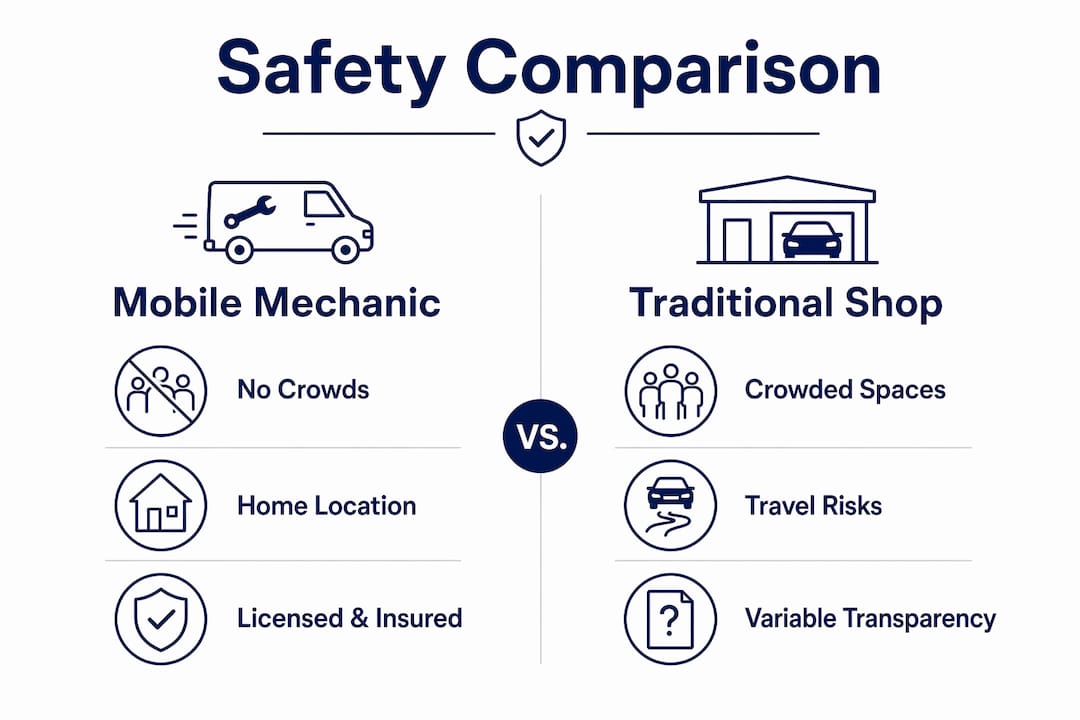
The safety comparison between mobile mechanics and traditional shops is not about quality. It is about exposure, control, and logistics.
| Safety factor | Mobile mechanic | Traditional shop |
|---|---|---|
| Exposure to crowded spaces | None. Repair happens at your location | Waiting rooms, shared spaces, public transport |
| Health risk reduction | Contactless service reduces transmission risk | Shared surfaces and waiting areas increase exposure |
| Travel risk | No driving a compromised vehicle to a shop | Requires driving or towing an unsafe vehicle |
| Child safety during repair | Children remain at home in a familiar environment | Children in unfamiliar, potentially hazardous shop areas |
| Repair transparency | Owner present throughout the repair | Work happens out of sight |
| Emergency response time | Mechanic comes to you, often same day | Requires scheduling, drop-off, and pickup |
The health dimension of this comparison became visible during the COVID-19 pandemic, when mobile auto repair was recognized as a safer alternative due to contactless service and the elimination of shared waiting spaces. That advantage applies beyond pandemic conditions. Families with young children, elderly members, or immunocompromised individuals benefit from the reduced exposure model year-round.
Key takeaways
Mobile mechanics are safer for families because they replace shop-based exposure and travel risk with controlled, on-site repairs performed by licensed and insured professionals in environments the family selects.
| Point | Details |
|---|---|
| Location control is the core safety benefit | Families choose a safe, flat repair area at home or work, removing travel and shop exposure risks. |
| Credentials determine actual safety | Only ASE-certified, insured mechanics provide the liability protection and quality assurance families need. |
| On-site repairs reduce breakdown hazards | Battery, belt, and cooling system repairs done in driveways eliminate roadside danger and towing costs. |
| Mobile service has real limits | Complex engine or transmission work requires shop equipment; know when to use each option. |
| Transparency builds long-term safety | Upfront pricing reduces deferred maintenance, keeping family vehicles in safer operating condition. |
What I’ve learned working with families on mobile repairs
Most families who call about mobile mechanic peace of mind are not asking whether the mechanic is qualified. They are asking whether the whole situation is safe. Will a stranger be in my driveway? Will my kids be near the car? What if something goes wrong?
Those are the right questions, and they deserve direct answers. The mechanic works in your space, which means you set the terms. You can keep children inside. You can watch the repair. You can ask questions at every step. That level of visibility is something a traditional shop physically cannot offer.
The misconception I encounter most often is that mobile means informal. Families assume that a mechanic working from a van must be less professional than one working in a building. The opposite is often true. A mobile mechanic’s reputation depends entirely on individual performance. There is no shop brand to hide behind. Every job is a direct reflection of that technician’s skill and professionalism.
The one caution I would add is about location selection. Mobile does not mean safe everywhere. A driveway is safe. A busy street is not. Families who take five minutes to identify a proper repair location before the appointment get the full safety benefit of the service. Those who do not are introducing a risk that has nothing to do with the mechanic.
— Aaron
Safe, on-site auto repair for Los Angeles families
Onsite Los Angeles Mobile Mechanic provides licensed, insured mobile mechanic services across the greater Los Angeles area, with upfront pricing and no hidden fees. Whether your family needs brake repair at home, a battery replacement in a parking lot, or a routine oil change at your workplace, the service comes to you. There is no towing, no waiting room, and no need to arrange a second vehicle. Call 213-583-4159 to get a quote and book your appointment. You can also review the full list of available mobile services to confirm your repair is covered before you call.
FAQ
What makes a mobile mechanic safer for families with kids?
Mobile mechanics work at your home or workplace, so children stay in a familiar, controlled environment rather than a busy repair shop. You remain present throughout the repair, which eliminates the supervision and logistics challenges of a traditional shop visit.
How do I know if a mobile mechanic is properly licensed and insured?
Ask for proof of insurance and ASE certification before any work begins. Reputable mobile mechanics provide this information upfront, and any professional who declines should not be hired.
Can a mobile mechanic handle emergency breakdowns for families?
Yes, for the most common breakdown causes including dead batteries, failed alternators, broken belts, and cooling system issues. Mobile mechanics fix these onsite without towing, which reduces both cost and roadside risk for families.
Are there repairs a mobile mechanic cannot safely do at home?
Major engine rebuilds, transmission overhauls, and structural repairs require shop equipment and are not suited to mobile service. For routine maintenance and most minor to mid-range repairs, a mobile mechanic is fully capable.
Is mobile auto repair safe during health concerns like COVID-19?
Mobile repair was specifically recognized as a safer option during the pandemic because it eliminates shared waiting spaces and allows for contactless service. That health safety advantage applies to families with vulnerable members in any season.