Fair market car repair price is the transparent, competitive cost you should expect to pay for automotive repairs based on honest labor rates, parts costs, and local market conditions. The term used in the industry is “prevailing market rate,” and understanding it is the single most effective way to avoid overpaying at the shop. Tools like RepairPal and Kelley Blue Book publish regional benchmarks that give you a concrete baseline before you hand over your keys. This guide breaks down how those prices are calculated, how to evaluate any estimate you receive, and what red flags to watch for.
What factors determine a fair market price for car repairs?
Fair repair prices are built from three components: labor, parts, and shop overhead. Each one has a measurable range, and knowing those ranges puts you in control of any repair conversation.
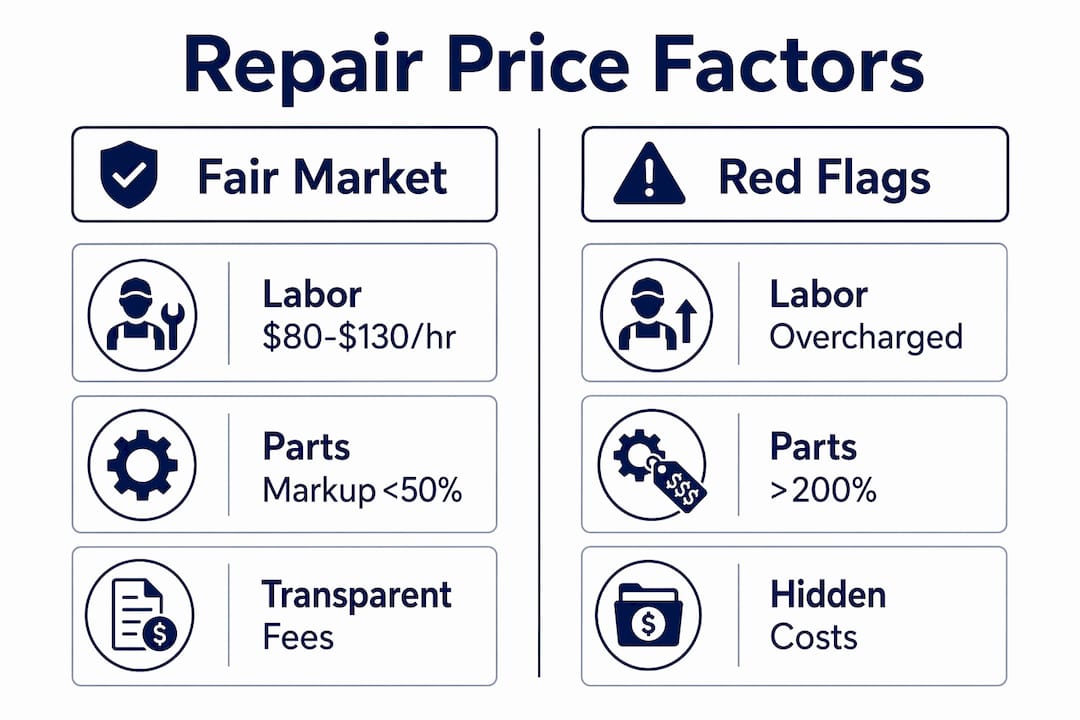
Labor rates vary significantly by shop type and geography. Independent shop rates typically run $80 to $130 per hour, dealership rates fall between $120 and $180 per hour, and national chains like Midas or Firestone charge $90 to $140 per hour. Metropolitan areas, including Los Angeles, consistently sit at the higher end of those ranges. That spread means the same brake job can cost $200 more depending solely on where you take your car.
Parts pricing follows a different logic. Shops buy parts at wholesale and mark them up for retail. A reasonable markup sits between 20% and 50% above wholesale cost. OEM (original equipment manufacturer) parts carry a higher base price than aftermarket alternatives, but both are subject to the same markup rules. You can check retail prices on RockAuto or AutoZone to verify whether what you are being charged is in line with the market.
Flat-rate labor systems are the industry standard for pricing jobs. A flat-rate guide, such as the Mitchell or AllData labor time database, assigns a fixed number of hours to each repair regardless of how long the technician actually takes. You pay for the quoted hours, not the clock. This system protects you when a job runs long, but it can work against you if a shop inflates the quoted hours beyond what the guide specifies.
- Labor rate tier (independent, dealership, chain)
- Parts type (OEM vs. aftermarket) and markup percentage
- Vehicle make, model, and year (luxury and European vehicles cost more to service)
- Geographic location and local cost of living
- Diagnostic fees, shop supplies, and disposal charges
Pro Tip: Ask the shop which flat-rate guide they use and how many hours they are billing for your specific repair. Cross-reference that number against a free estimate on RepairPal using your zip code. A discrepancy of more than 30 minutes on a standard job is worth questioning.
How to evaluate car repair estimates for fairness and transparency
A written, itemized estimate is the foundation of any fair repair transaction. For any repair over $200, you should request a written estimate that breaks out labor, parts, diagnostics, and shop fees as separate line items. A single lump-sum number tells you nothing about where the money is going.
When you receive multiple quotes, the comparison only works if the scope of work matches line by line. A quote that omits the diagnostic fee or uses a cheaper aftermarket part will always look lower on paper. That price difference is not savings. It is a gap in service. Incomplete quotes often explain why one estimate undercuts another by 40%.
Here is a practical checklist for evaluating any repair estimate:
- Confirm the estimate is written and signed by the shop.
- Verify that labor hours match the flat-rate guide for your vehicle.
- Check parts prices against RockAuto or AutoZone to confirm the markup is under 50%.
- Confirm whether the quote includes diagnostics, shop supplies, and tax.
- Ask whether the quoted parts are OEM, OEM-equivalent, or aftermarket.
- For repairs over $500, get a second opinion from a different shop. Paying $50 to $100 for an independent diagnosis on a $1,500 repair can save hundreds.
- Use RepairPal or Kelley Blue Book’s repair cost tool to benchmark the total against your zip code.
Pro Tip: When comparing quotes, build a simple side-by-side table in your notes app. List each line item from the first estimate and fill in what each competing shop charges for the same item. Gaps become obvious immediately.
The auto repair cost comparison process is not about finding the cheapest number. It is about confirming that every dollar in the estimate is accounted for and priced within market range.
Common pitfalls and red flags in car repair pricing
The most overlooked structural problem in auto repair is that the person diagnosing your car is also the person selling you the repair. That conflict of interest means you should treat any estimate as a sales proposal first and a neutral diagnosis second. Research indicates that 30 to 50% of quotes include unnecessary or overpriced work as a result of this dynamic.
The table below shows typical cost ranges for common repairs alongside figures that should trigger further scrutiny.
| Repair type | Fair market range | Suspicious quote range |
|---|---|---|
| Synthetic oil change | $65 to $120 | Under $40 or over $180 |
| Brake pad replacement (axle) | $150 to $300 | Under $100 or over $500 |
| Head gasket repair | $1,500 to $3,500 | Under $900 or over $5,000 |
| Alternator replacement | $400 to $700 | Under $250 or over $1,000 |
| Transmission rebuild | $2,500 to $6,000 | Under $1,500 or over $8,000 |
Parts markup is where overcharging hides most effectively. A markup above 200% above wholesale is a clear red flag. If a shop charges $180 for a part you can find on AutoZone for $55, that is not a market rate. That is a profit extraction strategy.
Flat-rate abuse is a related problem. Some shops switch pricing methods depending on which approach yields more revenue. They bill flat-rate hours when the job runs fast and switch to actual time when it runs long. Asking upfront which method applies to your repair closes that loophole.
Pro Tip: If a shop is reluctant to provide a written itemized estimate before starting work, treat that as a disqualifying signal. California law requires shops to provide a written estimate for repairs over $50, and any shop that resists is not operating transparently.
Practical steps to get honest, competitive repair quotes
Getting a fair price starts before you walk into any shop. Describe your symptoms precisely. “The car pulls left when braking” gives a technician a diagnostic direction. “My brakes feel weird” invites a broader and more expensive inspection.
Obtain at least three written quotes for any repair over $300. When two quotes are similar and a third is significantly higher, the outlier is almost certainly overcharging. Quotes that differ by more than 20 to 30% from the median deserve a direct explanation from the shop.
- Get written, itemized estimates from at least three shops before committing.
- Use RepairPal, Kelley Blue Book, or the local auto repair checklist to benchmark prices by zip code.
- Ask each shop to specify whether parts are OEM or aftermarket and confirm the markup is within the 20% to 50% range.
- Never authorize additional work verbally. Require a written amendment to the original estimate before any new work begins.
- Trust middle-range estimates over the lowest or highest. Suspiciously low quotes typically exclude diagnostics, use substandard parts, or lack proper insurance.
- If the total repair cost approaches or exceeds your vehicle’s market value, consider whether repair is the right financial decision at all.
Understanding how parts pricing works in auto repair gives you a concrete advantage in every quote conversation. Most car owners skip this step and pay for it.
Key takeaways
Fair market car repair pricing requires matching labor rates to shop type, verifying parts markup stays under 50%, and comparing at least three itemized written estimates before authorizing any work.
| Point | Details |
|---|---|
| Know the labor rate tiers | Independent shops charge $80 to $130/hr; dealerships charge $120 to $180/hr. |
| Verify parts markup | A fair markup is 20% to 50% above wholesale; anything above 200% is overcharging. |
| Always get written estimates | Itemized written estimates for repairs over $200 are the baseline for fair comparison. |
| Get a second opinion on big repairs | A $50 to $100 second opinion on a $1,500 repair can save hundreds of dollars. |
| Middle-range quotes are safest | The lowest quote often hides missing services; the highest often reflects inflated labor or parts. |
What I’ve learned from watching car owners navigate repair quotes
The most common mistake car owners make is accepting the first estimate they receive. Not because they are careless, but because the shop environment creates pressure. The car is already there, the problem feels urgent, and asking for time to compare quotes feels awkward. That discomfort costs real money.
Working in and around the auto repair world, the pattern I see repeatedly is that owners who ask one specific question get dramatically better outcomes: “Can you show me the flat-rate hours for this job?” That question signals to the shop that you understand how pricing works. The estimate that comes back after that question is almost always more accurate than the one that came before it.
The transparency challenge is not unique to bad shops. Even honest mechanics operate within a system that rewards higher ticket totals. Understanding that structure does not mean distrusting every technician. It means verifying the numbers independently, the same way you would review any significant purchase. RepairPal and Kelley Blue Book exist precisely because the information asymmetry between shop and customer is real and measurable.
The long-term value of understanding fair market pricing goes beyond any single repair. Owners who know what they should pay build relationships with shops that respect that knowledge. Those relationships produce better service, faster turnaround, and fewer surprise charges over years of ownership.
— Aaron
Get transparent repair pricing with Onsite Los Angeles Mobile Mechanic
Knowing what fair repair prices look like is only half the equation. The other half is finding a provider who charges within those ranges without requiring you to negotiate for basic transparency.
Onsite Los Angeles Mobile Mechanic provides written, itemized estimates before any work begins, with labor rates and parts pricing you can verify against market benchmarks. There are no hidden shop fees, no inflated diagnostic charges, and no pressure to approve work on the spot. Service comes directly to your location anywhere in the greater Los Angeles area, which means no towing costs and no waiting room time. Call 213-583-4159 to get a quote, or review the full list of available repair services to see what Onsite Los Angeles Mobile Mechanic covers.
FAQ
What is a fair market car repair price?
Fair market car repair price is the competitive, transparent cost for a repair based on local labor rates, parts pricing, and standard flat-rate labor hours. It reflects what a reasonably informed customer should expect to pay without hidden fees or inflated markups.
How much should car repairs cost on average?
Routine repairs typically range from $300 to $500, while significant repairs run $800 to $1,350. Major rebuilds such as transmission or engine work can reach $2,500 to $6,000 depending on the vehicle and shop.
How do I know if a mechanic is overcharging me?
Compare the parts prices in your estimate against retail prices on RockAuto or AutoZone. A markup above 200% above wholesale is a red flag. Also verify that the labor hours match the flat-rate guide for your specific repair.
Should I always choose the lowest repair quote?
No. The lowest quote frequently excludes diagnostics, uses substandard parts, or omits shop fees. Middle-range estimates from shops that provide full itemized breakdowns represent the best balance of price and completeness.
When should I get a second opinion on a car repair?
Get a second opinion for any repair estimated at $500 or more. Spending $50 to $100 on an independent diagnosis before committing to a major repair is a straightforward way to confirm both the diagnosis and the price are accurate.