A roadside fix without a tow truck is the process of resolving common vehicle problems safely on location, avoiding the cost, delay, and hassle of towing. Most breakdowns on American roads involve flat tires, dead batteries, or fuel issues. All three are solvable on the spot with the right tools and a clear plan. The National Highway Traffic Safety Administration recommends carrying jumper cables, a tire pressure gauge, a jack, and basic hand tools as core emergency kit items. Knowing how to use them turns a stressful situation into a manageable one.
What a roadside fix without a tow truck actually requires
Before you touch anything under the hood or near the wheels, safety comes first. Drivers often underestimate roadside risks by focusing on the vehicle rather than establishing a safety perimeter, which is the leading cause of secondary accidents at breakdown scenes. The fix itself is secondary to making sure you and other drivers are protected.
The second requirement is the right toolkit. A portable jump starter, a tire plug kit, and a quality flashlight cover the majority of no-tow-truck scenarios. The third requirement is honest self-assessment. Not every breakdown is a DIY situation, and recognizing the difference between a fixable flat and a blown sidewall can save you from making things worse.
Essential safety steps before you attempt any repair
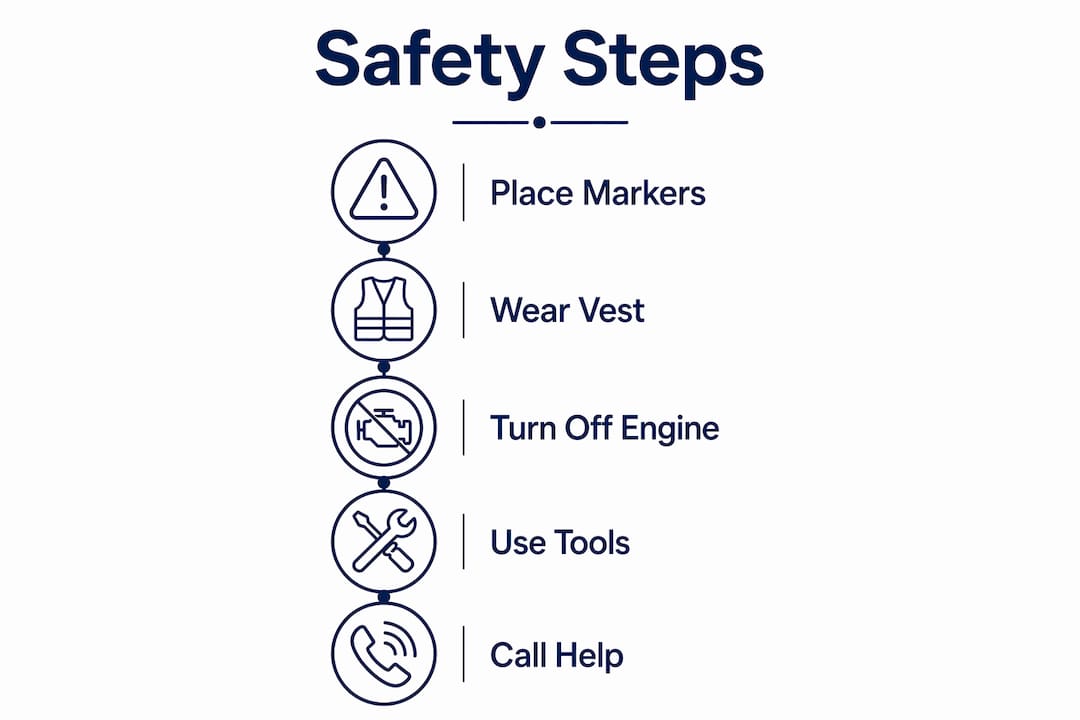
The moment your vehicle stops working, your first move is to activate your hazard lights. Then steer the car as far off the road as possible, ideally onto a flat shoulder or into a parking lot. Every second the vehicle sits in a travel lane increases your exposure to passing traffic.
Once stopped, follow this sequence:
- Activate hazard lights immediately, even before the car fully stops.
- Steer fully off the road onto the shoulder or a safe surface.
- Place the first reflective triangle 10 feet behind the vehicle, then additional markers at 100-foot and 200-foot intervals for maximum visibility to approaching drivers.
- Assess whether it is safer to stay inside the vehicle or exit. On a high-speed highway with no barrier, staying inside with your seatbelt fastened is often the right call.
- If you must exit, use the door farthest from traffic and move at least 40 feet away, standing behind a guardrail if one is available.
- Put on a reflective vest before doing anything else outside the vehicle.
Warning triangle placement is based on driver reaction times at highway speeds, not guesswork. The 10/100/200-foot spacing gives approaching drivers enough time to see, process, and respond before reaching your position. Skipping this step because it feels like extra work is how people get hurt.
Most U.S. states enforce Slow Down, Move Over laws that require drivers to change lanes or reduce speed when passing stopped vehicles with flashing lights. Knowing this law exists does not protect you. Setting up your markers does.
Pro Tip: Pack a reflective vest in your glove compartment, not your trunk. If the trunk is blocked or the car is in a dangerous position, you need the vest before you need anything else.
Must-have tools for effective no-tow-truck repairs
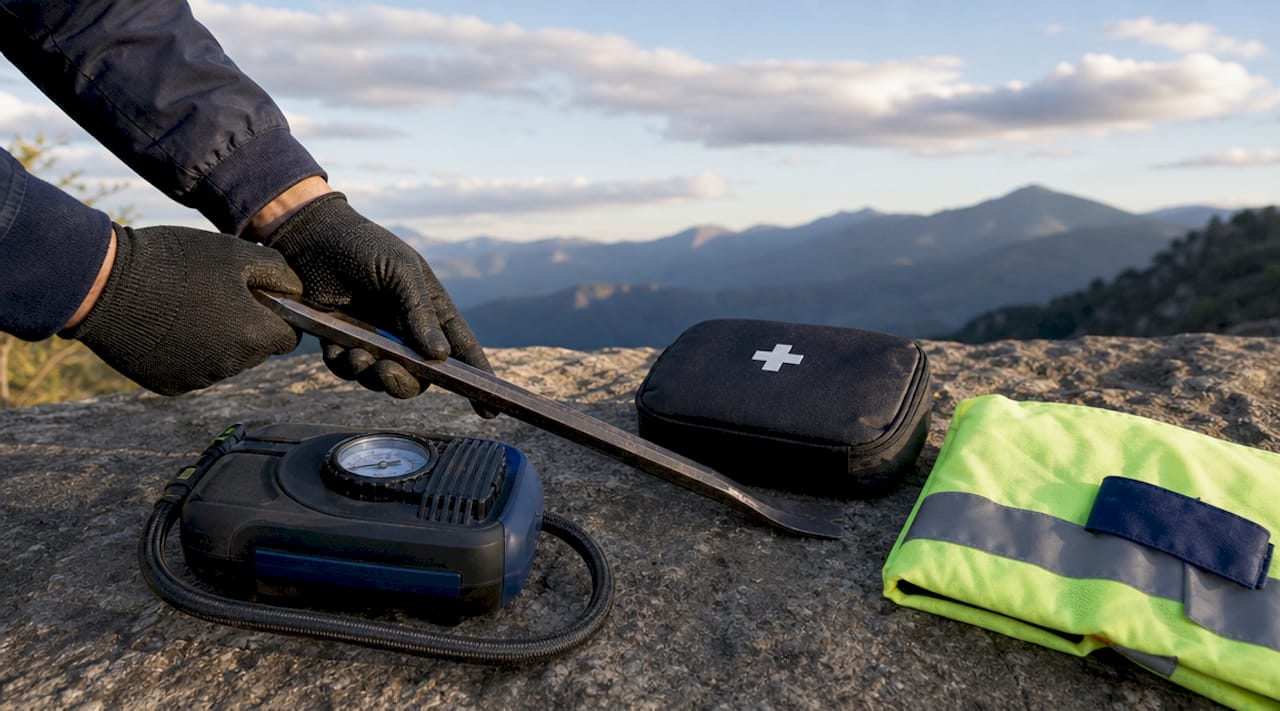
An emergency roadside kit built around the right components handles the vast majority of common breakdown scenarios. Here is what belongs in every driver’s vehicle:
- Portable jump starter: Handles dead battery situations without needing another car. Models with built-in air compressors address multiple roadside issues in one device.
- Jumper cables: A reliable backup when a portable starter is unavailable. Choose cables with adequate length and wire gauge so you are not dependent on how close another driver can park.
- Tire pressure gauge: Catches slow leaks before they become full flats. Digital gauges from brands like Accutire or AstroAI read accurately to 0.5 PSI.
- Hydraulic floor jack and lug wrench: The factory jack included with most vehicles is functional but slow. A compact hydraulic jack from Torin or Pro-Lift speeds up tire changes significantly.
- Tire plug kit: Covers small tread punctures quickly and effectively. Slime and Safety Seal both make kits that fit in a glove compartment.
- Flashlight or headlamp: A hands-free headlamp from Black Diamond or Coast lets you work in the dark without holding anything.
- Basic hand tools: A set of combination wrenches, a flathead and Phillips screwdriver, and zip ties handle a surprising range of minor fixes.
- Fuel canister: A 1-gallon approved container for fuel emergencies. Keep it empty until needed to avoid storage hazards.
| Tool | Primary use | Estimated cost |
|---|---|---|
| Portable jump starter | Dead battery recovery | $60 to $120 |
| Tire plug kit | Small tread punctures | $10 to $25 |
| Hydraulic jack | Tire changes | $30 to $80 |
| Reflective triangles | Safety perimeter | $15 to $30 |
| Tire pressure gauge | Pressure monitoring | $10 to $20 |
Pro Tip: Check your kit every six months. Jump starter batteries lose charge over time, and tire sealant canisters have expiration dates. A kit you have not tested is a kit you cannot count on.
Step-by-step fixes for flat tires, dead batteries, and fuel issues
Changing a flat tire safely
- Confirm the vehicle is on stable, flat ground before jacking. Never jack on gravel or a slope.
- Loosen the lug nuts slightly before raising the vehicle. Breaking them loose while the tire is on the ground prevents the wheel from spinning.
- Position the jack under the manufacturer-specified jack point, usually marked in the owner’s manual or visible as a reinforced notch under the rocker panel.
- Raise the vehicle until the flat tire clears the ground by about two inches.
- Remove lug nuts fully and swap the flat for the spare.
- Tighten lug nuts in a star pattern, not a circle. This distributes pressure evenly and prevents warping.
- Lower the vehicle and torque the lug nuts fully once the tire contacts the ground.
Many vehicles now come without full-size spares, replacing them with sealant kits and compressors. Temporary spares, called space savers, are more reliable for most flat tire situations than sealants alone. If you drive a vehicle without a full spare, consider adding one to your kit.
Tire sealant kits work only on small punctures under 0.24 inches and are not effective on sidewall damage. After using a sealant, the maximum safe speed is 50 mph, and you must get to a repair shop promptly. Sealants are a bridge to professional service, not a permanent fix.
Pro Tip: Before a road trip, check your spare tire’s pressure. A flat spare discovered roadside is one of the most preventable problems in emergency car repair.
Jump-starting a dead battery
The correct connection sequence for jumper cables protects your vehicle’s electronics and prevents dangerous sparks:
- Connect the red (positive) clamp to the positive terminal of the dead battery.
- Connect the other red clamp to the positive terminal of the donor battery.
- Connect the black (negative) clamp to the negative terminal of the donor battery.
- Connect the final black clamp to an unpainted metal surface on the dead vehicle, away from the battery. This acts as a ground and reduces spark risk near the battery.
- Start the donor vehicle and let it run for two to three minutes.
- Attempt to start the dead vehicle.
For a detailed walkthrough of safe battery jump procedures, the jump-start safety guide from KKRichardson covers connection steps and common mistakes in plain language.
| Method | Requires another vehicle | Best for |
|---|---|---|
| Jumper cables | Yes | When a helper is nearby |
| Portable jump starter | No | Solo drivers, remote locations |
Handling a fuel emergency
Adding fuel from a portable canister is straightforward. Use only an approved container, pour slowly to avoid spilling, and never add diesel to a gasoline engine or vice versa. Contaminated fuel causes engine damage that no roadside kit can fix. If you are unsure what fuel type your vehicle takes, check the fuel door label before pouring anything.
How to decide when towing or professional help is the right call
Knowing when to seek help prevents worsening damage and protects your safety. Emergency kits are designed to stabilize common failures and enable a safe drive to a mechanic, not to replace professional repair. The following situations call for professional assistance rather than a DIY approach:
- Sidewall tire damage, bulges, or blowouts. No sealant or plug kit addresses these safely.
- Overheating engine. Driving an overheating vehicle causes catastrophic internal damage.
- Brake failure or soft brake pedal. This is a safety emergency, not a roadside fix.
- Smoke, burning smell, or visible fluid leaks under the vehicle.
- Any breakdown in a location with poor visibility, no shoulder, or active traffic hazards.
- Uncertainty about what is wrong. Guessing and attempting a fix can turn a minor issue into a major repair.
A mobile mechanic is often the fastest professional option when towing is not necessary but the repair is beyond your skill level. A qualified technician comes to your location, diagnoses the problem accurately, and completes the repair on the spot. This eliminates towing fees and shop wait times entirely.
Pro Tip: Save a local mobile mechanic’s phone number in your contacts before you need it. Searching for help while stranded on a busy road is stressful and slow.
Key takeaways
A successful roadside fix without a tow truck depends on three things: immediate safety actions, the right tools in the vehicle, and honest judgment about what you can and cannot fix on your own.
| Point | Details |
|---|---|
| Safety perimeter first | Place reflective markers at 10, 100, and 200 feet before touching the vehicle. |
| Right tools change outcomes | A portable jump starter and tire plug kit resolve the two most common breakdowns. |
| Sealants have hard limits | Tire sealants work only on small tread punctures and require a shop visit afterward. |
| Battery connection order matters | Connect positive terminals first, then negative, to protect electronics and prevent sparks. |
| Know when to stop | Sidewall damage, overheating, and brake issues require professional help, not DIY fixes. |
What I have learned from years of roadside situations
The biggest mistake drivers make is treating the broken vehicle as the emergency. The real emergency is being stopped on a road with moving traffic. Every time I see a driver crouched next to a flat tire with no markers out and no vest on, I think about how quickly that situation can turn fatal. The fix can wait 90 seconds for you to set up your safety perimeter.
The second thing experience teaches you is that preparation is almost entirely mental. Most drivers own a jack and a spare. Very few have practiced using them. Changing a tire in your driveway on a Sunday afternoon takes 20 minutes the first time and 8 minutes by the third. That practice is worth more than any kit upgrade.
I also want to be direct about the limits of DIY roadside assistance. There is no shame in calling for help. A sidewall blowout, a grinding brake pedal, or an engine that will not turn over after a jump are all situations where attempting more on your own creates risk without reward. The goal of every roadside fix is to get you and your vehicle to safety. Sometimes the safest path is a phone call.
For drivers preparing for longer trips, the car road trip prep guide at KKRichardson is worth reading before you leave. Catching a weak battery or low tire tread before a trip is far better than managing it on the side of a highway.
— Aaron
Get fast onsite repairs anywhere in Los Angeles
When the situation goes beyond what your kit can handle, Onsite Los Angeles Mobile Mechanic brings professional repair directly to your location across the greater Los Angeles area. No tow truck, no shop wait, no hidden fees.
Onsite Los Angeles Mobile Mechanic handles battery replacements, tire services, oil changes, and a wide range of mechanical repairs on the spot, often within an hour. The service covers Los Angeles, Long Beach, and surrounding areas. Upfront quotes mean you know the cost before any work begins. For complex repairs that go beyond quick car fixes roadside, this is the fastest path from broken down to back on the road. Call 213-583-4159 to book or visit the mobile mechanic services page for a full list of repairs handled onsite.
FAQ
What is the first thing to do when your car breaks down?
Activate your hazard lights immediately and steer the vehicle as far off the road as possible. Then place reflective markers at 10, 100, and 200 feet behind the vehicle before attempting any repair.
Can I fix a flat tire without a spare?
A tire sealant kit works on small tread punctures under 0.24 inches, but it is not effective on sidewall damage or large punctures. After using a sealant, drive no faster than 50 mph and get to a repair shop as soon as possible.
How do I jump-start a car safely without damaging electronics?
Connect the positive (red) clamp to the dead battery first, then to the donor battery. Connect the negative (black) clamp to the donor battery’s negative terminal, then to an unpainted metal surface on the dead vehicle as a ground. This sequence prevents sparks near the battery.
When should I call a tow truck instead of attempting a roadside fix?
Call for professional help when you notice sidewall tire damage, engine overheating, brake failure, smoke, or fluid leaks. Any breakdown in a hazardous location with poor visibility also warrants a call rather than a DIY attempt.
What tools should every driver carry for emergency car repair?
The most useful items are a portable jump starter, a tire plug kit, a tire pressure gauge, a hydraulic jack, a lug wrench, a headlamp, and reflective triangles. These cover the majority of common roadside breakdowns without requiring outside help.