Plug in a scanner, read a code, fix the car. That’s what most people assume mobile diagnostic tools do. The reality is more layered, and understanding it will save you money, frustration, and bad decisions. The role of mobile diagnostic tools goes well beyond pulling fault codes off your OBD-II port. These devices give you a window into your vehicle’s electronic systems, but what you do with that information matters far more than the tool itself. This article breaks down how these tools actually work, what they can and cannot tell you, and how to use them like someone who knows cars.
Table of Contents
- Key Takeaways
- The role of mobile diagnostic tools in modern car maintenance
- What mobile diagnostic tools can and cannot do
- How to choose the right mobile diagnostic tool
- Using mobile diagnostic tools effectively
- Where mobile diagnostic technology is heading
- My take on mobile diagnostics and smarter car care
- Get expert mobile diagnostics at your location
- FAQ
Key Takeaways
| Point | Details |
|---|---|
| Codes guide, they don’t fix | A fault code points to a system, not a specific part; further testing is always required. |
| Adapter and app compatibility matters | Your scanner’s chipset and your app’s software must match, or you’ll get unreliable data. |
| Clearing codes has consequences | Resetting codes before an emissions test can cause a failure until readiness monitors complete. |
| Tool selection depends on your needs | Match your scanner’s module coverage to your vehicle’s systems and your diagnostic goals. |
| Professional insight amplifies tool value | Mobile diagnostic data is most powerful when combined with a trained mechanic’s interpretation. |
The role of mobile diagnostic tools in modern car maintenance
Every car made after 1996 has an OBD-II port, typically located under the dashboard on the driver’s side. Mobile diagnostic tools plug into this port via a small hardware adapter, then communicate wirelessly or through a cable to a smartphone app or tablet. The app does the heavy lifting: translating raw data from your car’s engine control unit (ECU) into readable fault codes, graphs, and sensor readings.
The hardware adapter is the critical link. It reads signals from the car’s ECU and sends them to your device. The software on your phone interprets those signals. These are two separate components, and both have to work correctly together.
Here’s what mobile diagnostic technology actually gives you access to:
- Diagnostic Trouble Codes (DTCs): Alphanumeric codes like P0420 or P0300 that identify which system triggered a fault
- Live data streams: Real-time readings from sensors including coolant temperature, oxygen sensors, fuel trims, and engine RPM. Apps provide live sensor data that turns abstract codes into a clearer picture of what’s happening in the engine
- Freeze frame data: A snapshot of sensor values captured at the exact moment a fault code was triggered
- Readiness monitors: Indicators showing whether your car’s emission-related systems have completed their self-tests, which matters for passing smog checks
This combination of data types is what makes mobile diagnostic applications genuinely useful rather than just a parlor trick.
What mobile diagnostic tools can and cannot do
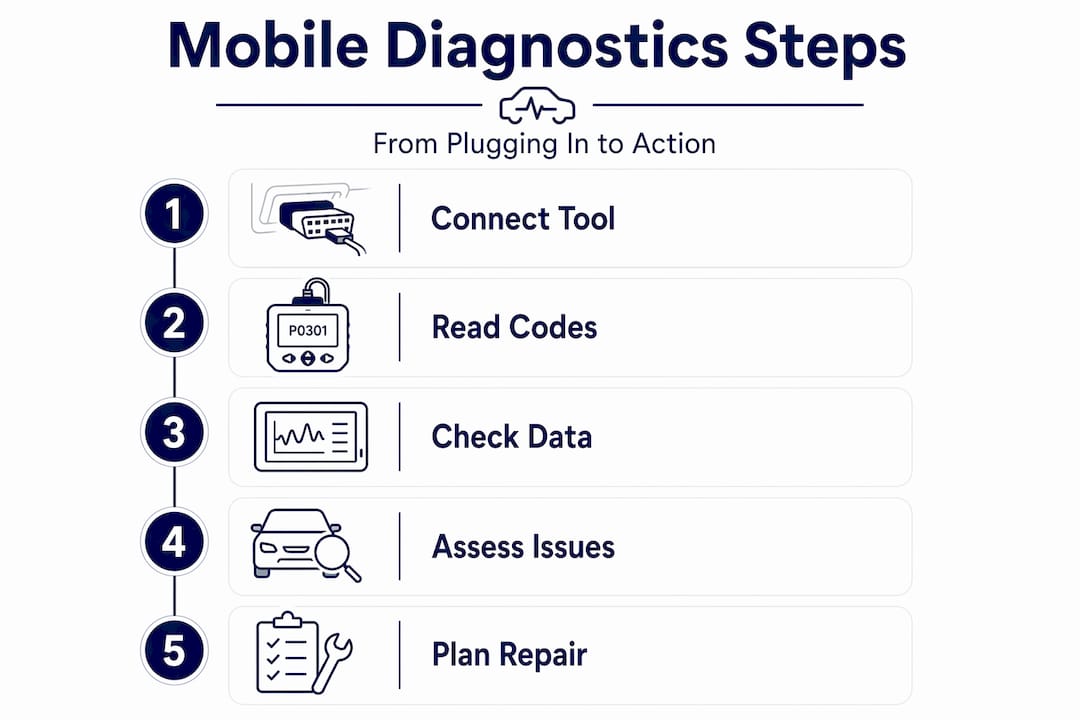
This is where expectations need to get realistic fast. A scanner reading a code does not equal a diagnosis. The code tells you which system the ECU flagged, not what caused the problem. P0300 means random/multiple cylinder misfire. It does not tell you whether the cause is a bad spark plug, a failing fuel injector, low compression, or a vacuum leak. That distinction requires additional testing.
Here are five things to understand clearly before relying on a mobile scanner:
Most basic scanners only read engine codes. Many “OBD2 compatible” tools cannot access ABS, SRS (airbag), or transmission modules. If your ABS light is on, a standard Bluetooth code reader likely won’t pull that code. You need a scanner that explicitly supports all modules relevant to your symptoms.
Advanced scanners reveal more history. Higher-end tools can detect recently deleted codes and historic emissions-related faults that basic readers miss entirely. This matters when buying a used car or diagnosing an intermittent issue.
Clearing codes resets readiness monitors. If you clear a check engine light and then drive to an emissions test, you may fail not because of the original fault but because the emissions monitors reset and haven’t completed their drive cycle. You typically need several days of mixed driving before all monitors report “ready.”
Physical inspection is always part of the job. A code narrows the field. A mechanic with their hands on the car confirms the actual fault. Skipping the physical step based on a code reading alone is how people replace the wrong part and spend money needlessly.
App and adapter compatibility is not guaranteed. The OBD Fusion app requires Wi-Fi or a compatible Bluetooth Low Energy adapter and will not function properly with generic ELM327 Bluetooth tools. Before buying any adapter, confirm it works with your chosen app and your specific vehicle.
Pro Tip: Never clear a check engine light within two weeks of a scheduled smog check. Drive the car normally and let the monitors complete on their own. Clearing codes right before a test almost guarantees a “not ready” failure.
How to choose the right mobile diagnostic tool
Scan tools range from a $10 Bluetooth dongle to a $4,000 professional unit with bi-directional controls and ECU coding. Choosing the right one means matching the tool to your actual needs, not buying the most expensive option by default.
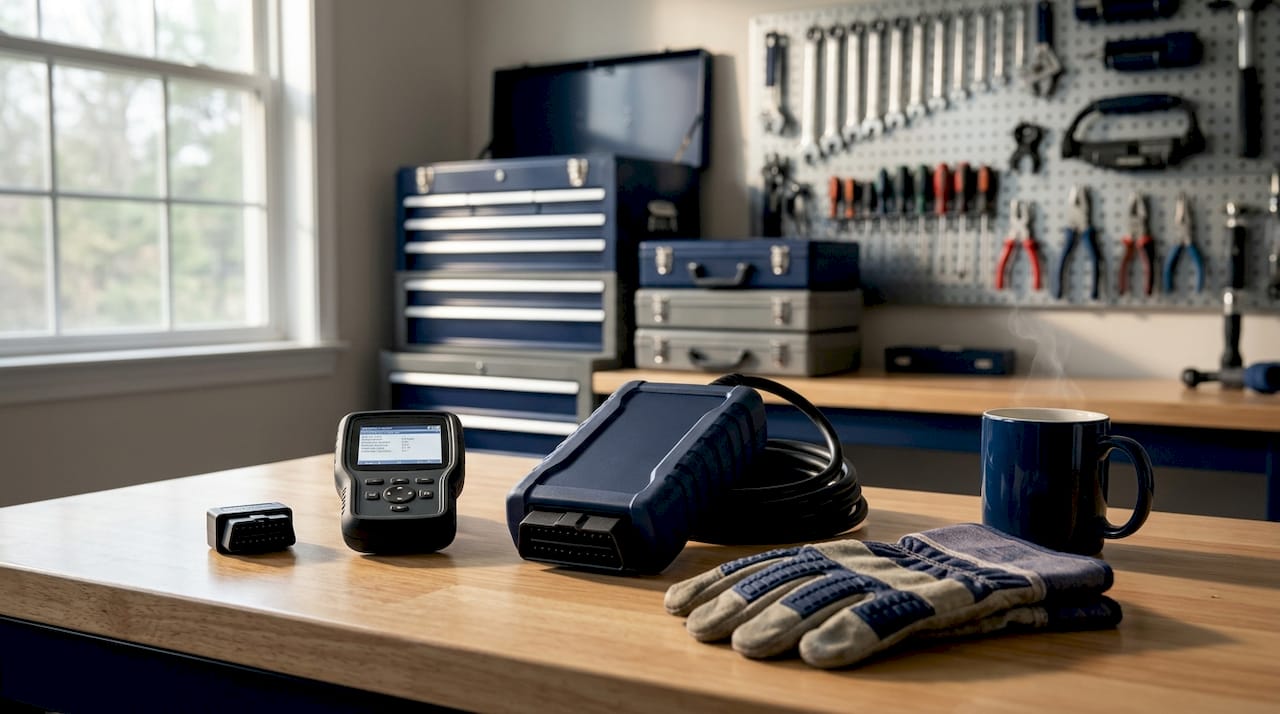
Here’s a quick comparison of the main categories:
| Tool type | Price range | Best for | Module coverage |
|---|---|---|---|
| Basic Bluetooth code reader | $10–$50 | DIY beginners, engine codes only | Engine/emissions only |
| Mid-range OBD2 scanner | $50–$300 | Enthusiasts, multiple systems | Engine, ABS, SRS, transmission |
| Professional scan tool | $300–$4,000+ | Mechanics, full system access | All modules + bi-directional controls |
Tools range widely in capability, and a $10 reader will frustrate you the moment a brake or airbag fault appears. Consider these factors when selecting a tool:
- Vehicle compatibility: Confirm the scanner works with your car’s year, make, and model. European vehicles often need enhanced protocol support.
- Bluetooth versus wired: Wireless adapters are convenient but can drop connection. Stable connections require Bluetooth 3.0 or newer, and the OBDLink MX+ is consistently rated the most reliable Bluetooth option.
- App subscription costs: Some apps charge monthly fees for advanced features. Factor that into the total cost of ownership.
- Software update frequency: A tool that doesn’t receive regular updates will fall behind as new vehicle models roll out.
Pro Tip: If you drive a newer vehicle with advanced safety systems, spend at least $150 on a scanner. The ability to read ABS and airbag codes alone justifies the price difference over a cheap dongle.
Using mobile diagnostic tools effectively
Having the right tool is half the equation. Knowing how to use it separates owners who waste money on wrong parts from those who walk into a shop with real information.
Start with a structured workflow every time you scan. Capture the fault codes first, then pull the freeze frame data to see what the engine was doing when the code triggered. Then switch to live data mode and watch the same sensors in real time while you replicate the driving conditions that caused the fault. This approach works especially well for intermittent problems that don’t trigger codes consistently. Capture codes plus freeze-frame data, then compare with live sensor readings to confirm whether the fault is active or historical.
A few practices that will sharpen your diagnostic work:
- Log live data during the problem. Most apps let you record a data session. If your car stumbles at highway speeds, record a drive and review the log afterward to spot the sensor that spiked or dropped.
- Bring your diagnostic data to your mechanic. A printed or screenshot summary of codes, freeze frames, and live data gives a professional mechanic a head start. It also protects you from paying for unnecessary diagnostic time.
- Avoid low-quality Bluetooth adapters. Connection drops and inaccurate readings are common with cheap chipsets. Garbage data from a bad adapter leads to misdiagnosis just as easily as no data at all.
- Don’t use the scanner as a permanent fix. Clearing a code and monitoring whether it returns is useful. Clearing a code repeatedly without addressing the root cause masks a problem that may get worse and more expensive.
For a cleaner look at how diagnostic accuracy connects to better repair outcomes, the relationship between good data and correct fixes is direct.
Where mobile diagnostic technology is heading
The advantages of mobile tools are expanding fast. In 2026, several trends are changing what these tools can do and who benefits from them.
AI integration is the biggest shift. Some diagnostic apps now cross-reference fault codes against repair databases in real time, suggesting the most statistically likely causes based on vehicle history and code combinations. This doesn’t replace mechanical judgment, but it gives informed car owners a sharper starting point.
Electric vehicle diagnostics represent a growing frontier. As EV adoption grows in markets like Los Angeles, professional scan tools are expanding to include battery management system data, thermal management readings, and high-voltage system monitoring. Basic OBD-II adapters still work on the powertrain side, but EV-specific diagnostics require specialized tools.
Mobile diagnostic technology won’t replace the trained eye of an experienced mechanic, but it’s already changing who shows up to that conversation informed, and who gets taken advantage of.
The impact of mobile diagnostics on the DIY culture is real. Owners who understand their own data negotiate better at repair shops, catch problems earlier, and spend less money on guesswork repairs.
My take on mobile diagnostics and smarter car care
I’ve watched too many car owners get burned by the same mistake: they plug in a scanner, see a code, order a part, swap it out, and the light comes back on in two days. They’re not dumb. They just didn’t know that a code is a starting point, not an answer.
What mobile tools genuinely do is give you leverage. When you show up to a mechanic with live data logs and freeze frame captures, you’re not at their mercy. You’ve already done the first layer of diagnostic work. That’s a real advantage, and it changes the dynamic entirely.
What frustrates me is when people treat the scanner app as the mechanic. The app tells you what the car’s computer flagged. It does not tell you why, and it definitely does not tell you whether the sensor itself is faulty or whether the condition it monitors is the real problem. That interpretation requires experience, physical testing, and sometimes equipment the app simply can’t replicate.
My honest advice: use mobile diagnostic tools to stay informed and to collaborate better with professionals. Don’t use them to avoid professionals. The combination of both is where you actually save money.
— Aaron
Get expert mobile diagnostics at your location
Onsite Los Angeles Mobile Mechanic brings professional-grade diagnostic equipment directly to wherever your car is parked, whether that’s your driveway, office parking lot, or curbside. Rather than guessing at fault codes or paying a shop just to run a scan, you get a trained mechanic who interprets the data, performs physical inspections, and explains exactly what your car needs. The mobile engine diagnostics service covers the greater Los Angeles area including Long Beach and Pasadena. Upfront pricing, no hidden fees. Call to book your diagnostic appointment and get real answers without leaving home.
Explore the full range of mobile repair services available across the LA area.
FAQ
What does a mobile diagnostic tool actually tell you?
A mobile diagnostic tool reads fault codes from your car’s ECU and displays live sensor data, freeze frames, and readiness monitor status. It points to which system has a fault, but identifying the exact cause still requires further inspection.
Can a basic OBD2 scanner read ABS or airbag codes?
Most basic Bluetooth scanners only read engine and emissions codes. Reading ABS, SRS, or transmission codes requires a mid-range or professional scanner that explicitly supports those modules.
Is it safe to clear a check engine code before an emissions test?
No. Clearing codes resets your vehicle’s readiness monitors, which can cause an automatic failure at the emissions test. Wait for several drive cycles after any code clearing before scheduling a smog check.
What’s the difference between a $20 adapter and a $200 scanner?
Price reflects module coverage, connection reliability, and software capability. Cheap adapters often drop connections and miss non-engine faults. A quality mid-range scanner covers ABS, SRS, and transmission systems and delivers consistent, accurate data.
How do mobile diagnostic tools help when working with a mechanic?
Bringing your own diagnostic data, including codes, freeze frames, and live data logs, to a mechanic gives them a head start and reduces the time spent on basic diagnosis. It also helps you understand what repairs are actually needed before agreeing to any work.
Recommended
- Mobile Engine Diagnostics – Onsite Los Angeles Mobile Mechanic
- Mobile Mechanic Services – 213-583-4159 – Local Auto Repair Services – Onsite Los Angeles Mobile Mechanic
- Mobile Mechanic Los Angeles — I Come to You | 213-583-4159 – Onsite Los Angeles Mobile Mechanic
- Mobile Mechanic Long Beach – I Come to You | 213-583-4159 – Onsite Los Angeles Mobile Mechanic