Expect a mobile oil change to typically cost between $50 and $150, with a common mid-point around $90 for a sedan using synthetic-blend oil. The final number moves based on three levers: oil grade, how many quarts your engine holds, and the travel fee for getting a technician to your driveway. Onsite Los Angeles Mobile mechanics and similar local operators typically give you that number before anyone touches your car.
TL;DR:
- The typical mobile oil change cost ranges from $50 to $150, depending on oil grade, engine capacity, and additional services or fees.
- Oil grade, vehicle size, labor structure, and travel fees are the main factors influencing the final price, with full synthetic oils being significantly more expensive.
- Properly estimating your vehicle’s oil capacity and asking for itemized quotes can help prevent surprises and reduce costs by bundling services when possible.
- Mobile oil changes are as reliable as shop visits for routine services when OEM parts are used, offering convenience and often saving time and money.
- Planning service intervals based on your driving habits and vehicle manual, along with understanding full out-the-door pricing, ensures better budgeting and transparency.
Table of Contents
- How Much Does a Mobile Oil Change Cost in the U.S.?
- What Actually Drives the Price of a Mobile Oil Change?
- Real Cost Scenarios: Basic, Mid-Range, and Premium
- Is a Mobile Oil Change as Good as a Shop Visit?
- How to Lower What You Pay for a Mobile Oil Change
- How Often Do You Actually Need an Oil Change?
- What’s the Real Total Once Fees and Taxes Are Added?
- Publisher Perspective: What Transparent Pricing Actually Looks Like
- Get a Transparent Mobile Oil Change Quote Today
- Sources
How Much Does a Mobile Oil Change Cost in the U.S.?
Home mobile oil change services typically land between $50 and $150 nationally, though the tighter, more commonly quoted band for at-home service is $75 to $150, depending on oil type and vehicle. The spread exists because a mobile oil change price isn’t one number. It’s several small line items stacked together, and each one can swing independently.
Break it down by component and the picture gets a lot clearer. Labor for the actual service runs about $20 to $70. Oil and filter together add another $20 to $90, depending on whether you’re using conventional, synthetic-blend, or full synthetic. A travel or call-out fee, when it’s charged separately, adds $0 to $40. Taxes tack on $0 to $15. Extras like a cabin air filter swap or a top-off of other fluids can add another $0 to $30 if you say yes to them.
Here’s how those pieces typically stack for a standard four-cylinder sedan needing about 5 quarts of oil:
| Cost Component | Low Estimate | Average Estimate | High Estimate |
|---|---|---|---|
| Oil and filter | $20 | $55 | $90 |
| Labor | $20 | $45 | $70 |
| Travel/call-out fee | $0 | $20 | $40 |
| Taxes | $0 | $8 | $15 |
| Extras (optional) | $0 | $10 | $30 |
| Total | $40 | $138 | $245 |
That “high” column assumes you say yes to every optional extra and land in a market with a premium travel charge. Most sedan owners choosing a mid-tier synthetic-blend oil land closer to the average column, somewhere around $90 to $140 out the door.
A few assumptions matter here. The table assumes a 5-quart engine, which covers most compact and midsize sedans. It assumes 25 to 45 minutes of actual service time, not counting drive time to your location. And it assumes travel gets billed as its own line item rather than folded silently into the labor charge, which is exactly the kind of thing you want to ask about before you book.
What Actually Drives the Price of a Mobile Oil Change?
Once you understand the four variables that move the number, you can look at any quote and tell whether it’s reasonable. Nobody’s hiding anything on purpose most of the time. It’s just that these variables genuinely change the math.
Oil grade is the biggest swing factor. Conventional oil costs the least per quart, synthetic-blend sits in the middle, and full synthetic costs the most, sometimes double or triple conventional per quart. A 5-quart engine on full synthetic can add $30 to $40 more to a bill than the same job on conventional oil.
Vehicle size and engine capacity matter almost as much. A compact sedan might need 4 to 5 quarts. A V6 crossover or midsize SUV often needs 5 to 6. A three-quarter-ton truck or a V8 SUV can need 6 to 8 quarts, and some larger engines hold more than techs assume if they’re estimating instead of checking the manufacturer’s spec.

Labor structure varies by provider. Some charge a flat per-job rate regardless of how long the technician is on-site. Others bill closer to actual time, which matters if your vehicle’s oil filter is buried behind a skid plate or your driveway access is tight.
Travel fees depend on distance from the technician’s base, whether you’re in a dense urban core versus a suburb, and whether you’re bundling the visit with anything else.
- Oil grade: conventional, synthetic-blend, or full synthetic, each with a different per-quart cost
- Filter type: standard versus a higher-capacity or OEM-spec filter
- Labor model: flat-rate per job versus time-based billing
- Travel/call-out fee: set by distance, local traffic density, and whether multiple vehicles are serviced in one trip
Pro Tip: Ask the technician what your car’s actual oil capacity is before you accept a quote. A lot of quick estimates assume 5 quarts across the board, but larger SUVs and some V6 engines hold more, and underestimating capacity is one of the most common reasons a “final” price creeps up on service day.
Real Cost Scenarios: Basic, Mid-Range, and Premium
Numbers mean more when you can match them to your own car. Here are three worked examples that cover most of what’s on the road.
- Basic scenario: small sedan, conventional oil. A compact four-cylinder taking 4.5 quarts of conventional oil runs about $20 for oil and filter, $25 for labor, and $15 for travel. Total before tax: roughly $60.
- Mid-range scenario: crossover or SUV, synthetic-blend. A V6 crossover needing 5.5 quarts of synthetic-blend runs closer to $45 for oil and filter, $40 for labor, and $20 for travel. Total before tax: roughly $105.
- Premium scenario: large SUV or truck, full synthetic. A V8 truck or large SUV needing 7 quarts of full synthetic can run $80 for oil and filter, $55 for labor, and $25 for travel. Total before tax: roughly $160.
Notice the pattern: oil and filter cost roughly doubles from basic to premium, while labor and travel move up more modestly. That’s because parts cost scales directly with quarts and oil grade, but a technician’s time on-site doesn’t grow nearly as fast.
If you want to estimate your own number before calling anyone, use this formula: (quarts needed × price per quart) + filter cost + labor + travel fee + taxes + any extras you actually want. Look up your vehicle’s oil capacity in the owner’s manual rather than guessing. It takes thirty seconds and it’s the single biggest source of quote surprises.
Is a Mobile Oil Change as Good as a Shop Visit?
For a routine oil and filter swap, a mobile technician using OEM-spec parts delivers the same quality result as a shop bay. The oil going into your engine doesn’t know or care whether it was poured in a driveway or under fluorescent lights. What differs is everything around the service.
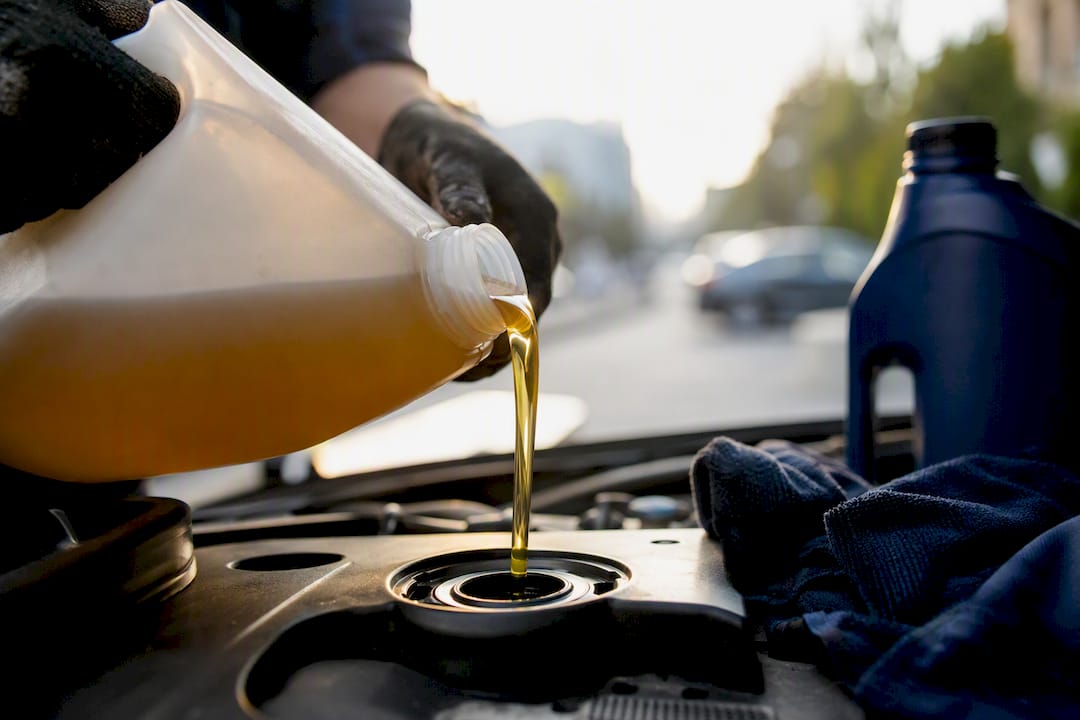
Mobile service wins on convenience, and that convenience has a real dollar value most people forget to count. Mobile providers can match shop parts pricing while saving you the drive time, waiting-room time, and the classic upsell pitch that quick-lube chains are famous for. When you price in your own time, mobile service frequently comes out ahead on total cost even when the invoice looks similar.
Shops still have an edge in specific situations. A lift gives technicians access that a driveway visit can’t replicate for certain inspections. Shops also tend to have specialty diagnostic tools on-site and can bundle multiple services in one visit if your car needs more than an oil change.
- Choose mobile service for routine oil changes, convenience, and avoiding a waiting room
- Choose a shop when the job requires a lift, specialty equipment, or a warranty-sensitive procedure
- Choose mobile service when your schedule is the real cost, not just the invoice total
- Choose a shop if you’re already bundling several unrelated repairs into one longer visit
Curious how the full pricing picture stacks up against a dealership? A dealer versus mobile mechanic comparison breaks down where each option tends to win.
How to Lower What You Pay for a Mobile Oil Change
You have more control over the final number than most quotes suggest. A few tactics consistently bring the total down without cutting corners on the service itself.
Ask for an itemized quote before you agree to anything, and specifically ask where the travel fee and disposal fee show up. A provider who hesitates to break down the number is telling you something.
Booking multiple vehicles for the same visit spreads the travel fee across cars instead of charging it once per vehicle. If your household has two or three cars, that alone can meaningfully cut your per-vehicle cost.
- Request an itemized quote and confirm travel/disposal fees are shown separately, not buried
- Bundle two or more household vehicles into one visit to split the travel charge
- Choose conventional oil when your manufacturer allows it, or a synthetic-blend instead of full synthetic
- Ask about membership plans, off-peak scheduling discounts, and repeat-customer pricing
Booking off-peak, bundling vehicles, and choosing conventional oil where the manufacturer permits it can cut your total by 20 to 40 percent compared to paying full retail with every optional extra checked yes.
Pro Tip: If your manufacturer’s manual lists conventional oil as acceptable, don’t assume you need synthetic. A lot of drivers pay for full synthetic out of habit, not requirement, and it’s often the single biggest line item you can shrink without any tradeoff in engine protection.
Looking for other ways to trim your maintenance bill over the year? How mobile service saves on repair costs covers tactics beyond just oil changes.
How Often Do You Actually Need an Oil Change?
Most modern vehicles running synthetic oil go 5,000 to 7,500 miles between changes, while conventional oil typically needs replacing closer to every 3,000 to 5,000 miles. Your owner’s manual is the actual source of truth here, not a sticker on your windshield from your last visit.
Frequency directly sets your recurring cost, which is worth doing the math on. If you drive 12,000 miles a year and change synthetic oil every 6,000 miles, you’re looking at two changes annually. At an average $90 to $140 per visit, that’s roughly $180 to $280 a year in oil changes alone. Stretch to synthetic’s upper interval and you might only need it 1.5 times a year on average, trimming your annual spend accordingly.
Some newer vehicles use oil-life monitoring systems that track driving conditions rather than a flat mileage number, which can extend or shorten your actual interval depending on how you drive. Stop-and-go city commuting wears oil faster than highway miles, so two drivers with identical cars can have genuinely different real-world intervals.
Knowing your interval also helps you plan bundled bookings and catch membership pricing, since some providers offer better per-visit rates for customers on a recurring schedule. For a deeper look at how intervals apply to your specific vehicle, see this guide on oil change intervals.
What’s the Real Total Once Fees and Taxes Are Added?
The number on the advertised flyer is rarely the number on your final receipt. Many providers publish starting prices like oil and filter from $89, and those anchors are useful, but they usually exclude travel and disposal fees. Treat any advertised “starting at” price as a floor, not the expected total.
A realistic full accounting for a mid-range synthetic-blend job looks like this: $55 for oil and filter, $40 for labor, $20 for a travel fee, roughly $8 in sales tax depending on your local rate, and maybe $5 for oil disposal if it’s charged separately. That lands around $128, noticeably higher than the $89 headline price you might have seen in an ad.
Tipping isn’t standard practice for mobile mechanic work the way it is for food delivery, but some customers add $10 to $20 for particularly fast or accommodating service, especially if the technician handled a tricky access issue without extra charge. It’s optional, never expected, and won’t affect the quote you’re given.
The takeaway: always ask what the “out the door” number includes before you book, not after the technician arrives.
Publisher Perspective: What Transparent Pricing Actually Looks Like
Most complaints about auto repair pricing don’t come from the price itself. They come from a number that changes after the work starts. Onsite Los Angeles Mobile mechanics build quotes that list oil type, filter, labor, travel, and disposal as separate line items before any wrench touches your car, which is a low bar that a surprising number of providers still don’t clear.
Most oil changes wrap up in under an hour once the technician arrives, which matters more than people expect. It’s not just about saving time. It’s about not rearranging your whole afternoon around a maintenance task that should be routine.
— Aaron
Get a Transparent Mobile Oil Change Quote Today
Onsite Los Angeles Mobile Mechanic is the alternative to guessing at a shop’s hidden fees or waiting around a quick-lube lobby: you get an itemized price over the phone before a technician ever leaves the shop, based on your actual car, not a generic estimate.

Have a few details ready when you call: your vehicle’s make, model, and year, its engine size if you know it, what oil type it currently runs, and your general location in the greater Los Angeles area. With that information, Onsite Los Angeles Mobile Mechanic can give you a real number covering oil, filter, labor, travel, and disposal, not a teaser rate that grows once the technician shows up. Most oil change appointments are scheduled with a same-day or next-day arrival window depending on your location and the day of the week.
There’s no app to download here. Booking happens the simple way: you call, you get a quote, and you pick a time that works. Check the full range of mobile mechanic services available, then call to lock in a price and a time that fits your schedule.
Sources
Price ranges and component breakdowns in this guide draw from the Cost Insider mobile oil change cost guide, SlashGear’s mobile mechanic pricing report, and SeaBee Jack’s cost-of-time analysis. For more on convenience and scheduling, read about mobile oil change convenience for busy drivers.
- Mobile Oil Change Cost Guide 2026 – Cost Insider
- How Much Does An At-Home Oil Change With A Mobile Mechanic Typically Cost? – SlashGear
- Is a Mobile Oil Change Worth It? The Honest Math | SeaBee Jack’s Blog
- Mobile Oil Change & Auto Maintenance Snohomish, WA | Mikey’s Mobile