Low oil pressure means the engine isn’t getting the oil flow it needs to protect its moving parts, and it can cause serious damage within minutes. If the warning light comes on, pull over and shut the engine off as soon as it’s safe. Confirm the oil level, then verify the actual pressure before you drive another mile or spend a dollar on repairs.
TL;DR:
- Confirm engine oil viscosity and level before considering repairs, as incorrect oil or sludge buildup are common causes of low pressure.
- Use a mechanical pressure gauge to verify actual oil pressure at operating temperature, comparing readings against specific manufacturer specifications.
- Steady, high RPM warnings often indicate sensor or wiring issues rather than true pressure loss, requiring thorough diagnostics.
- Replacing internal components like the oil pump or bearings is costly and should only be done after confirming the problem with proper testing.
- Onsite diagnosis with a mechanic and a clear upfront cost can prevent unnecessary repairs and ensure accurate identification of the true issue.
Table of Contents
- What to Do Right Now When the Low Oil Pressure Light Appears
- Symptoms That Point to Real Low Oil Pressure
- Common Causes of Low Oil Pressure, From Simple to Serious
- How Pros Diagnose Low Oil Pressure
- Fixes and Repair Costs You Should Expect
- Preventing the Next Low Oil Pressure Warning
- How Onsite Los Angeles Mobile Mechanic Handles Low Pressure Calls
- How to Properly Measure Oil Pressure
- Normal vs. Abnormal Oil Pressure Ranges
- Verify Before You Replace Anything
- Get Your Oil Pressure Checked Without the Tow Truck
- Sources
What to Do Right Now When the Low Oil Pressure Light Appears
The oil pressure warning light is not a “get to it this week” kind of alert. Running the engine with no real oil pressure can cause catastrophic damage in a matter of minutes, so your first move matters more than any diagnostic guess.
- Get to the shoulder or a safe spot and shut the engine off immediately. Don’t try to “limp it home.”
- Check the oil level on level ground with the engine off, using the dipstick’s proper hot or cold procedure.
- If the dipstick reads low but not bone dry, and you hear no knocking, a careful top-up with the correct spec can get you moving cautiously.
- If the dipstick is dry, you hear knocking or ticking, or you’re not sure what caused the drop, don’t restart it. Call for a tow or an on-site mobile mechanic to check it where it sits.
Pro Tip: Keep a quart of the manufacturer-spec oil in your trunk. A quick top-up on the shoulder can be the difference between a $40 fix and a $4,000 one.
Symptoms That Point to Real Low Oil Pressure
Not every dashboard light means the same thing, and mixing them up wastes money in both directions. A red oil-pressure warning is a lubrication emergency. An amber “change oil soon” reminder, by contrast, is just a mileage-based nudge with no urgency attached.
Watch for these signs alongside the light itself:
- Ticking or knocking sounds from the engine, especially right after startup
- Rough or uneven idle that wasn’t there before
- Engine temperature climbing faster than normal
- A burning-oil smell from under the hood
- The light flickering only at idle, then going out once RPMs rise
A flicker that appears only at idle and disappears as soon as you rev the engine often points to a marginal pump, thick sludge, or a worn oil pump pickup rather than a full failure. A light that stays on steadily, even at higher RPM, is the more serious pattern. If the oil level checks out fine and the engine sounds and runs completely normal, a faulty sender or wiring fault is a real possibility, and that’s worth ruling out before anyone touches the pump.
Common Causes of Low Oil Pressure, From Simple to Serious
Insufficient oil level, wrong viscosity, a clogged pickup or filter, a failing pump, and worn internal bearings all sit on the list of usual suspects, and they range wildly in cost. Here’s how they stack up, cheapest and most common first:
- Low oil level. Leaks past gaskets and seals, or an engine simply burning oil over time, are the most frequent cause and usually the least expensive to correct.
- Wrong or degraded viscosity. Using oil that doesn’t match your owner’s manual, or oil that’s broken down and thinned from fuel dilution, reduces the film strength the pump needs to build pressure. Reaching for something thicker as a workaround is a common instinct, but oil outside the manufacturer’s spec can hurt protection and interfere with variable valve timing systems on newer engines.
- Clogged pickup screen or sludge buildup. Neglected oil changes let sludge collect in the pan and restrict the pickup tube, starving the pump even when the dipstick shows plenty of oil.
- Oil pump wear or a failing pump drive. A worn pump, or a stretched chain or worn gear driving it, can’t move enough volume to hold pressure, particularly at idle.
- Worn internal bearings. As bearing clearances open up with mileage, oil escapes faster than the pump can replace it. This is the expensive end of the spectrum and often shows up as a persistent low reading even with a full, clean oil system.
- A faulty sensor or wiring. Sometimes nothing is actually wrong with the lubrication system at all. The gauge or sender itself is lying.
That last point is exactly why guessing at a fix from this list is a bad idea. You need to know which one you’re actually dealing with before you spend money.
How Pros Diagnose Low Oil Pressure
A shop worth its rate doesn’t start with parts. It starts with confirmation, because a dash light alone can’t tell you whether you’re looking at a $30 sensor or a $3,000 bottom-end problem.
- Confirm oil level and check that the oil matches the manufacturer’s viscosity spec. This step alone catches a surprising share of cases.
- Attach a mechanical pressure gauge at the sender port and read it with the engine hot, both at idle and around 2,000 to 2,500 RPM. This comparison against factory specs is the step that actually separates a sensor problem from a real lubrication problem.
- Pull codes with a scan tool, but treat sensor data as a starting point, not a verdict. Check the sender’s wiring and connector before trusting the number it reports.
- Inspect oil condition for sludge or metal particles, and check the pickup screen and filter housing for restriction.
- Based on what the gauge actually shows, decide whether you’re looking at a sensor and wiring fix, a pickup or pump service, or deeper internal work.
Pro Tip: If a mechanic wants to replace your oil pump before ever hooking up a mechanical gauge, ask why. A gauge test takes minutes and can save you from paying for a part you didn’t need.
Fixes and Repair Costs You Should Expect
Repair cost tracks pretty closely with how far the problem has spread through the system.
- Sensor or sending unit replacement. Usually the cheapest fix on this list, and it’s a quick job when the mechanical gauge confirms pressure is actually fine.
- Oil filter change, oil flush, and pickup cleaning. A moderate-cost repair that resolves the problem when sludge or a partially clogged pickup is choking off supply.
- Oil pump replacement. More labor-intensive since it usually requires removing the oil pan and sometimes the timing cover, which pushes the bill higher.
- Bearing replacement or engine rebuild. The most expensive path, reserved for cases where internal wear has already let too much oil bleed past the bearings.
Skipping the gauge test and just guessing, especially by dumping in thicker oil and hoping the light goes away, tends to backfire. It can mask a real problem while doing nothing to fix it, and on modern engines it risks new drivability issues with variable valve timing components.
Preventing the Next Low Oil Pressure Warning
Most low-pressure emergencies trace back to a handful of habits that are easy to fix once you know to watch for them.
- Use the oil viscosity your manufacturer specifies and stick to the recommended change interval. Skipping this is one of the fastest routes to sludge buildup.
- Check under the car occasionally for spots or drips. A slow leak caught early is a cheap fix; caught late, it’s a tow.
- Check your oil level periodically between changes, especially on older or high-mileage engines that tend to burn a little oil.
- Consider oil analysis if you’re running a high-mileage vehicle or a small fleet. It flags wear metals and contamination before pressure ever drops.
Pro Tip: Set a phone reminder to check your dipstick once a month. It takes 90 seconds and it’s the single easiest way to catch a slow leak before it becomes a warning light. Following a consistent oil change interval does more to prevent low pressure than almost any other single habit.
How Onsite Los Angeles Mobile Mechanic Handles Low Pressure Calls
When a low oil pressure call comes in, the first steps happen right where the car sits: checking the oil level, scanning for obvious leaks, and running a mechanical gauge test rather than trusting the dash light alone. Every diagnostic and repair comes with an upfront quote before any work starts, so there are no surprises on the bill. Straightforward fixes, like a sensor swap or a top-up, often get handled on the spot. If the gauge points to internal wear or major pump failure, the team will tell you honestly, and recommend a shop for teardown work.
How to Properly Measure Oil Pressure
A dash light is a warning, not a measurement. The only way to know your actual oil pressure is a mechanical gauge threaded into the sender port, and the conditions under which you read it matter as much as the tool itself.
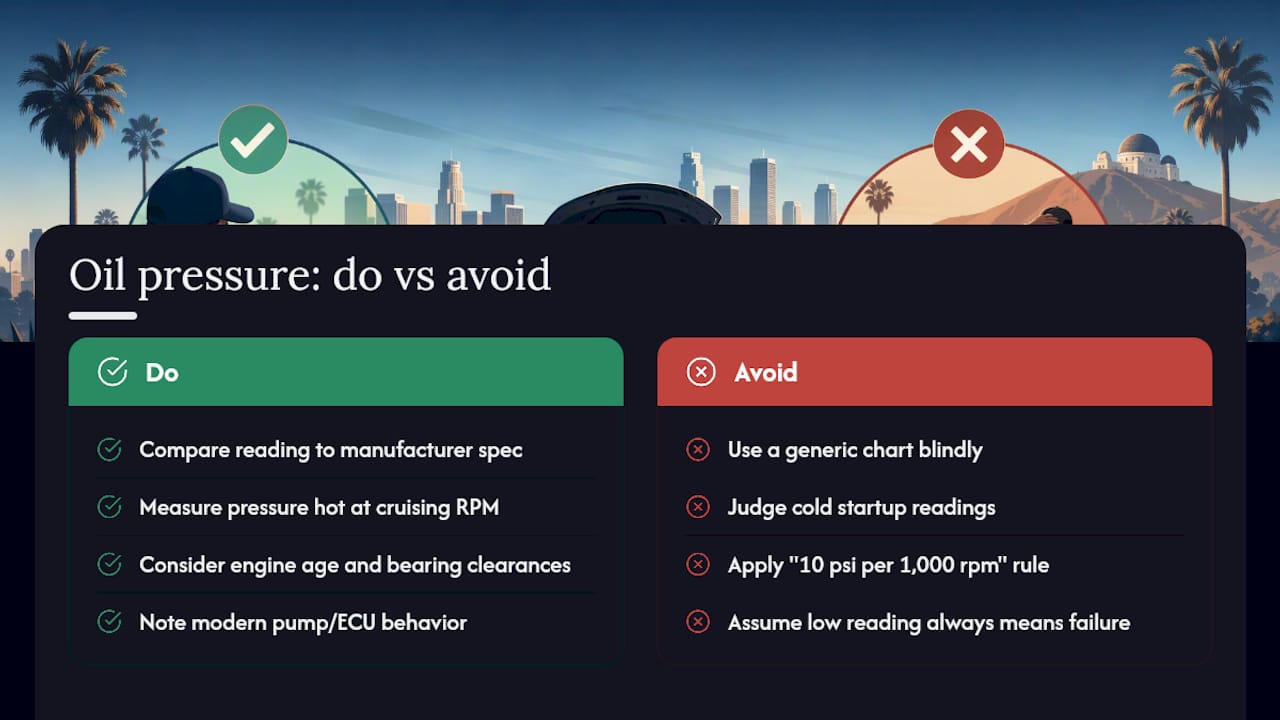
The engine needs to be at full operating temperature, since cold oil is thicker and will show artificially high pressure that has nothing to do with how the system performs once everything’s warmed up. From there, a technician reads the gauge at idle, then again at roughly 2,000 to 2,500 RPM. Comparing both numbers against the manufacturer’s published specs, rather than a generic rule of thumb, tells you whether the pump and lubrication system are actually keeping up under load.
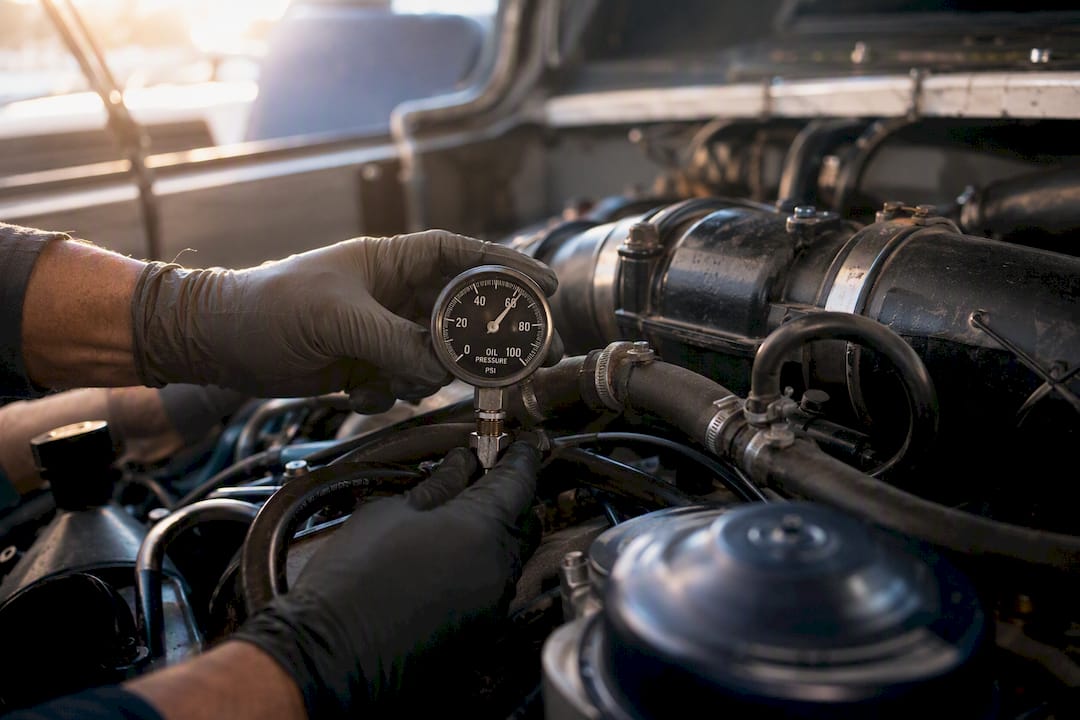
A handheld mechanical gauge, threaded directly into the port where the factory sensor lives, is the standard tool for this. Scan tools can pull live data from the factory sensor too, but that’s still reading the same component you’re trying to verify, so it’s not a substitute when you suspect the sensor itself might be lying to you.
Oil viscosity plays into this reading directly. If someone’s topped off the engine with the wrong weight of oil, or the oil has broken down and thinned from age or fuel contamination, the gauge will show it. That’s part of why confirming you’re running the correct oil spec for your engine comes before any pump or bearing diagnosis. Skip the gauge step and you’re diagnosing blind, guessing at parts instead of reading what the system is actually doing.
Normal vs. Abnormal Oil Pressure Ranges
There’s no single number that applies to every engine, which is exactly why comparing your reading to a generic chart online can send you down the wrong path. Typical passenger car engines run within a range of pressure at cruising RPM once warm, with idle pressure sitting lower depending on the design. Older high-mileage engines with wider bearing clearances often run toward the lower end of their own healthy range and still perform fine.
Temperature changes the picture too. Cold oil is thick and will show a higher reading right after startup, which drops once the oil warms and thins to its normal operating viscosity. A pressure reading needs to be judged hot, not cold, to mean anything.
Modern engines complicate this further with variable-displacement and electronically controlled oil pumps that intentionally reduce pressure at certain loads and RPMs to save fuel and reduce parasitic drag on the engine. A reading that would have signaled a problem on a 1990s engine might be exactly what the computer commanded on a current one. That’s the whole reason the old “10 psi per 1,000 rpm” shortcut doesn’t hold up anymore. The only reliable move is checking your specific engine’s manufacturer specification and confirming your gauge reading against it, not against a rule that predates the technology in your car.
Verify Before You Replace Anything
The old rule of thumb, that healthy oil pressure should track roughly 10 psi for every 1,000 rpm, made sense on engines from decades ago. It doesn’t hold up against a modern engine running a variable-displacement pump that deliberately dials pressure down at partial load to save fuel. Apply that outdated math to a current engine and you’ll misdiagnose a perfectly healthy system, or worse, miss a real problem because the number looked “close enough.”
The research here points to one clear priority: confirm before you spend. A mechanical gauge test costs a fraction of an oil pump, and it tells you definitively whether you’re facing a $30 sensor or a real mechanical failure. Too many drivers skip straight to swapping parts, or worse, pouring in thicker oil and hoping the light goes away. That habit doesn’t fix anything. It just delays an accurate diagnosis while potentially harming variable valve timing components tuned for a specific viscosity.
What should change is the order of operations. Level check first. Gauge test second. Everything else, sensor, pump, internal wear, follows from what the gauge actually shows. Mobile, on-site diagnosis fits neatly into that sequence because it puts a gauge on your engine wherever the car happens to be, without a tow truck in between.
— Aaron
Get Your Oil Pressure Checked Without the Tow Truck
A dash warning light doesn’t wait for a convenient time, and driving to a shop with genuinely low oil pressure risks turning a sensor problem into an engine problem. Onsite Los Angeles Mobile Mechanic runs the mechanical gauge test right in your driveway, parking lot, or roadside pullout, so you get a real answer before you decide whether to drive another mile.

Every visit starts with an upfront quote, so you know the cost of a sensor swap, an oil top-up, or a filter and pickup service before any work begins. Simple fixes are often completed the same visit. If the gauge points to something more serious, like pump failure or internal wear, the technician will tell you plainly and help you plan the next step instead of guessing. There’s no app to download here; you book by calling and talking to a real person about what your car is doing.
Browse the full list of mobile mechanic services or call to get a same-day diagnosis scheduled before that warning light turns into a tow bill.
Sources
- Top Causes of Low Oil Pressure in Engines and How To Fix It
- Oil Light: Can You Keep Driving? Risks & What To Do | OBDadvisor
- Low Oil Pressure: What It Means and What To Do — Rick’s Free Auto Repair Advice
- What the Low Oil Pressure Light Indicates | Capital One Auto Navigator