Skipping a traditional auto repair shop means choosing mobile mechanics, informed DIY, or other alternatives that deliver faster service, lower costs, and clearer communication. Vehicle maintenance costs have surged nearly 25% since 2022, pushing more drivers to look beyond the brick-and-mortar garage. The mobile repair sector is now growing 15 times faster than traditional shops as of Q2 2026. That growth reflects a real shift in what car owners expect: upfront pricing, no unnecessary waiting, and a technician who talks to you directly instead of routing everything through a service advisor.
Why skip auto repair shop and choose mobile instead?
Mobile mechanics are the most practical alternative to traditional shops for the majority of everyday repairs. They bring tools, parts, and expertise directly to your driveway, office parking lot, or any suitable location. The operational difference is significant, and it shows up directly in your bill.
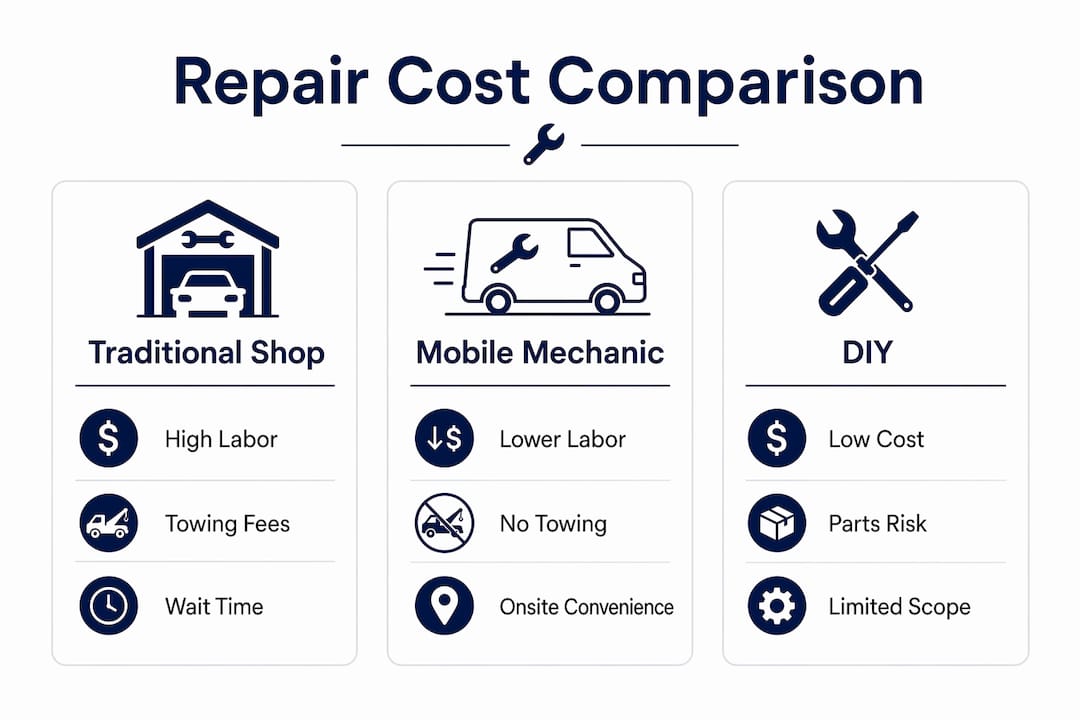
Labor rates run 15%–30% lower with mobile mechanics compared to dealerships and franchise garages. That gap exists because mobile mechanics carry no rent, utilities, or property tax overhead. Those fixed costs in a brick-and-mortar shop do not disappear. They get passed to you as inflated labor fees.
About 85% of standard repairs can be completed onsite by a mobile mechanic. That means you avoid towing fees, which average $75–$150 per incident in urban areas like Los Angeles. For a routine repair that a mobile mechanic can handle in your driveway, paying a tow truck to haul your car across town is pure waste.
The communication difference is just as valuable. Removing the service advisor middleman reduces upselling pressure and gives you direct access to the technician doing the work. You hear the diagnosis in plain language, ask questions in real time, and approve only what you decide is necessary.
Common repairs mobile mechanics handle onsite include:
- Oil and filter changes
- Battery replacement and testing
- Brake pad and rotor service
- Spark plug replacement
- Alternator and starter replacement
- Serpentine belt service
- Coolant flushes and fluid top-offs
Pro Tip: Before booking any mobile mechanic, confirm they carry liability insurance and ask whether they provide a written quote before starting work. Reputable providers give you a firm price upfront, not an estimate that grows after the job begins.
Traditional shop vs. mobile mechanic: costs and logistics
The cost difference between traditional shops and mobile alternatives goes beyond labor rates. Traditional shops carry high fixed operational expenses including rent, utilities, and property taxes. Every one of those costs is built into the price you pay, whether your repair takes 30 minutes or three hours.

Logistics add another layer of friction. Dropping a car off at a shop means arranging a ride home, waiting for a callback, and then arranging another ride to pick it up. For working adults in Los Angeles, that dead time is a real cost. Time saved by avoiding towing and waiting is one of the top reasons consumers choose mobile mechanics over shops.
DIY repair is a third option, but it carries specific risks. Most DIY errors come from ordering incompatible parts due to inaccurate online parts filters. A generic “make, model, year” search does not account for regional trim variations or undocumented previous repairs on your specific vehicle. Buying the wrong part and discovering the error mid-repair can cost more than hiring a professional from the start.
Here is a direct comparison of key cost factors:
| Cost Factor | Traditional Shop | Mobile Mechanic | DIY |
|---|---|---|---|
| Labor rate | High (overhead included) | 15%–30% lower | None (your time only) |
| Towing fee | Often required | Eliminated for 85% of repairs | Not applicable |
| Overhead fees | Built into every invoice | Minimal to none | None |
| Parts compatibility risk | Low (professional sourcing) | Low (professional sourcing) | High (filter inaccuracies) |
| Logistics burden | High (drop-off, pickup) | None (comes to you) | None |
Pro Tip: Use the 2026 dealer vs. mobile cost comparison to benchmark what you should actually pay for common repairs before calling any shop or mobile provider.
What are the real limits of skipping a traditional shop?
Mobile mechanics and DIY are not the right answer for every situation. Knowing the limits protects you from making a costly mistake in the name of convenience.
Mobile mechanics face genuine constraints for certain repair categories:
- Major engine rebuilds require a lift, controlled environment, and specialized tooling that a mobile setup cannot replicate safely.
- Complex transmission work often demands a full shop floor and multiple technicians.
- Advanced diagnostics for intermittent electrical faults sometimes require dealer-level scan tools that are not practical to transport.
- Workspace requirements are non-negotiable. Mobile mechanics need a level, stable surface such as a private driveway to safely operate hydraulic equipment. Public streets, inclined driveways, and soft ground are unsuitable and often illegal for this type of work.
DIY carries its own category of risk. Parts incompatibility is the most common and expensive pitfall. Regional trim differences and undocumented prior repairs on your vehicle create gaps that online parts catalogs simply do not capture. A stranded vehicle mid-repair costs far more than the labor you were trying to avoid.
That said, modern mobile mechanics have closed the diagnostic gap significantly. Mobile mechanics now use the same digital inspection tools as dealerships, including real-time photo and video documentation. They use a “must-do now” versus “watch soon” framework to prioritize repairs honestly. That approach builds the kind of trust that most traditional shops, optimized for liability-safe manufacturer workflows, rarely offer.
Choose a traditional shop when the repair requires a lift, specialized dealer equipment, or warranty compliance. For everything else, the alternatives are worth a serious look.
How to choose the right auto repair alternative
Choosing between a mobile mechanic, DIY, and a traditional shop comes down to four factors: severity of the issue, complexity of the repair, cost versus risk, and available workspace. Work through these steps before you commit to any option.
- Assess the severity. Is the vehicle drivable? If not, a mobile mechanic who can come to you eliminates the towing cost entirely. Check the emergency mobile mechanic options available in your area before defaulting to a tow.
- Evaluate the complexity. Brake service, oil changes, battery replacement, and belt work are well within mobile mechanic capability. Engine rebuilds and transmission overhauls are not.
- Calculate the real cost. Add towing, shop labor, and wait time when comparing a traditional shop quote to a mobile mechanic quote. The mobile option often wins on total cost even if the hourly rate looks similar.
- Check your workspace. A flat, private driveway or a stable parking lot surface is required for mobile service. Review mobile mechanic parking lot service guidelines if you are unsure whether your location qualifies.
- Vet the provider. For mobile mechanics, confirm ASE certification or equivalent credentials, read recent reviews on Google or Yelp, and ask for a written upfront quote. Trust is built through transparent behavior, not branding alone.
For DIY, limit your scope to well-documented, low-risk tasks: air filter replacement, wiper blades, cabin filters, and battery swaps on vehicles without complex battery management systems. Anything involving brake hydraulics, suspension geometry, or fuel systems carries safety consequences that outweigh the savings.
Pro Tip: Ask any mobile mechanic to share digital inspection photos before and after the repair. Providers who use photo documentation are far less likely to recommend unnecessary work.
Key takeaways
Skipping a traditional auto repair shop saves money and time when you match the repair type to the right alternative, whether that is a mobile mechanic or a carefully scoped DIY task.
| Point | Details |
|---|---|
| Mobile mechanics cost less | Labor rates run 15%–30% lower than dealerships by eliminating overhead. |
| Towing is often avoidable | Mobile mechanics handle 85% of repairs onsite, cutting $75–$150 towing fees. |
| DIY has a narrow safe range | Limit DIY to simple tasks; parts incompatibility errors cost more than professional labor. |
| Traditional shops still win sometimes | Major engine work, transmission rebuilds, and warranty repairs require a full shop. |
| Transparency is the deciding factor | Mobile mechanics using digital inspections and upfront quotes deliver more honest service. |
The honest case for ditching the shop (most of the time)
I have seen the same pattern repeat itself too many times. A driver drops their car at a shop for a straightforward brake job, waits half a day, gets hit with a bill that includes three items they never discussed, and leaves feeling like they had no control over the process. That experience is not an accident. Traditional shops are structured in a way that puts a service advisor between you and the technician, and that layer exists partly to manage upsell opportunities.
Mobile mechanics change that dynamic in a way that feels almost obvious once you experience it. The person doing the work is the person explaining the work. You can watch, ask questions, and make decisions in real time. For the vast majority of repairs, that is a better experience at a lower price.
Where I think people go wrong is assuming mobile or DIY is always the answer. A complex electrical fault that requires a dealer-level scan tool, or a transmission that needs a full rebuild, belongs in a proper shop. Trying to force those jobs into a mobile or DIY context creates bigger problems. The skill is knowing which category your repair falls into before you commit.
The growth of mobile auto service is not a trend driven by novelty. It is driven by drivers who got tired of paying for overhead they never needed and waiting for service they could have received in their own driveway. That shift is going to keep accelerating.
— Aaron
Get your car fixed without the shop hassle
Onsite Los Angeles Mobile Mechanic brings professional repair service directly to your location across the greater Los Angeles area. No towing, no waiting rooms, and no service advisor filtering what the technician tells you. You get upfront pricing before any work begins, and most common services including oil changes and battery replacements are completed within an hour.
Whether you need brake service, an alternator replacement, or a diagnostic check, the full list of mobile services covers the repairs most drivers need most often. Onsite Los Angeles Mobile Mechanic operates with transparent quotes and no hidden fees, so you stay in control of your repair decisions. Call 213-583-4159 to get a quote and schedule service at your location today.
FAQ
Why do people skip auto repair shops?
The main reasons are cost, convenience, and transparency. Mobile mechanics offer 15%–30% lower labor rates and eliminate towing fees, while direct technician communication removes upselling pressure.
What repairs can a mobile mechanic do onsite?
Mobile mechanics handle about 85% of standard repairs onsite, including oil changes, brake service, battery replacement, belt work, and alternator replacement.
Is DIY car repair worth it?
DIY is worth it for simple tasks like air filters, wiper blades, and cabin filters. For anything more complex, parts incompatibility errors frequently cost more than professional labor would have.
When should you still use a traditional auto repair shop?
Use a traditional shop for major engine rebuilds, transmission overhauls, complex electrical diagnostics requiring dealer-level tools, and any repair covered under a manufacturer warranty.
How do i know if a mobile mechanic is trustworthy?
Verify ASE certification, read recent Google or Yelp reviews, and require a written upfront quote before work begins. Providers who share digital inspection photos before and after the repair are the most transparent.