Mobile auto service is defined as on-demand vehicle repair and maintenance delivered directly to a customer’s location, and it is fundamentally changing how the automotive service industry operates. The shift away from traditional repair shops is not a trend. It is a structural change driven by customer demand for time savings, upfront pricing, and direct communication. 40% of car owners are willing to pay a premium for on-site convenience, which signals that why mobile auto service disrupts industry norms goes far deeper than novelty. Ford’s dealer network already operates over 4,500 mobile service vehicles, with top dealerships completing more than 2,000 visits per month. That scale proves this model has moved well past the experimental stage.
Why mobile auto service disrupts industry convenience standards
The traditional repair shop model asks you to do all the work. You schedule an appointment, arrange a ride, sit in a waiting room, and then reverse the whole process when your car is ready. Mobile auto service eliminates every one of those steps by sending a certified technician to your home, office, or parking lot.
The impact on customer behavior is measurable. Consider what changes when a routine oil change no longer requires two hours of your day:
- No transportation logistics. You do not need a second car, a rideshare, or a friend to pick you up.
- No waiting room. You stay productive at home or at work while the service happens outside.
- Faster turnaround. Routine maintenance completes in under 60 minutes on-site, compared to multi-hour waits at a traditional shop.
- Flexible scheduling. Mobile providers typically offer early morning, evening, and weekend slots that fixed shops cannot match.
The convenience of mobile car services is not just about comfort. It directly reduces vehicle downtime, which matters for anyone who depends on their car for work or family logistics. Mobile service visits average 55 minutes, covering oil changes, tire rotations, battery replacements, and similar high-frequency tasks. That efficiency is why professionals and families are choosing mobile mechanics at growing rates. For a deeper look at how this saves real working hours, the analysis on mobile mechanic time savings is worth reading.
Pro Tip: When booking a mobile appointment, confirm the technician carries all fluids, filters, and parts for your specific vehicle make and model. This prevents delays caused by missing supplies.
How does mobile service improve transparency and trust?
Transparency is one of the most underappreciated reasons why mobile auto service reshapes customer expectations. At a traditional shop, a service advisor stands between you and the technician. That layer of communication creates room for misunderstandings, upsells you did not ask for, and repair explanations that feel vague.

Mobile technicians serve a dual role as repair experts and advisors, explaining the work directly to the customer while performing it. You can watch the process, ask questions in real time, and understand exactly what was done and why. This direct communication model builds a level of trust that a waiting room and a printed invoice cannot replicate.
Trust also depends on verification before the appointment. Because mobile technicians come to your personal space, customers scrutinize mobile mechanics more carefully than they do traditional shops. That scrutiny is healthy. Here is what to check before booking:
- Certifications. Look for ASE (Automotive Service Excellence) certification as a baseline standard.
- Online reviews. 77% of consumers rely on reviews when choosing a mobile mechanic, compared to 50% for traditional shops. Reviews carry more weight here because the stakes of inviting someone to your location feel more personal.
- Upfront pricing. A reputable mobile provider gives you a fixed quote before any work begins, with no hidden fees added afterward.
- Insurance and liability. Confirm the provider carries liability coverage in case of accidental damage.
The role of the certified mobile technician is genuinely different from a shop tech. The communication skills required are higher, and the best providers train for both.
Pro Tip: Ask for an itemized digital receipt after every mobile service. This creates a maintenance record you control, which adds value when you sell the vehicle.
Are mobile auto services actually cheaper than traditional shops?
Cost efficiency is one of the clearest mobile car repair benefits, and the math is straightforward. Traditional repair shops carry significant fixed overhead: commercial lease payments, utility bills, equipment financing, and large support staffs. Mobile services avoid most of those expenses entirely. Lower overhead translates directly into more competitive labor rates for customers.
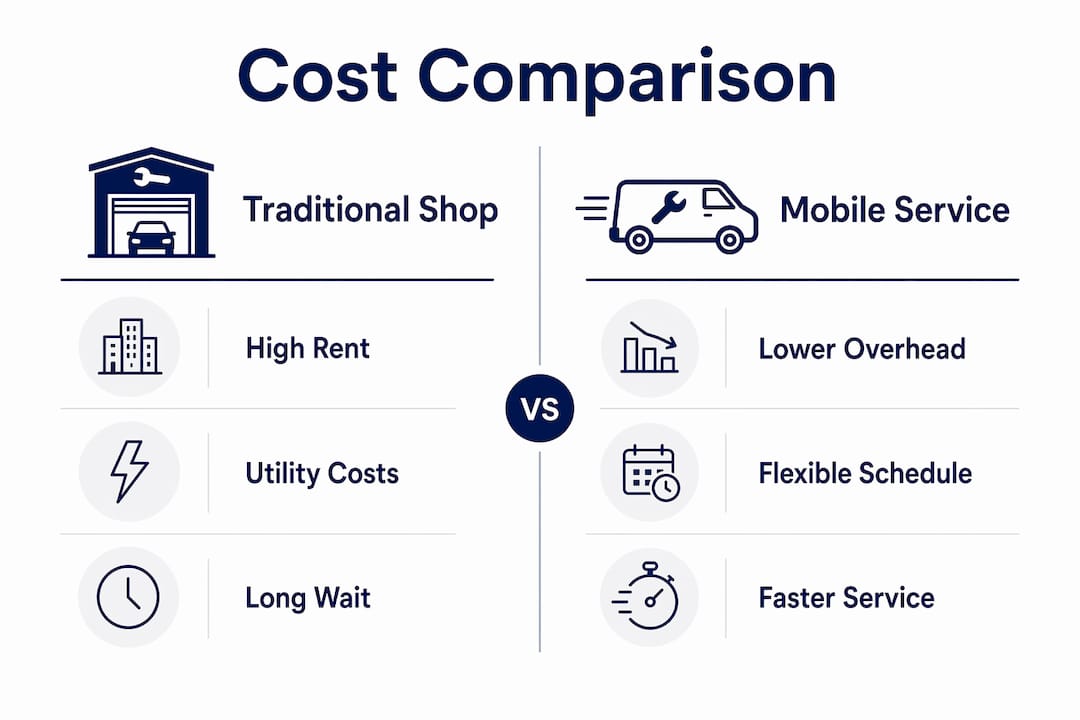
The table below compares the key cost factors between mobile and traditional repair options:
| Cost factor | Traditional shop | Mobile service |
|---|---|---|
| Shop rent and utilities | High fixed cost passed to customer | None |
| Towing fees | Customer pays if vehicle cannot drive | Not required for on-site service |
| Labor rate | Higher to cover overhead | Typically lower due to reduced overhead |
| Wait time cost | Lost productivity during multi-hour visits | Minimal, work continues during service |
| Parts markup | Standard retail markup | Varies by provider, often comparable |
Mobile services are not the right choice for every repair. Complex engine rebuilds, transmission overhauls, and collision work require shop equipment that a mobile van cannot carry. The cost comparison between dealers and mobile mechanics shows the clearest savings on routine maintenance, diagnostics, and minor repairs. That is exactly where most car owners spend the majority of their annual service budget.
Mobile auto services combine lower operational costs with higher customer satisfaction, which is a competitive combination that traditional shops cannot easily replicate without restructuring their entire business model.
Pro Tip: Get quotes from both a mobile provider and your local dealership for the same service. The difference on a standard oil change or brake pad replacement often runs 20 to 40 percent in the mobile provider’s favor.
How mobile services are reshaping dealerships and customer retention
The disruption in automotive services is not limited to independent mechanics. Dealerships are adopting mobile programs at scale because the business case is compelling. Here is how mobile service creates a retention advantage for dealerships that commit to it:
- Higher CSI scores. Mobile service drives stronger customer satisfaction indices, which directly influence manufacturer incentives and dealer rankings. A customer who never has to rearrange their schedule for an oil change is a customer who keeps coming back.
- Recall completion rates. Mobile recall work removes the friction of getting customers into a shop for safety-critical repairs. Completing recalls on-site increases completion rates and reduces liability exposure for manufacturers and dealers alike.
- Upsell opportunities. When a technician is already at a customer’s location and spots worn wiper blades or a low coolant level, the upsell conversation happens naturally and without pressure. Customers are more receptive when they can see the issue directly.
- Future vehicle sales. Mobile service programs create positive experiences that translate into loyalty at the point of vehicle purchase. A customer who trusts a dealership’s service department is significantly more likely to buy their next car from the same brand.
- Operational investment required. Successful mobile programs require integrated systems for scheduling, routing, parts logistics, and customer communication. Dealerships that treat mobile service as an afterthought rather than a structured program see poor results.
The mobile auto repair trends pointing toward 2026 and beyond show that early movers in this space are building customer relationships that late adopters will struggle to replicate. The mobile mechanic versus dealership comparison makes clear that the competitive pressure runs in both directions.
Key takeaways
Mobile auto service disrupts the industry because it removes every friction point in the traditional repair model while delivering measurable cost, time, and trust advantages to customers.
| Point | Details |
|---|---|
| Convenience drives adoption | Mobile visits average 55 minutes and eliminate transportation logistics entirely. |
| Transparency builds trust | Technicians serve dual roles, explaining repairs directly to customers on-site. |
| Lower overhead benefits customers | Reduced fixed costs allow mobile providers to offer competitive labor rates. |
| Dealerships gain retention leverage | Mobile programs improve CSI scores, recall completion, and long-term loyalty. |
| Reviews matter more here | 77% of consumers check reviews before booking a mobile mechanic, versus 50% for traditional shops. |
The part most people miss about this shift
Most coverage of mobile auto service focuses on convenience, and convenience is real. But the deeper disruption is about trust and information transfer. For decades, the repair shop model kept customers at a distance from their own vehicles. You dropped off the car, waited for a phone call, and approved work you could not see or verify. That information gap is where distrust lives.
Mobile service collapses that gap. When a technician shows you the worn brake pad before replacing it, or explains why your battery is reading low voltage on a meter you can see, the entire dynamic changes. You stop being a passive customer and start being an informed participant in your own vehicle’s maintenance. That shift in dynamic is what makes this model genuinely different, not just more convenient.
The providers who will win long-term are not the ones with the fastest vans or the lowest prices. They are the ones who invest in technicians who can communicate clearly, price honestly, and show up prepared. The questions worth asking any mechanic before booking apply even more to mobile providers, because the relationship is more direct and the accountability is higher.
For car owners in Los Angeles, the practical advice is simple. Try one mobile appointment for a routine service. Compare the experience to your last shop visit on every dimension: time spent, clarity of communication, final cost versus quote, and how you felt about the interaction. The data on customer satisfaction is consistent, but your own experience will tell you more than any statistic.
— Aaron
Get on-site auto repair anywhere in Los Angeles
Onsite Los Angeles Mobile Mechanic brings certified technicians directly to your home, office, or anywhere else in the greater Los Angeles area. Services include oil changes, brake repairs, battery replacements, diagnostics, and more, with most appointments completed in under an hour. Every job comes with an upfront quote and no hidden fees, so you know exactly what you are paying before any work begins. There is no app to download. Just call 213-583-4159 to book your appointment and get your vehicle serviced without rearranging your day. See the full list of available mobile repair services and find out why Los Angeles drivers are making the switch.
FAQ
What does mobile auto service actually include?
Mobile auto service covers routine and minor repairs performed at your location, including oil changes, tire rotations, battery replacements, brake pad replacements, and diagnostics. Complex repairs requiring lifts or specialized shop equipment are generally not suited for mobile service.
Why is mobile auto service considered a disruption?
Mobile auto service disrupts the industry by removing the need for customers to visit a shop, cutting wait times to under 60 minutes for most routine work, and replacing the traditional service advisor model with direct technician communication. This combination shifts customer expectations across the entire automotive service sector.
Are mobile mechanics trustworthy?
Reputable mobile mechanics carry ASE certification, liability insurance, and verifiable online reviews. Because technicians come to your personal location, 77% of consumers check reviews before booking, making reputation a stronger accountability mechanism than it is for traditional shops.
Is mobile auto repair cheaper than going to a dealership?
Mobile auto repair is typically less expensive for routine maintenance because providers carry no shop rent, utility costs, or large support staffs. The savings are most pronounced on oil changes, battery replacements, and brake work compared to dealership labor rates.
How do I book a mobile mechanic in Los Angeles?
Onsite Los Angeles Mobile Mechanic does not require an app. Call 213-583-4159 to schedule an appointment at your preferred location anywhere in the greater Los Angeles area, including Long Beach and surrounding communities.