Roadside breakdown assistance is an on-demand emergency service that sends a trained technician or tow truck to your vehicle when it can’t be driven safely. A technician typically arrives in under an hour, depending on your location and the severity of the problem. One thing many drivers don’t realize until they need it: most plans cap towing distance rather than offering unlimited towing.
Here’s what standard roadside assistance services cover:
- Jump-start for a dead battery
- Flat-tire change when a usable spare is available
- Towing to a nearby shop, subject to mileage limits
- Lockout assistance when keys are locked inside
- Fuel delivery when you run dry (you pay for the fuel itself)
- Winching or recovery if the vehicle is stuck in mud, snow, or a ditch
Table of Contents
- What does roadside breakdown assistance actually cover?
- How roadside assistance works, step by step
- Where does your roadside coverage come from?
- Limits, exclusions, and costs to check before you need help
- What to expect when the technician arrives
- When a mobile mechanic beats standard roadside assistance
- Safety checklist: what to have ready when you call
- Key Takeaways
- The gap between what roadside assistance promises and what it actually delivers
- Skip the tow with Onsite Los Angeles Mobile Mechanic
- Useful sources and further reading
What does roadside breakdown assistance actually cover?
The covered services in most plans follow a consistent pattern, though the fine print varies.
- Towing: Gets your car to the nearest qualified shop, up to the plan’s mileage cap. Beyond that distance, you pay per mile.
- Jump-starts: A technician connects a portable battery pack or cables. If the battery is dead from age, you’ll still need a replacement on your own dime.
- Flat-tire help: The tech installs your spare. If the spare is also flat or missing, the call becomes a tow.
- Fuel delivery: A small amount of gas or diesel is delivered so you can reach a station. The fuel cost itself is almost always excluded.
- Lockout service: The technician’s dispatch fee is covered. Replacement keys or advanced locksmith work are typically your responsibility.
- Winching: Usually covered within a short distance from a paved road. Deep off-road recovery often falls outside standard plans.
What roadside assistance does not cover: replacement parts, repair labor beyond the on-scene attempt, the cost of fuel delivered, or towing beyond the policy’s mileage limit. Think of it as emergency stabilization, not a full repair.
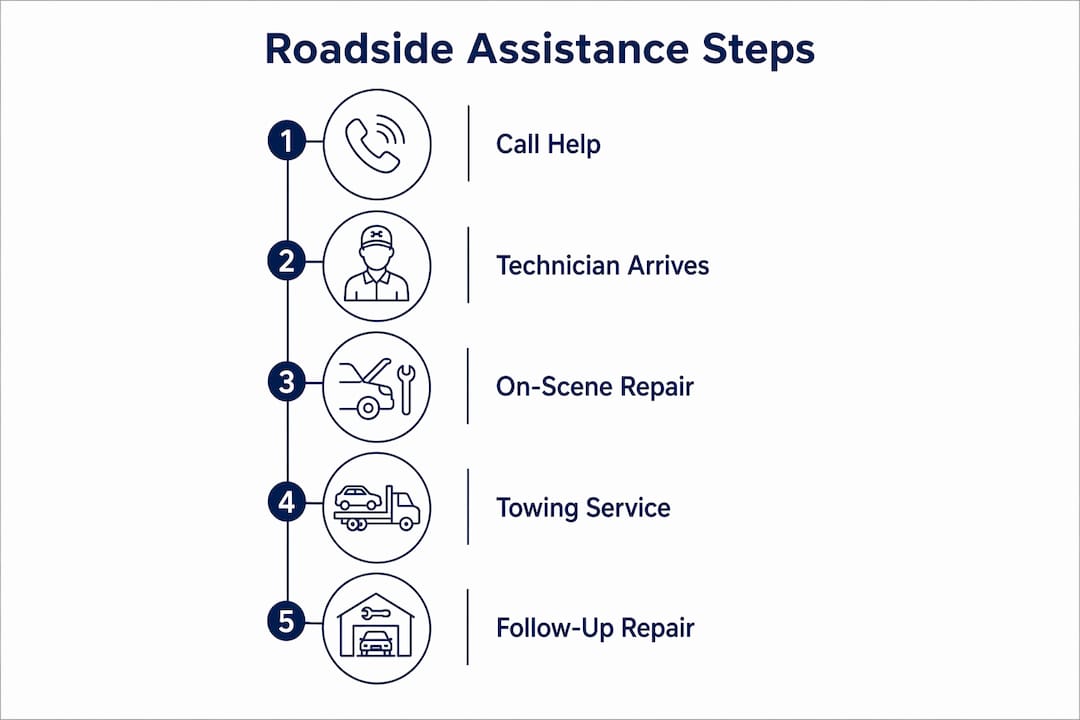
How roadside assistance works, step by step
- Pull over safely. Get as far off the road as possible. Turn on your hazard lights immediately and, if you have them, place warning triangles behind the vehicle.
- Assess the situation. Is the vehicle in a dangerous spot? Are there passengers? Note your exact location using GPS or a nearby address, intersection, or highway marker.
- Call your provider. Give the dispatcher your location, vehicle make, model, and color, license plate, a brief description of the problem, and how many people are with you. Many providers use GPS-enabled dispatch to speed routing.
- Stay with your vehicle. Leaving the car unattended can restrict your service to towing only. Many policies explicitly state that on-site repairs are only performed when the driver is present.
- Wait safely. If you’re on a highway, stay behind a barrier or guardrail, not in the vehicle. On a quiet street, stay in the car with doors locked if you feel unsafe outside.
- Meet the technician. Describe the symptoms clearly. The tech will diagnose the problem, attempt an on-scene fix, and arrange a tow if the vehicle can’t be safely driven.
- Confirm any costs before work begins. Ask what’s covered under your plan and what will be billed to you directly.
Pro Tip: Save your roadside provider’s number in your phone contacts right now, before you ever need it. Searching for it on the side of a highway at night is harder than it sounds.
Where does your roadside coverage come from?
Roadside assistance can come from several different sources, and the scope of each one differs in ways that matter when you’re stuck.
- Auto insurance add-on: Many insurers offer emergency roadside service as an optional rider. Coverage is usually basic (towing up to a mileage cap, jump-start, lockout) and tied to the insured vehicle.
- Motor-club membership: Organizations like AAA provide membership-based plans with tiered coverage options, including home-start and longer towing distances at higher membership levels.
- Vehicle manufacturer or extended warranty: New vehicles often include roadside assistance for a set period. Check whether it covers the driver or the vehicle, since that distinction affects who can use it.
- Credit-card benefits: Some travel and premium rewards cards include roadside dispatch as a cardholder perk. Coverage limits vary widely, so read the benefits guide.
- Pay-per-use or on-demand services: Independent providers offer single-incident coverage for a flat fee. Useful if you have no existing plan, though the per-call cost is higher.
Coverage tiers range from basic roadside-only plans to more extensive options that include at-home service and longer-distance towing. To confirm your current coverage, check your insurance policy’s declarations page, call your insurer directly, or log into your motor-club account.
Limits, exclusions, and costs to check before you need help
Most breakdown surprises come from policy details drivers never read. Here’s what to verify now:
- Towing mileage cap: Many insurer plans cap towing at 15 miles. Know your limit and the nearest qualified shop.
- Spare-tire requirement: Flat-tire service requires a usable spare. No spare means a tow.
- Fuel delivery rules: Delivery is covered; the fuel itself is not.
- Lockout limits: Technician dispatch is typically covered. Replacement keys are not.
- Winching distance: Usually limited to a short distance from a paved surface.
- Excluded locations: Some plans won’t cover breakdowns on private property or in certain off-road situations.
- Repeat-use restrictions: A few plans limit the number of service calls per year before fees apply.
- Replacement parts: Never covered under standard roadside plans.
When service exceeds your coverage, the provider will tell you the out-of-pocket cost before proceeding. Get that figure in writing or confirmed verbally before you agree.
What to expect when the technician arrives
Response times vary. Major providers can reach most locations within 60 minutes, but rural areas often take longer and may have fewer contracted technicians available. Plan for a longer wait if you’re outside a metro area.
Once on scene, the technician will:
- Confirm your identity and policy details
- Diagnose the problem
- Attempt an on-site fix (jump-start, spare installation, fuel top-up)
- Arrange a tow if the vehicle can’t be safely driven
Ask these questions when help arrives: What’s your estimated arrival time if you’re still en route? Can this be fixed here, or will I need a tow? What will be billed to me beyond my coverage? Knowing the answers upfront prevents confusion at the end of the call.

When a mobile mechanic beats standard roadside assistance
Standard roadside dispatch gets you unstuck. A mobile mechanic can actually fix the problem on the spot, which is a meaningful difference when the issue is something diagnosable and repairable at the curb.
Consider calling a mobile mechanic when:
- The problem is likely a battery, alternator, starter, or a straightforward electrical fault
- You want a diagnosis before deciding whether to tow
- You’re in an urban area where a mechanic can reach you quickly
- You want upfront pricing before any work begins
Mobile mechanics carry diagnostic tools and common parts, so they can perform on-site electrical diagnostics and parts replacements that a standard roadside tech won’t touch. The difference in scope is significant: a roadside dispatch tech is trained to stabilize the situation, while a mobile mechanic is trained to repair it. For a driver in Los Angeles, that often means skipping the tow entirely. Onsite Los Angeles Mobile Mechanic handles exactly these scenarios, arriving with the tools and parts to attempt a real fix rather than just a temporary solution.
Pro Tip: Check your roadside policy before calling a mobile mechanic. Some plans allow you to use a third-party mechanic for on-site repairs and still claim the towing benefit if the repair doesn’t work out.
Safety checklist: what to have ready when you call
Before you call, gather:
- Exact location (GPS coordinates, intersection, highway mile marker)
- Vehicle make, model, year, and color
- License plate number
- Your phone number and the number of occupants
- A brief description of the problem and any warning lights showing
Keep these in your vehicle:
- Warning triangles or road flares
- Reflective safety vest
- Spare tire, jack, and lug wrench in working condition
- Basic emergency roadside kit (jumper cables, flashlight, gloves)
While you wait: Stay visible but off the travel lanes. Don’t stand between your vehicle and oncoming traffic. Keep your phone charged and stay on the line with the dispatcher if the situation feels unsafe.
Key Takeaways
Roadside breakdown assistance is short-term emergency help that gets you safely off the road, but a follow-up visit to a qualified mechanic is almost always necessary to fix the underlying problem.
| Point | Details |
|---|---|
| Arrival time | Technicians often arrive in under an hour, though rural areas typically take longer. |
| Towing mileage limits | Many insurer plans cap towing distance; confirm your limit before you need it. |
| Stay with your vehicle | Leaving the car unattended can restrict service to towing only under most policies. |
| Exclusions to know | Replacement parts, fuel cost, and towing beyond the mileage cap are almost never covered. |
| Mobile mechanic option | Onsite Los Angeles Mobile Mechanic can diagnose and repair on-site in the greater Los Angeles area, often avoiding a tow entirely. |
The gap between what roadside assistance promises and what it actually delivers
Most drivers assume roadside assistance is a safety net with no holes. The reality is more specific. The service is designed to stabilize a situation, not resolve it. A jump-start gets you to a shop; it doesn’t tell you why the battery died or whether the alternator is failing. A tow gets the car off the road; it doesn’t diagnose the transmission.
The bigger issue is that roadside assistance is not a substitute for follow-up mechanical work. Drivers who skip the shop visit after a roadside repair often end up stranded again within days. The on-scene fix is the beginning of the process, not the end.
The other common mistake is assuming towing is unlimited. It isn’t, and the gap between your plan’s mileage cap and the nearest qualified shop can cost you more than the annual membership fee. Check that number now, when you’re not standing on the shoulder of a freeway.
Skip the tow with Onsite Los Angeles Mobile Mechanic
When your car won’t start and the real question is why, a tow truck doesn’t answer it. Onsite Los Angeles Mobile Mechanic comes directly to your location anywhere in the greater Los Angeles area, diagnoses the problem on the spot, and gives you an upfront price before any work begins. No hidden fees, no waiting at a shop, no guessing.
Many common repairs, including battery replacements and basic electrical fixes, are completed within an hour. There’s no app to download. Call 213-583-4159 to book on-site service and get a same-day appointment. See the full list of on-site repair services or visit the homepage to reach the team directly.
Useful sources and further reading
These are the primary sources used for facts in this article. Policy pages reflect general industry standards; your specific plan may differ.
- AAA Roadside Assistance — Motor-club policy page explaining covered services and typical response expectations.
- GEICO Emergency Road Service — Insurer policy page detailing covered services, exclusions, and towing mileage limits.
- Agero Roadside Assistance — Industry logistics provider explaining response-time variability by geography.
- Chase: What Is Roadside Assistance? — Explanatory guide covering GPS dispatch and how to contact providers.
- Roadside Assistance — Wikipedia — General reference covering the definition, service types, and provider categories.
- Onsite Los Angeles Mobile Mechanic: Roadside Fix Without a Tow Truck — Practical guide on avoiding a tow through on-site repair in Los Angeles.
- Onsite Los Angeles Mobile Mechanic: Types of Emergency Auto Services — Overview of emergency services and how they differ from full shop repairs.