Mechanic labor rates are largely fixed on paper, but the total repair quote is almost always negotiable. A written, itemized estimate is your starting point, and asking two questions before anything else, “What labor guide are you using?” and “What is the book time for this job?”, immediately signals you know how the system works. That alone changes the conversation.
The fastest check you can run: pull up RepairPal’s estimator or the Kelley Blue Book repair tool, enter your ZIP code and vehicle details, and compare the labor hours and total price against the shop’s quote. If the shop’s number is more than 15% above the tool’s midpoint, you have a documented basis to push back.
Quick benchmark: Independent shops nationally have a typical hourly labor rate range, with dealerships in large metropolitan areas generally charging higher rates. Your goal is not the lowest hourly number, it is the fairest total for verified work.
Three things to do right now before authorizing any repair:
- Run a price check on RepairPal, KBB, or AAA’s repair estimator using your VIN and ZIP code.
- Ask the shop for the book time (billed labor hours) and which labor guide they reference.
- Request a written, line-item estimate separating labor hours, hourly rate, and parts before you approve anything.
Table of Contents
- What do mechanic labor rates look like across the U.S.?
- How do shops actually calculate what they charge you?
- Which tools let you verify a quote in under 10 minutes?
- A step-by-step negotiation playbook that actually works
- Questions that force transparency before you commit
- How to lower the total bill without cutting corners
- Red flags that suggest a quote is unfair
- Why transparent on-site pricing changes the negotiation entirely
- Key Takeaways
- What most car owners get wrong about mechanic negotiations
- Skip the negotiation: get a transparent on-site quote today
- Tools and sources to verify labor rates and run quick estimates
What do mechanic labor rates look like across the U.S.?
Labor rates vary more than most car owners expect, and the gap between a rural independent shop and a metro dealership can be $150 per hour or more.
The national independent shop labor rate generally reflects a mid-tier market. Dealerships in major cities tend to charge higher hourly rates due to greater overhead and specialized equipment. Rural independent shops often charge noticeably less, though other factors can affect overall cost.
| Shop type / region | Typical hourly range | Notes |
|---|---|---|
| Independent shop, rural U.S. | Often well below the national range due to lower overhead | Lower overhead; may lack specialty tools |
| Independent shop, national average | $120–$175/hr | Most common range for everyday repairs |
| Dealership, mid-size metro | Typically above the independent average; often in the $200–$275/hr range for larger cities | Brand-certified techs, OEM parts standard |
| Dealership, large metro (LA, NYC) | $200–$275/hr | Highest overhead; warranty work included |
| Mobile/on-site mechanic | Varies, often competitive with independent shop rates | Lower facility overhead; transparent upfront quotes |
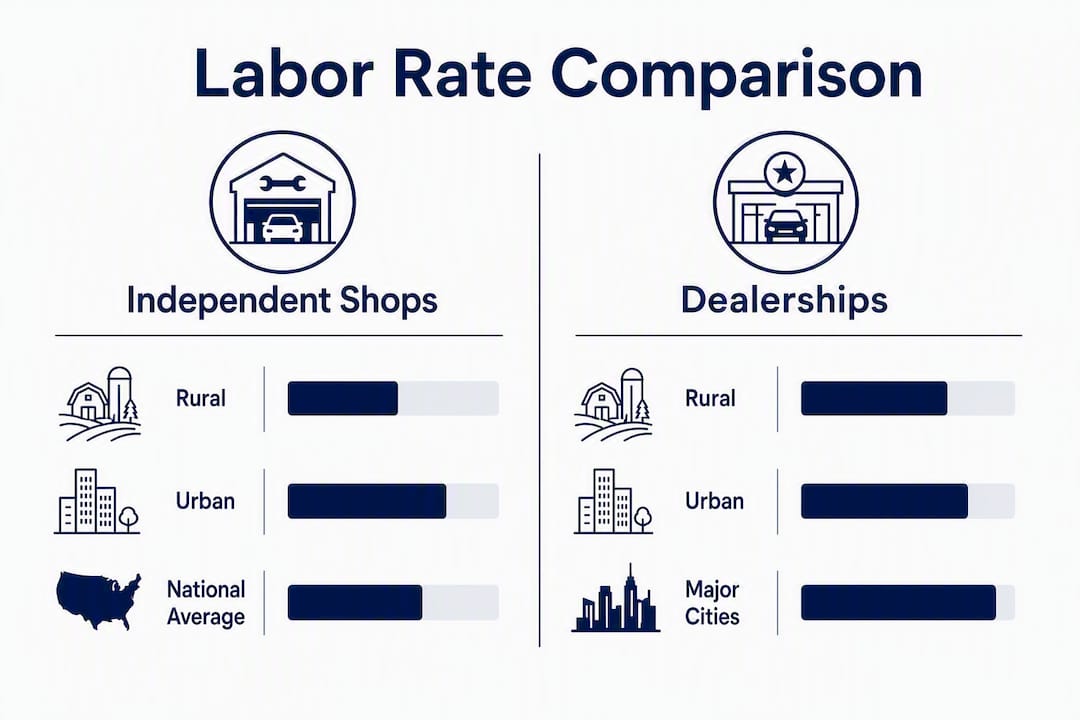
Urban shops carry higher rent, more staff, and more expensive equipment, all of which show up in the posted rate. A shop in downtown Los Angeles charging $185/hr is not necessarily gouging you; a shop in a small town charging the same rate probably is.
Pro Tip: When comparing quotes across shops, always compare total job cost, not just the hourly rate. A shop at $160/hr that quotes 2.0 book hours beats a shop at $130/hr that quotes 3.5 hours for the same job.
How do shops actually calculate what they charge you?
The number on your estimate is not arbitrary, but understanding how it is built helps you spot where there is room to move.
Every shop posts a “door rate,” the standard hourly labor charge applied to all jobs. That rate funds far more than the technician’s time. Posted rates cover specialized diagnostic equipment, tools, facility costs, and warranty reserves, which is why pushing a shop to cut its hourly rate is usually a dead end. The overhead is real.
What actually determines your bill is the combination of the door rate and the book time, the number of labor hours assigned to a specific job by an industry guide. Shops use guides like Alldata or Mitchell 1, which publish standardized hour estimates for virtually every repair on every vehicle. A brake job on a 2019 Honda Accord might carry a book time of 1.8 hours. The shop bills 1.8 hours at their door rate, period.
- Flat-rate billing: You pay the book time, not the actual clock time. A fast tech who finishes in 1.2 hours still bills 1.8. A slow tech who takes 2.5 hours also bills 1.8. This protects you from inefficiency but removes the benefit of a quick job.
- Overhead components: Rent, insurance, diagnostic software subscriptions, tool replacement, and warranty reserves all factor into the posted rate.
- Tech certifications: ASE-certified technicians command higher wages, which shops recover through their labor rate.
Pro Tip: Ask the shop which labor guide they use (Alldata or Mitchell 1 are the two most common). Then ask for the specific book time for your job. If their quoted hours exceed the guide’s standard time without a clear explanation, that is a negotiating point.
Which tools let you verify a quote in under 10 minutes?
Three independent tools give you a defensible price range before you walk into any shop.
RepairPal is the most widely used. Enter your year, make, model, and ZIP code, select the repair, and it returns a fair price range that separates labor and parts. RepairPal’s estimator draws on industry-standard labor times and a proprietary regional labor rate model, so the range it returns reflects your actual market. If a shop’s quote sits above the RepairPal high end, you have a concrete number to reference.
Kelley Blue Book’s repair estimator works similarly. KBB is trusted for vehicle valuations, and its repair cost tool applies the same ZIP-code logic to return labor and parts ranges. It is particularly useful for common maintenance jobs like brake pads, oil changes, and timing belts.
AAA Approved Auto Repair takes a different approach. Rather than returning a price estimate, it identifies shops that have passed AAA’s facility and technician standards. AAA members often receive discounts on labor, making membership worth mentioning at the counter.
Here is a simple workflow before you authorize any repair:
- Collect your VIN, current odometer reading, and the shop’s written description of the job.
- Run the job through RepairPal and KBB using your ZIP code. Note the labor hours each tool shows, not just the dollar total.
- Compare the shop’s quoted labor hours against the tool’s hours. A discrepancy of more than 20% without explanation is a red flag.
- If the shop’s total is more than 15% above the tool midpoint, print or screenshot the result and bring it to the conversation.
Pro Tip: Always check your estimate’s line items against a tool before you call back to negotiate. Showing up with a printed RepairPal range is far more effective than saying “I think that’s too high.”
A step-by-step negotiation playbook that actually works
The most effective approach is not aggressive bargaining. It is showing the shop you are an informed buyer who is prepared to walk.
Preparation (do this before you call or visit)
- Get at least two written estimates from different shops.
- Run RepairPal and KBB checks and note the labor hours and price ranges.
- Decide whether OEM or quality aftermarket parts are acceptable for your situation. Aftermarket parts on non-safety-critical components can reduce parts cost meaningfully.
- Know the book time for your job before you arrive.
Opening the conversation
Start politely and specifically. A good opening on the phone:
“I have a written estimate from another shop for [job] at [dollar amount]. I also ran a RepairPal check and the fair price range for my ZIP code comes out to [range]. Can you help me understand how your quote compares, and whether there’s any flexibility on the total?”
In person, the same logic applies. You are not attacking the shop’s rate; you are presenting data and asking for an explanation. Service advisors are often commission-incentivized and prefer to keep a sale rather than lose it, so a polite, documented ask frequently succeeds.
The levers to use, in order
- Competing written estimate. The single strongest lever. A documented lower quote from a comparable shop gives the advisor a concrete reason to match or beat it.
- AAA or military discount. Ask directly. Many shops offer 5–10% on labor for AAA members; military and senior discounts are also common.
- Bundling. If you need two related repairs, ask whether the shop can reduce the total labor because some disassembly steps overlap. Bundling related services can legitimately reduce billed hours when overlapping tasks are combined.
- Parts substitution. Ask for a quote using quality aftermarket parts alongside the OEM quote. The difference on parts cost can be significant.
- Fee waivers. Ask whether the shop-supplies fee (often $15–$40) can be waived or reduced. Small concessions like this are common and easy for advisors to approve.
Used together, a competing quote plus a membership discount plus bundling can frequently reduce the original quote by 15–25%.
What to get in writing before you say yes
- Total price with labor hours, hourly rate, and parts listed separately.
- Parts brand and whether they are OEM or aftermarket.
- Warranty on both parts and labor.
- Estimated completion time.
- Any agreed discounts or fee waivers noted on the estimate.
If the shop refuses to provide a written estimate or resists noting the agreed terms, that is a reason to pause.
Questions that force transparency before you commit
These questions work because they require specific answers. Vague responses tell you something too.
- “What labor guide are you using for this job, and what is the book time?” This is the single highest-leverage question you can ask. Asking about the labor guide and book time signals an informed consumer and reduces the chance of inflated hours.
- “Can I see a written, line-item estimate with labor hours, the hourly rate, and parts listed separately?”
- “Are the parts OEM or aftermarket, and what warranty comes with them?”
- “Is there a diagnostic fee, and will it be applied toward the repair cost if I proceed?”
- “Do you offer AAA, military, or loyalty discounts?”
- “Who will perform the work, and are they ASE-certified?”
A shop that answers these questions directly and without hesitation is worth trusting. One that deflects, gives vague answers, or refuses a written estimate is showing you something important.
How to lower the total bill without cutting corners
Reducing what you pay does not have to mean accepting lower-quality work. These levers are legitimate and widely used.
- Aftermarket parts on non-critical components. Quality aftermarket brake pads, filters, and belts from reputable brands perform comparably to OEM on most vehicles. Ask the shop to quote both and review the parts pricing differences before deciding.
- Bundle related jobs. Replacing rear brake pads while the rear wheels are already off for a wheel bearing job eliminates redundant labor. Ask the shop to identify any overlapping disassembly.
- Timing matters. Shops are often more flexible mid-week or during slow seasons. Scheduling a non-urgent repair for a Tuesday or Wednesday can open room for negotiation that a Friday drop-off does not.
- Member discounts. AAA membership, military ID, and senior status are all worth mentioning at the counter. These discounts are pre-approved by many shops and require no negotiation at all.
- Consider a mobile mechanic for smaller jobs. For oil changes, battery replacements, brake pads, and diagnostics, a transparent on-site provider eliminates facility overhead entirely. The quote you get is the quote you pay.
Pro Tip: Ask the shop whether any scheduled maintenance is due soon that could be bundled into today’s visit. Combining an oil change with a brake inspection, for example, often costs less than two separate appointments.
Red flags that suggest a quote is unfair
Some quotes are not just high; they are structured to prevent you from pushing back.
- Quoted hours far above book time — If RepairPal or KBB shows 2.0 labor hours and the shop quotes 4.5 with no explanation of complications, that gap needs an answer.
Why transparent on-site pricing changes the negotiation entirely
The core problem with traditional shop negotiations is information asymmetry. The shop knows the book time, the parts cost, and the margin; you are working from a single number on a piece of paper.
On-site mobile mechanics reduce that gap significantly. When a technician arrives at your location, quotes the job in front of you, and explains exactly what parts will be used and why, the dynamic shifts. There is no service desk markup, no facility fee buried in the rate, and no pressure to approve additional work while your car is already on the lift.
Upfront pricing means you see the labor hours, the parts cost, and the total before any work begins. For common jobs like oil changes, battery replacements, and brake service, that quote is the final number.
For Los Angeles car owners, this matters practically. A mobile mechanic serving the greater LA area operates without the overhead of a fixed facility, which often translates directly into a more competitive total cost. Jobs like battery replacements, oil changes, and brake pad swaps are frequently completed within an hour at your home or office.
| Situation | Traditional shop | On-site mobile mechanic |
|---|---|---|
| Quote transparency | Estimate given at drop-off; may change | Upfront quote before work begins |
| Facility overhead | Built into posted rate | Minimal; lower total cost on many jobs |
| Negotiation required | Often yes | Rarely; price is stated upfront |
| Convenience | You bring the car | Mechanic comes to you |
| Best for | Major repairs, warranty work | Maintenance, diagnostics, common repairs |
For smaller jobs where convenience and clear pricing matter most, mobile service often saves more than any negotiation tactic would.
Pro Tip: For any repair under $500, compare the on-site mobile quote against a shop estimate before deciding. The absence of a facility fee and the time you save not dropping off and picking up the car frequently tips the math.
Key Takeaways
Presenting a competing written estimate alongside a membership discount and bundled services is a reliable way to reduce a repair quote by a meaningful amount.
| Point | Details |
|---|---|
| Check the quote first | Run RepairPal and KBB before negotiating; flag any quote more than 15% above the tool midpoint. |
| Ask for book time | “What labor guide do you use and what is the book time?” is the single highest-leverage question you can ask. |
| Stack your levers | Competing estimate plus available member discounts and bundling can often reduce the total by 15–25%. |
| Get everything in writing | Confirm labor hours, hourly rate, parts brand, warranty, and any agreed discounts before authorizing work. |
| Onsite Los Angeles Mobile Mechanic | Provides upfront on-site quotes with no hidden fees, removing the need to negotiate for common repairs in the LA area. |
What most car owners get wrong about mechanic negotiations
The conventional advice is to haggle on the hourly rate. That is almost always the wrong target. Shops set their door rate to cover real costs, and asking them to cut it is like asking a restaurant to charge less per hour of kitchen time. The rate is not where the margin lives.
The margin lives in the hours quoted, the parts markup, and the fees. A shop that quotes 3.5 hours for a job with a 2.0 book time is not charging a high rate; it is billing inflated hours. That is where the money goes, and that is where your leverage is. Asking “what is the book time?” costs nothing and immediately reframes the conversation around a verifiable number rather than a subjective price.
The other thing most guides understate: a polite, informed ask works far better than a confrontational one. Service advisors deal with difficult customers constantly. Someone who walks in with a printed RepairPal estimate, asks a specific question about book time, and says “I’d like to work with you on this” is far more likely to get a concession than someone who says “that’s too expensive.” The goal is to make it easy for the advisor to say yes, not to win an argument.
Realistic expectations matter too. Most shops will not cut their hourly rate. Many will waive a shop-supplies fee, apply a membership discount, or adjust the quoted hours if you can document a lower book time. Shops with lower volume or slower periods have more flexibility than busy dealerships. Expect 10–20% off the total repair invoice when you use negotiation levers such as a competing written estimate, requesting available discounts, or asking about premium aftermarket parts instead of OEM.
Building a relationship with one trusted mechanic over time is the long game that eliminates most of this friction. A shop that knows your car and your history has a reason to keep you happy without you having to negotiate every time.
Skip the negotiation: get a transparent on-site quote today
Onsite Los Angeles Mobile Mechanic gives you the upfront quote before a single bolt is turned. No service desk, no facility fee, no surprise line items when you come to pick up your car. The price you see at the start of the job is the price you pay.
Common repairs like oil changes, battery replacements, brake pad swaps, and engine diagnostics are handled at your home, office, or wherever your car is parked across the greater Los Angeles area. Many jobs are done within an hour. There is no app to download; just call 213-583-4159 to schedule, and a technician comes to you.
For a full list of covered services and to get a quote, visit the Onsite Los Angeles Mobile Mechanic services page.
Tools and sources to verify labor rates and run quick estimates
Use these directly before calling any shop or authorizing any repair:
- Kelley Blue Book Repair Estimator: Same ZIP-code logic as RepairPal; particularly strong for common maintenance jobs. Use it as a second data point when the two tools diverge.
- Onsite Los Angeles Mobile Mechanic: For LA-area car owners who want transparent pricing without negotiating, call 213-583-4159 for an upfront on-site quote.
- Auto repair pricing checklist: A practical reference for comparing estimates and confirming fair-market value before you commit to any repair.